Jurassic Dinos editorial · Updated · Source-based review
What is Leptoceratops?
Leptoceratops was a Late Cretaceous North American ceratopsian known from skulls and several informative skeletons.
Distinctive features and evidence
The Alberta Scollard material anchors Leptoceratops gracilis. Some early Montana assignments were moved to other genera, a reminder that a horned-dinosaur family does not imply every member resembled Triceratops.
Genus overview and research references.
Leptoceratops fossil discoveries
The first specimens were found in 1910 by an American Museum of Natural History expedition along the Red Deer River in Alberta, Canada. Two individuals lay together in a weathered cow trail that had broken up parts of the skeletons. Barnum Brown described one of them as Leptoceratops gracilis in 1914. His reasons for the name were not explained, but it is understood to combine the Greek word for ‘small’ with Ceratops, ‘horned face’.
Better skeletons came later. In 1947 Charles M. Sternberg found three more in Alberta, one of them complete. They were good enough for Dale Russell to publish a full reconstruction of the animal. Leptoceratops is now known from more than ten individuals from Alberta, Montana and Wyoming, which together cover the whole skeleton. Some early Montana finds have since been moved to separate genera, Montanoceratops and Cerasinops.
How big was Leptoceratops?
Leptoceratops was small for a horned dinosaur. The most complete skeleton, scaled with the tail of a second individual, measures about 1.8 metres. The largest individuals were probably around 2 metres long and might have weighed about 100 kilograms, according to one published summary. The Natural History Museum directory instead gives a length of about 3 metres, so published sizes do not fully agree, and the weight is a single estimate.
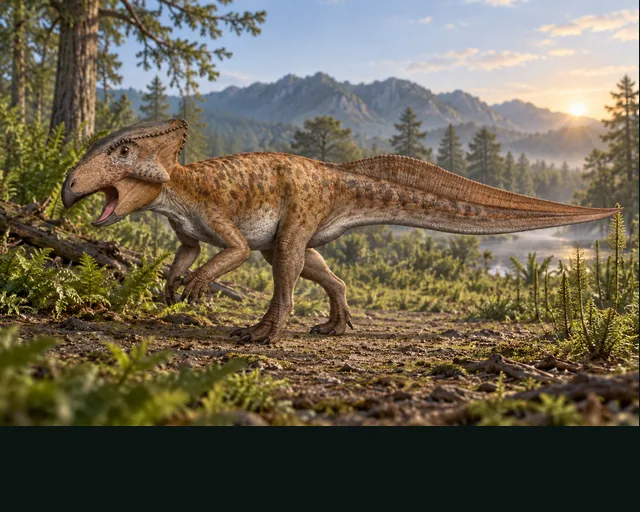
The head was very large with a strong jaw, but it had no horns and only a very small frill. The skull of the biggest complete specimen is about 45 centimetres long. The skeleton mixes old and new features: the arms and legs were sturdy, the tail had tall spines on its vertebrae, and the shoulder and hip bones were slim like those of earlier ceratopsians.
Did Leptoceratops walk on two legs or four?
Probably both. The forelimbs were long enough to reach the ground, but Phil Senter found in 2007 that the forearm bones could not rotate to turn the hand, so on four legs the hands would have been spread out sideways. Body proportions suggest that Leptoceratops may have run on two legs at speed and gone back to four when moving slowly, a little more bipedal than Protoceratops.
The forelimb anatomy also suggests that it could scratch-dig. Three bonebeds in the Hell Creek Formation of Montana contain many Leptoceratops of different ages. They were first thought to record animals trapped in mud, but Denver Fowler and colleagues proposed in 2019 that they show adults buried when burrows collapsed, possibly burrows that were used by several generations. This is a hypothesis, not a settled fact.
What did Leptoceratops eat?
Leptoceratops was a plant-eater. The teeth are unusual: the wear on them forms a steep, nearly vertical surface with a sharp shelf, and the pattern could only have been produced if the jaw moved in a curved, rotating path. Frank Varriale described this in 2016 as unlike the chewing of other dinosaurs and, in a general way, mammal-like. A large ridge on the upper jaw suggests a muscular cheek pouch, which would have helped with shredding.
Studies of jaw strength indicate an efficient bite that could cope with different foods. The plants of its world included conifers, cycads, ferns and flowering plants, but the fossils do not show exactly which ones it chose.
Is Leptoceratops a ceratopsid?
No. Leptoceratops is a ceratopsian, but it is outside Ceratopsidae, the family of big horned and frilled dinosaurs such as Triceratops. It gives its name to a separate family, Leptoceratopsidae. For many years it was grouped with Protoceratops in the family Protoceratopsidae, but newer analyses indicate that these early ceratopsians were not all one family.
The exact relationships inside Leptoceratopsidae are still not well resolved, partly because many early ceratopsians are known from incomplete fossils.
Where and when Leptoceratops lived
Leptoceratops lived at the very end of the Cretaceous, in the Maastrichtian. The Scollard Formation, where it was first found, was deposited between about 66.9 million years ago and the end of the period, about 66 million years ago. The Hell Creek Formation extends back to around 67.2 million years. The landscape was a floodplain with braided and meandering streams and small trees, west of the Western Interior Seaway.
Leptoceratops was not a common animal. In the Scollard Formation it is only about 6 per cent of the dinosaur fossils. It shared its world with Triceratops, Ankylosaurus and, in the youngest layers, Tyrannosaurus.
Classification and fossil record
The Paleobiology Database taxonomic record catalogues Leptoceratops under Leptoceratopsidae. This is the immediate parent in that catalogue, rather than a complete list of evolutionary relationships.
The corroborated occurrence sample includes United States, Canada; those are modern discovery locations, not a complete ancient geographic range.
Research starting point
The catalogue links Leptoceratops to Brown, 1914, published in Bulletin of the American Museum of Natural History. This identifies a research starting point; the catalogue’s citation alone does not verify every later reconstruction or species assignment.
For the meaning of taxonomic terms and how evidence is checked, see the glossary and editorial policy.
Quick answers
- Is Leptoceratops a dinosaur?
- Yes. Leptoceratops was a small, plant-eating ceratopsian dinosaur from the latest Cretaceous of western North America.
- When did Leptoceratops live?
- It lived in the Maastrichtian, at the very end of the Cretaceous, roughly 67 to 66 million years ago.
- How big was Leptoceratops?
- Around 2 metres long and perhaps 100 kilograms according to one summary, though the Natural History Museum directory lists about 3 metres. Sizes are estimates.
- Is Leptoceratops a ceratopsid?
- No. It is a ceratopsian outside the family Ceratopsidae, and is the namesake of its own family, Leptoceratopsidae, with horns and a frill much reduced or absent.
- What did Leptoceratops eat?
- It ate plants. Its teeth show unusual wear from a rotating jaw motion, and its jaws could handle a range of foods such as ferns, conifers and cycads.
- Where was Leptoceratops found?
- Fossils are known from Alberta in Canada and from Montana and Wyoming in the United States, in rocks such as the Scollard and Hell Creek formations.