Jurassic Dinos editorial · Updated · Source-based review
What is Futalognkosaurus?
Futalognkosaurus was a Late Cretaceous Argentine titanosaur from the Portezuelo Formation.
Distinctive features and evidence
Associated plant material, fish and other fossils provide environmental context beyond the dinosaur’s bones. Those associated remains inform habitat reconstruction without providing a direct record of its daily feeding behavior.
Genus overview and research references.
Futalognkosaurus fossil discoveries
The first bones of Futalognkosaurus were found in 2000 in Neuquén Province, Argentina. They were described in 2007, based on three partial skeletons that together give roughly 70 per cent of the animal. That is an unusually high share for a sauropod this large, and the describing team presented it as one of the most complete giant dinosaurs known at the time.
The main skeleton lay beside the edge of an ancient river. Researchers suggested the body was washed into the water after death. The huge carcass may then have acted as a barrier that bent the river’s course around it, until the channel was eventually left behind as an oxbow lake, a curved pond cut off from the main stream. Fish and freshwater shellfish later lived in that quiet water.
How big was Futalognkosaurus?
Estimates of Futalognkosaurus have shrunk over the years. The first figure was 32 to 34 metres in length, but by 2008 it had been revised down to about 26 metres. Later published estimates range from about 24 metres (Molina-Pérez and Larramendi in 2020, and Paul in 2024) up to about 30 metres (Paul in 2016). Weight estimates are similarly spread, from roughly 29 to 51 tonnes depending on the method used.
Because the estimates disagree, it is safest to think of Futalognkosaurus as a sauropod somewhere in the mid-20-metre range rather than to quote a single number. The skeleton does show some clear proportions: the neck had 14 vertebrae, and the hips were bulky, measuring nearly 3 metres across.
What made the neck of Futalognkosaurus unusual?
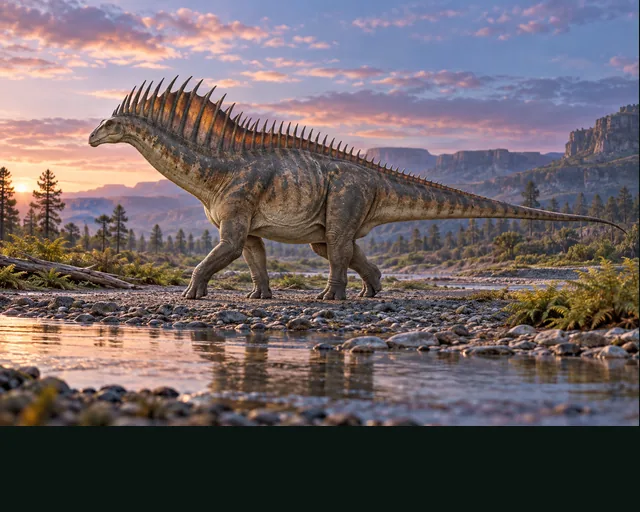
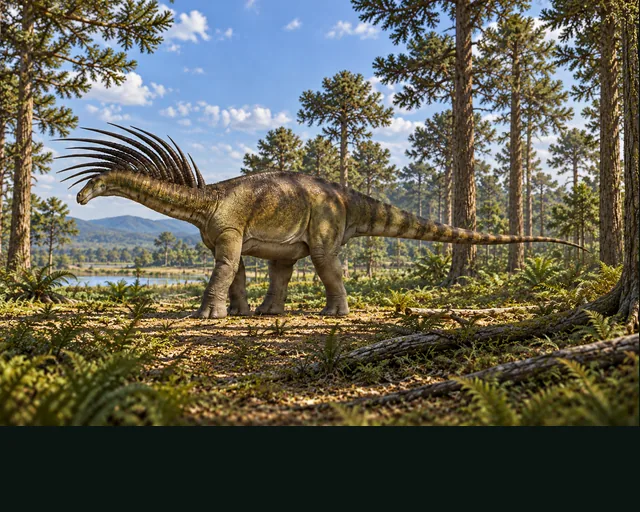
The neck vertebrae carried very tall neural spines, the upright bony blades on top of each vertebra. In Futalognkosaurus these were shaped like a shark’s fin, and in places the neck was over a metre deep from top to bottom. Together with the broad hips, that gave the front half of the body a deep, heavy build.
No function for these tall spines has been established, so they are best treated as an anatomical feature rather than a known adaptation.
Is Futalognkosaurus a titanosaur?
Yes. Futalognkosaurus is a titanosaur, a member of the titanosaurian branch of the long-necked sauropods. In their 2007 analysis, Calvo and colleagues placed it close to Mendozasaurus and grouped the two in a new clade they named Lognkosauria. A clade is a group made of an ancestor and all its descendants.
Later members of the group include Puertasaurus, a much later relative that may be among the biggest dinosaurs known. For comparison with other Argentine giants, see Argentinosaurus and Dreadnoughtus.
Where and when Futalognkosaurus lived
Futalognkosaurus lived in the Late Cretaceous, in the Turonian and Coniacian stages, roughly 94 to 86 million years ago. Its fossils come from the Portezuelo Formation, a rock unit of sandstones and siltstones laid down mostly by rivers. Fish and fossil leaf fragments found with the skeleton suggest a warm climate in Patagonia at the time.
The same site produced other animals, including two further sauropods that have not been formally described, remains of Megaraptor, the theropod Unenlagia and side-necked turtles.
Classification and fossil record
The Paleobiology Database taxonomic record catalogues Futalognkosaurus under Lognkosauria. This is the immediate parent in that catalogue, rather than a complete list of evolutionary relationships.
The corroborated occurrence sample includes Argentina; those are modern discovery locations, not a complete ancient geographic range.
Research starting point
The catalogue links Futalognkosaurus to Calvo and Porfiri, 2007, published in Anais da Academia Brasileira de Ciências. This identifies a research starting point; the catalogue’s citation alone does not verify every later reconstruction or species assignment.
For the meaning of taxonomic terms and how evidence is checked, see the glossary and editorial policy.
Quick answers
- Is Futalognkosaurus a dinosaur?
- Yes. Futalognkosaurus was a titanosaur, a type of long-necked, plant-eating sauropod dinosaur from the Late Cretaceous of Argentina.
- When did Futalognkosaurus live?
- It lived in the Late Cretaceous, during the Turonian and Coniacian stages, roughly 94 to 86 million years ago.
- How big was Futalognkosaurus?
- Estimates range from about 24 to 30 metres long and roughly 29 to 51 tonnes, and the first estimate of 32 to 34 metres was later revised downwards. Treat any single figure as uncertain.
- What does Futalognkosaurus mean?
- The name comes from the Mapudungun language and means "giant chief lizard", from futa (giant) and lognko (chief).
- Where was Futalognkosaurus found?
- Its fossils were found in 2000 in Neuquén Province, Argentina, in the Portezuelo Formation, and the genus was described in 2007.