Jurassic Dinos editorial · Updated · Source-based review
What is Europasaurus?
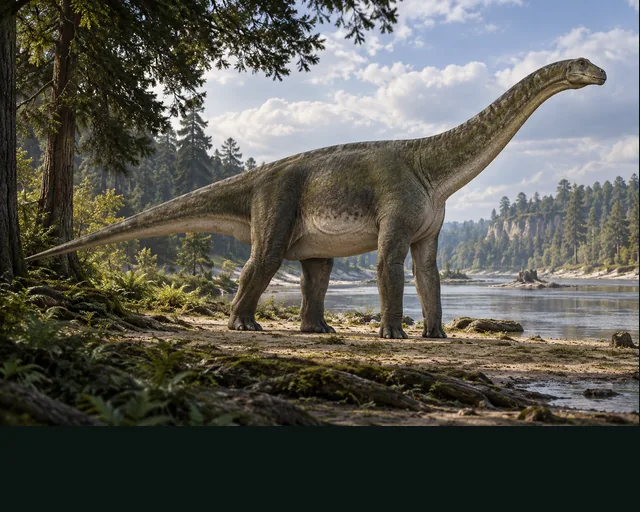
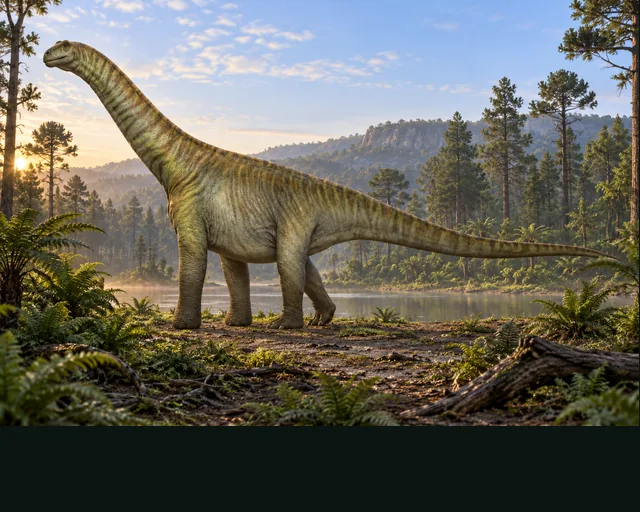
Europasaurus was a relatively small Late Jurassic German sauropod interpreted as an island dwarf.
Distinctive features and evidence
Its significance is the evidence for reduced body size within a lineage famous for giants. Island dwarfism is an evolutionary interpretation supported by the fossil context, rather than a claim that every small sauropod lived on an island.
Genus overview and research references.
Europasaurus fossil discoveries
In 1998 a private collector, Holger Lüdtke, found a single sauropod tooth in the Langenberg quarry near Oker in Lower Saxony, Germany. It was the first sauropod specimen reported from the Jurassic of northern Germany. More bones followed, and digging began in 1999. The bones had to be collected from loose blocks left by blasting, and about 50 tonnes of bone-bearing rock were rescued in 2000. A partial skull appeared in 2002.
In October 2003 an arson fire destroyed the preparation laboratory of the Dinosaur Park Münchehagen, where the fossils were kept. It destroyed 106 prepared bones, about 15 percent at the time, including the best series of vertebrae and the only complete pelvis. The species was described in 2006 as Europasaurus holgeri, honouring Lüdtke, and by 2014 around 1,300 bones had been prepared from the main bed, with at least 20 individuals identified from jaw bones.
How big was Europasaurus?
Europasaurus was a very small sauropod. Adults are estimated at about 5.7 to 6.2 metres long, and the Natural History Museum gives 6.2 metres. One published weight estimate is 750 to 2,100 kilograms. The length is a scaled estimate, based on one partial thigh bone compared with a nearly complete skeleton of Camarasaurus.
Because the bones are small, they were first assumed to come from young animals. The 2006 description showed that most specimens were adults. Bone structure confirmed this: the largest thigh bone shows lines of arrested growth, a sign that growth had stopped, while the youngest individuals were only about 1.75 metres long. The evidence suggests that it reached this size because it grew more slowly than larger relatives.
Was Europasaurus an island dwarf?
That is the leading interpretation. In the Late Jurassic, northern Germany was a group of islands, and the largest of them was smaller than 200,000 square kilometres, which may have been too small to support huge sauropods. Researchers have suggested that an ancestor shrank quickly after reaching an island, or that a lineage shrank along with its shrinking landmass. Close relatives such as Brachiosaurus and Sauroposeidon were among the largest dinosaurs known.
Footprints found about 5 metres above the bone bed suggest what may have happened later. They were made by much bigger theropods, estimated at 7 to 8 metres long, compared with about 4 metres for those that lived alongside Europasaurus. Lallensack and colleagues suggested that a fall in sea level opened a land bridge and that these newcomers helped end the dwarf fauna, though this is a hypothesis.
Is Europasaurus a brachiosaurid?
Probably, but it has been placed in different spots. When it was named, Europasaurus was placed among the macronarians, the big-nosed sauropods, outside the brachiosaur family, which showed that its small size was an evolved trait and not a group feature. In 2012 Michael D’Emic placed it inside Brachiosauridae, though cautiously, because several characteristic bones, such as tail vertebrae, are missing. Later analyses by Mannion and by Royo-Torres, both in 2017, found it to be the earliest-branching brachiosaurid, with Brachiosaurus and Giraffatitan as more advanced relatives. Its slightly twisted teeth were suggested as a trait of the family.
Where and when Europasaurus lived
Europasaurus lived in the Kimmeridgian stage of the Late Jurassic, about 154 to 151 million years ago. The rocks of the Langenberg quarry were laid down in a shallow sea, so the animals probably lived on nearby islands and were carried a short distance before burial. Other animals found there include turtles, fish, marine crocodile relatives, a pterosaur, a stegosaur and several kinds of theropods.
About a third of the Europasaurus bones show tooth marks that match small fish, crocodile relatives and sharks, with no confirmed theropod marks. The number of individuals led researchers to suggest that a herd was crossing a tidal flat and drowned, which is an interpretation.
Classification and fossil record
The Paleobiology Database taxonomic record catalogues Europasaurus under Camarasauromorpha. This is the immediate parent in that catalogue, rather than a complete list of evolutionary relationships.
The corroborated occurrence sample includes Germany; those are modern discovery locations, not a complete ancient geographic range.
The sourced length estimate for Europasaurus is 5.7–6.2 metres. This is an estimate for the reconstructed animal, not a measurement shared by every individual. See the body-size discussion and linked evidence for context.
Research starting point
The catalogue links Europasaurus to Sander and Mateus, 2006, published in Nature. This identifies a research starting point; the catalogue’s citation alone does not verify every later reconstruction or species assignment.
For the meaning of taxonomic terms and how evidence is checked, see the glossary and editorial policy.
Quick answers
- Is Europasaurus a dinosaur?
- Yes. Europasaurus was a small plant-eating sauropod dinosaur from the Late Jurassic of northern Germany.
- Why was Europasaurus so small?
- It is usually interpreted as an island dwarf: bone studies show adults grew slowly to about 6 metres, and its relatives were giants. The island setting is an inference from the fossil context.
- How big was Europasaurus?
- Adults were about 5.7 to 6.2 metres long, with one estimate of 750 to 2,100 kilograms. That is very small for a sauropod.
- When did Europasaurus live?
- It lived in the Kimmeridgian stage of the Late Jurassic, around 154 to 151 million years ago.
- Where was Europasaurus found?
- In the Langenberg quarry near Oker in Lower Saxony, northern Germany. It was named after Europe, and the species name honours its finder, Holger Lüdtke.