Jurassic Dinos editorial · Updated · Source-based review
What is Cetiosaurus?
Cetiosaurus was a Middle Jurassic sauropod from Britain whose early discovery helped establish the study of giant dinosaurs.
Distinctive features and evidence
Richard Owen initially interpreted its remains as those of a marine animal. Later taxonomic work restricted a once very broad genus, and Cetiosaurus oxoniensis became the designated type species in 2014.
Genus overview and research references.
Cetiosaurus fossil discoveries
The first large bones were found in the early 1800s near Chipping Norton in Oxfordshire. A collector, John Kingdon, reported them in a letter to the Geological Society in 1825, when they were thought to belong to a whale or a crocodile. Richard Owen gave them the name Cetiosaurus in 1841, and he named several species the next year.
The best Victorian discovery came in 1868 to 1870 at Bletchingdon, Oxfordshire. Professor John Phillips dug up three partial skeletons there, and in 1871 he named the species Cetiosaurus oxoniensis, after Oxford. The bones include most of the skeleton except the skull.
In 1968 workers at a clay pit near Great Casterton, in Rutland, dumped blocks of ironstone that were later found to contain bones. The specimen, nicknamed the “Rutland Dinosaur”, is about 40 per cent complete and has added many neck bones to the record. It is one of the most complete dinosaur finds in the UK. A mounted display at Leicester Museum and Art Gallery is about 15 metres long, but it is largely a replica, with the more fragile originals kept in store.
Why is Cetiosaurus called the “whale lizard”?
Owen made the name from Greek words for “sea monster” and “lizard” because he assumed an animal this large must have lived in water. He first compared it to a gigantic crocodile. When he created the group Dinosauria in 1842, Cetiosaurus was left out. In the early 1850s Gideon Mantell started to suspect it was a land animal, but the idea spread slowly, and Owen was still treating it as a crocodile relative in 1859. Thomas Huxley stated in 1869 that Cetiosaurus was a dinosaur. The name now records a mistake, but it is also a reminder that giant sauropods were so unfamiliar that early scientists had no obvious place for them.
How big was Cetiosaurus?
Estimates differ by a few metres. In 2010 Gregory Paul put the animal at about 16 metres long and 11 tonnes, the Natural History Museum lists 18 metres, and the mounted Leicester specimen is about 15 metres. Because there is no complete skeleton, these are best treated as approximate.
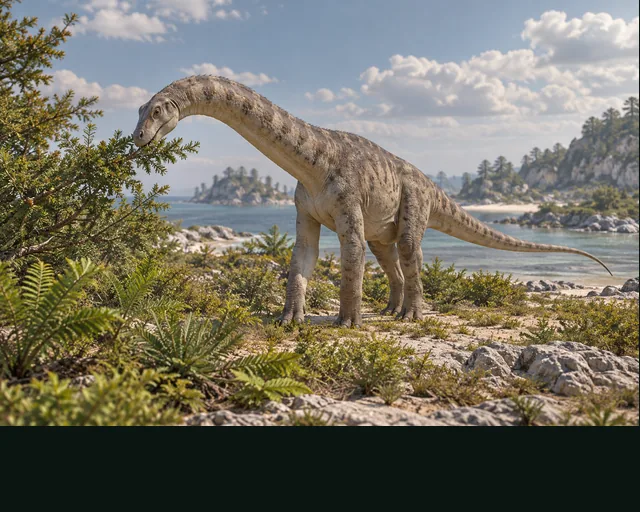
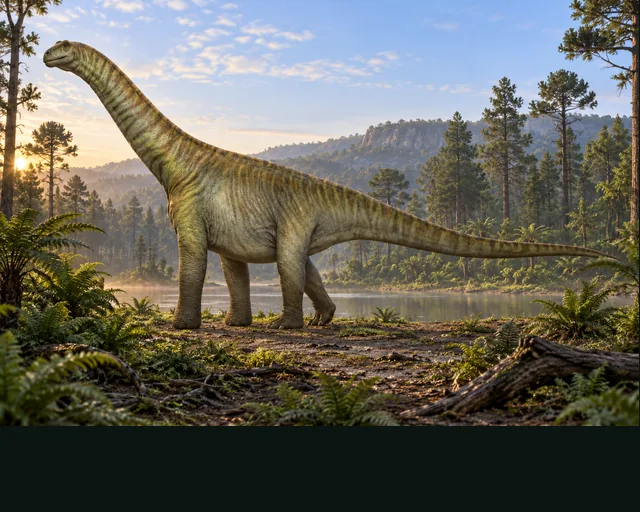
Compared with giants such as Brachiosaurus, Cetiosaurus had a moderately long neck, about as long as its body, and a longer tail of at least 40 bones. Its forearms were as long as its upper arms, which is unusual for sauropods, so its front legs matched the hind legs in length. The vertebrae in its back were heavily built and had only limited air spaces, unlike the highly hollowed bones of later sauropods. The skull is almost unknown: only a braincase and a single tooth crown have been tentatively linked to it.
Where and when Cetiosaurus lived
Cetiosaurus lived in the Middle Jurassic, in the Bajocian and Bathonian stages, roughly 171 to 165 million years ago in one account and 170 to 160 million years ago in the Natural History Museum’s. Its bones are known mainly from England, and the animal probably also lived in France, where a possible chevron, a small bone from beneath the tail, has been reported.
Europe then was a scattering of islands in warm shallow seas. Cetiosaurus lived on a large island that covered southern Britain and neighbouring regions, which has been compared in size to Cuba. The landscape was floodplain and open woodland with a seasonally dry climate, with conifers, cycads, ferns and ginkgo. Meat-eating neighbours included Megalosaurus. Gregory Paul suggested that Cetiosaurus fed at both low and medium heights, but without a skull this is only an educated guess.
Is Cetiosaurus a sauropod, and what are its relatives?
Yes, Cetiosaurus is a sauropod, though its exact family tree position is unsettled. Some analyses group it in the Cetiosauridae with the Indian Barapasaurus, the Argentine Patagosaurus and the Moroccan Chebsaurus. Others place it near the base of the advanced sauropod group Neosauropoda, or just outside it.
Its story also shows how a name can become a “wastebasket”. Eighteen species were once placed in Cetiosaurus, and most have since been moved to other genera or abandoned as based on poor material. The original type species, C. medius, rested on undiagnostic bones from several places, so in 2014 the international naming commission made C. oxoniensis the type species. That decision kept the name attached to the animal that scientists have always meant by it.
Classification and fossil record
The Paleobiology Database taxonomic record catalogues Cetiosaurus under Gravisauria. This is the immediate parent in that catalogue, rather than a complete list of evolutionary relationships.
Discovery and naming history
Richard Owen named Cetiosaurus in 1842 while interpreting the bones as those of a large aquatic animal. Later study established the sauropod connection, and Cetiosaurus oxoniensis was designated the type species in 2014. Historical overview.
The corroborated occurrence sample includes France; those are modern discovery locations, not a complete ancient geographic range.
Research starting point
The catalogue links Cetiosaurus to Owen, 1841, published in Proceedings of the Geological Society of London. This identifies a research starting point; the catalogue’s citation alone does not verify every later reconstruction or species assignment.
For the meaning of taxonomic terms and how evidence is checked, see the glossary and editorial policy.
Quick answers
- Is Cetiosaurus a dinosaur?
- Yes. Cetiosaurus was a plant-eating sauropod dinosaur from the Middle Jurassic of Britain, although its describer Richard Owen first thought it was a giant marine reptile.
- When did Cetiosaurus live?
- In the Middle Jurassic, during the Bajocian and Bathonian stages, roughly 171 to 165 million years ago in one account and 170 to 160 million years ago in another.
- How big was Cetiosaurus?
- Estimates are about 15 to 18 metres long, with one 2010 estimate of 16 metres and 11 tonnes. No complete skeleton or skull is known, so the figures are approximate.
- What does Cetiosaurus mean?
- It means "whale lizard", or more exactly "sea monster" lizard. Owen chose it because he assumed the huge bones belonged to a marine animal, which proved wrong.
- Where was Cetiosaurus found?
- Mostly in England, with key finds at Bletchingdon in Oxfordshire and Great Casterton in Rutland. Possible remains have also been reported from France.