Jurassic Dinos editorial · Updated · Source-based review
What is Dakotaraptor?
Dakotaraptor is a disputed large theropod name associated with the latest Cretaceous Hell Creek Formation.
Distinctive features and evidence
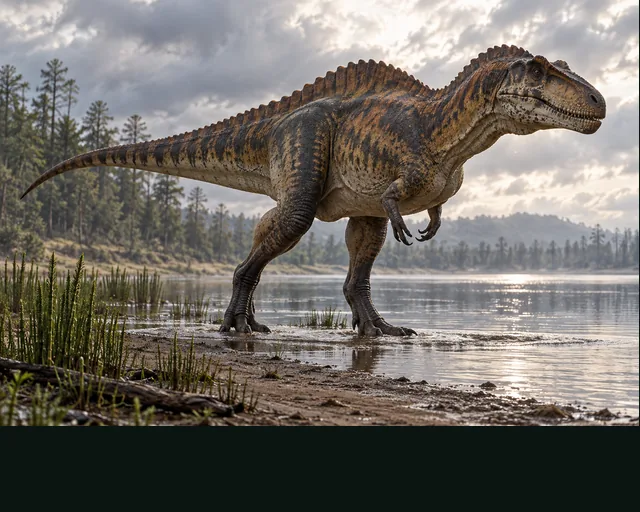
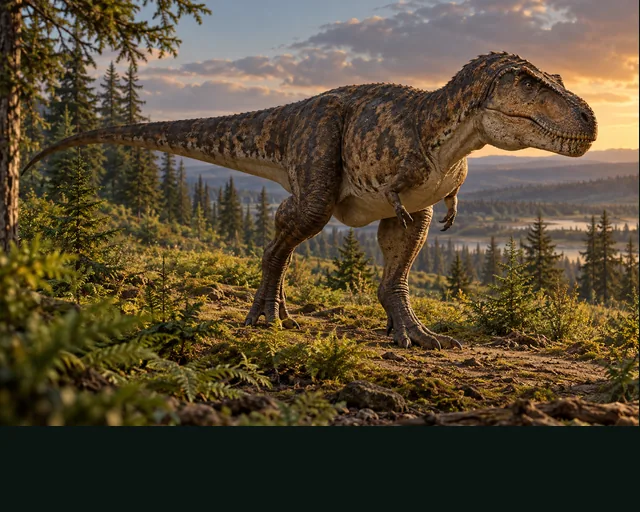
Bones originally included in the material were later identified as turtle remains. The mixed bonebed and questioned affinities make an unqualified giant-raptor reconstruction inappropriate; this page preserves the disagreement rather than assigning a settled body size.
Genus overview and research references.
Dakotaraptor fossil discoveries
Robert DePalma found a river-deposited bonebed in Harding County, South Dakota, in 2005. It held remains of many animals, dinosaurs and others, and from it came a partial skeleton that DePalma attributed to a large dromaeosaurid, the family of “raptor” dinosaurs with a sickle-shaped claw on each foot. More dromaeosaurid-like bones were found at the same site later.
DePalma, David Burnham, Larry Martin, Peter Larson and Robert Bakker named Dakotaraptor steini in 2015. The holotype has no skull. It includes part of a back vertebra, ten tail vertebrae, arm bones from both sides, a thigh bone, both shin bones, ankle and foot bones and several claws. It was found in the upper Hell Creek Formation, and the fossils are held at the Palm Beach Museum of Natural History.
Is Dakotaraptor a real dromaeosaurid?
This is the main debate about the genus. The describing team read the bones as dromaeosaurid, but later work challenged that. Bones first described as wishbones (furculae) were shown in 2015 by Victoria Arbour and colleagues to be parts of a turtle shell, and DePalma and colleagues accepted in 2016 that none of the referred wishbones belonged to Dakotaraptor.\n\nLater studies went further. Some elements of the holotype and referred specimens were found to belong to turtles, and the type specimen is in a private collection, which makes re-study difficult. A 2024 analysis argued that features thought to be typical of dromaeosaurids also occur in caenagnathids and ornithomimosaurs. Analyses have placed Dakotaraptor in different spots within the family, and a 2020 study of another Hell Creek dromaeosaurid suspected that the name covers a chimaera, a mixture of bones from more than one animal. As of 2024 it could not be confidently called a dromaeosaurid beyond being a maniraptoriform, a wider group of bird-like theropods.
How big was Dakotaraptor?
The describing team estimated an adult length of about 5.5 metres, and a 2016 summary gave a range of roughly 4.35 to 6 metres and 220 to 350 kilograms. These estimates come from a single partial skeleton, some of whose bones may not belong together, so they are best read as one possible size.\n\nThe describers noted slender legs with a long shin bone, more like smaller dromaeosaurids such as Deinonychus than like the heavily built Utahraptor. Because the identity of some leg bones is itself disputed, treat these body-shape statements with caution.
Did Dakotaraptor have feathers?
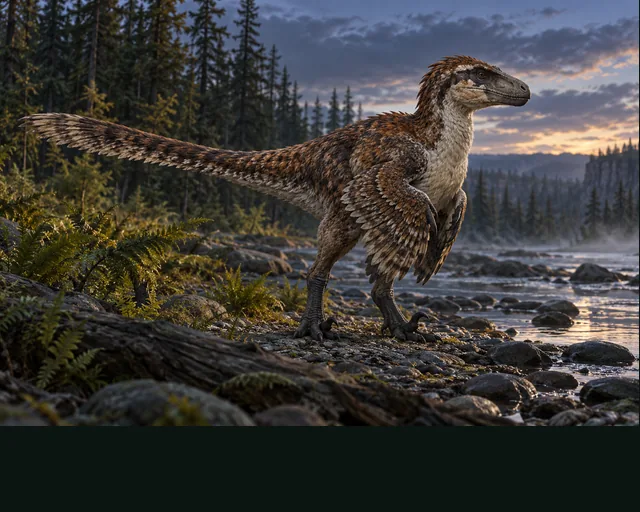
The original description reported a row of bumps, called quill knobs, along the forearm bone (the ulna). In living birds these mark where large wing feathers anchor to bone, and their presence was taken as a strong sign of long wing feathers. The team estimated a wingspan of about 1.2 metres and noted that such an animal was far too heavy to fly.
This evidence depends on the forearm bones really belonging to the same animal and to a dromaeosaurid, which is the very point under debate. For that reason the feathered reconstruction should be treated as a proposal and not a settled fact.
Where and when Dakotaraptor lived
Dakotaraptor comes from the Hell Creek Formation, dated to the Maastrichtian, the very end of the Mesozoic. The Paleobiology Database gives about 72.2 to 66 million years ago for its record. If it really was a dromaeosaurid, it would have been one of the last of its group.\n\nThe formation is better known for Tyrannosaurus and Triceratops. Another Hell Creek theropod, Acheroraptor, is known from jaws and teeth, and one researcher raised the possibility that the Dakotaraptor teeth may simply belong to it.
Classification and fossil record
The Paleobiology Database taxonomic record catalogues Dakotaraptor under Dromaeosaurinae. This is the immediate parent in that catalogue, rather than a complete list of evolutionary relationships.
The corroborated occurrence sample includes United States; those are modern discovery locations, not a complete ancient geographic range.
Research starting point
The catalogue links Dakotaraptor to DePalma and Burnham, 2015, published in The University of Kansas Paleontological Contributions. This identifies a research starting point; the catalogue’s citation alone does not verify every later reconstruction or species assignment.
For the meaning of taxonomic terms and how evidence is checked, see the glossary and editorial policy.
Quick answers
- Is Dakotaraptor a dinosaur?
- Yes, the bones are those of a theropod dinosaur from the Hell Creek Formation, but whether it is a true dromaeosaurid is disputed and parts of the original material came from turtles.
- When did Dakotaraptor live?
- It comes from the Maastrichtian Hell Creek Formation at the very end of the Cretaceous, about 72 to 66 million years ago by the Paleobiology Database's range.
- How big was Dakotaraptor?
- Estimates range from roughly 4.35 to 6 metres long and 220 to 350 kilograms, but they are based on one partial skeleton that may include bones from other animals.
- Is Dakotaraptor a dromaeosaurid?
- It was described as one in 2015, but later work found turtle bones in the material and some analyses give it different positions. As of 2024 it is not confidently classified beyond maniraptoriform.