Jurassic Dinos editorial · Updated · Source-based review
What is Buitreraptor?
Buitreraptor was a small unenlagiine theropod from Argentina, characterized by an elongated head with numerous small teeth.
Distinctive features and evidence
Its skull proportions distinguish it from many familiar raptors. The cached overview’s stage assignment requires checking before publishing an exact date; the anatomical description provides the firmer starting point for this account.
Genus overview and research references.
Buitreraptor fossil discoveries
Buitreraptor fossils were found in 2004 in reddish sandstone at La Buitrera, a fossil area in Patagonia, Argentina. The dig was led by Sebastián Apesteguía and Peter Makovicky, and four specimens were recovered. The best one, the holotype MPCA 245, is a partial skeleton with a skull, and it is still the most complete Buitreraptor found. Makovicky, Apesteguía and Agnolín named the animal in 2005, honouring the González brothers, who did much of the excavation and preparation of the bones.
The skull was described in detail in 2017, and a group of papers in 2018 described more specimens and the skeleton behind the head. Gianechini and colleagues called it the best-represented dromaeosaurid yet found in the southern continents.
How big was Buitreraptor?
Buitreraptor was small. The Natural History Museum gives a length of about 1.3 metres, and Gregory Paul estimated about 1.5 metres and roughly 3 kilograms in 2010. That is a single published weight estimate, so treat it as a rough guide.
The real animals may have grown a little larger. Thin slices of limb bone from the holotype and two other specimens show growth lines and no sign that growth had slowed, which suggests these individuals were still maturing when they died.
Did Buitreraptor have feathers?
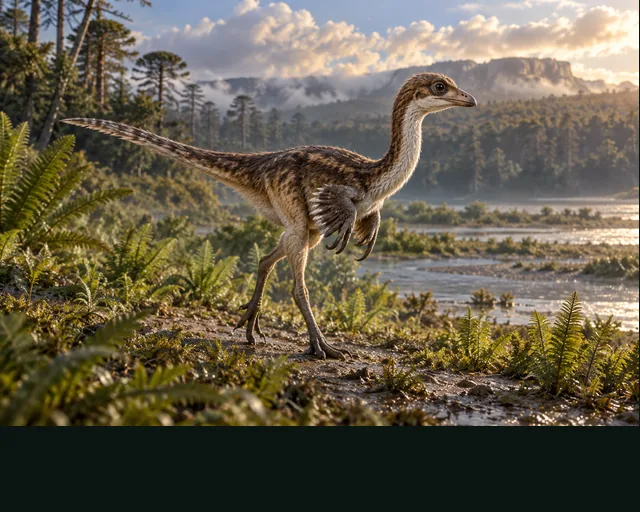
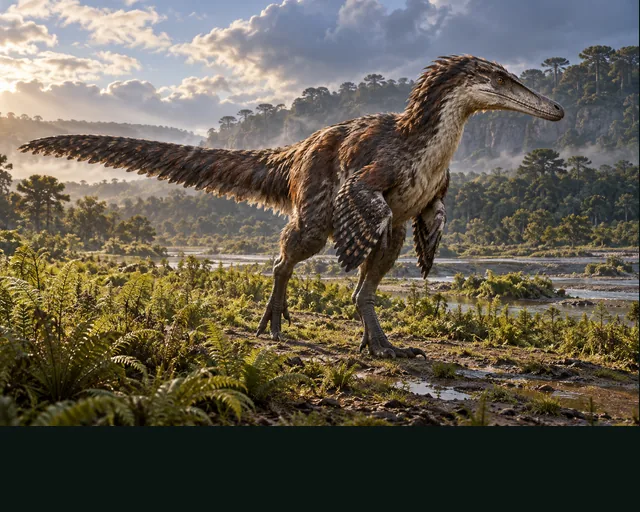
No feathers have been found with Buitreraptor. Scientists expect it to have had them anyway, because close relatives such as Microraptor, from China, are preserved with feathers. This is an inference from relatives, in the same way that a fossil monkey might be shown with fur because all living monkeys have it. Any colour or exact pattern in artwork is imagination.
What did Buitreraptor eat?
Its snout was long, flat and slim, with many small teeth that were grooved and curved but lacked meat-slicing serrations. The describing team concluded that it probably hunted small animals such as lizards and mammals, not large prey. Its arms and hands were long, and the sickle-shaped claw on the second toe was smaller than in Velociraptor or Deinonychus.
Some researchers think the teeth were used mainly to hold prey that was swallowed whole. The exact prey is unknown.
Is Buitreraptor a raptor like Velociraptor?
Buitreraptor is a dromaeosaurid, the family that includes Velociraptor, but it belongs to a different branch called the unenlagiines, which is mostly known from the southern continents. It combines features seen in dromaeosaurids, troodontids and early birds. Its long legs and lightly built body also differ from the stockier build of northern dromaeosaurids. Other unenlagiines include Austroraptor from South America.
Where and when Buitreraptor lived
Buitreraptor comes from the Candeleros Formation, which is Late Cretaceous in the geological study of its skeleton. Sources differ on the exact age: one overview calls it Albian, while the 2018 skeletal study places the formation in the Cenomanian and estimates the La Buitrera outcrops at about 95 to 92 million years old. The 2018 study also says that the age of the formation is not tightly fixed.
The sandstones are interpreted as a dune field with small, temporary lakes. Other animals from the site include crocodile relatives, pterosaurs, snakes, lizards and mammals. Giganotosaurus came from another nearby site.
Classification and fossil record
The Paleobiology Database taxonomic record catalogues Buitreraptor under Unenlagiinae. This is the immediate parent in that catalogue, rather than a complete list of evolutionary relationships.
Discovery and naming history
Buitreraptor gonzalezorum was described in 2005. Its name-bearing research and later skeletal work document a southern dromaeosaurid whose distinctive proportions should be assessed independently of better-known northern relatives. Historical overview.
The corroborated occurrence sample includes Argentina; those are modern discovery locations, not a complete ancient geographic range.
The sourced length estimate for Buitreraptor is 1.3–1.5 metres. This is an estimate for the reconstructed animal, not a measurement shared by every individual. See the body-size discussion and linked evidence for context.
Research starting point
The catalogue links Buitreraptor to Makovicky and Apesteguía, 2005, published in Nature. This identifies a research starting point; the catalogue’s citation alone does not verify every later reconstruction or species assignment.
For the meaning of taxonomic terms and how evidence is checked, see the glossary and editorial policy.
Geological age clarification
The published skeletal study places Buitreraptor in the Late Cretaceous Candeleros Formation, correcting the Early Cretaceous wording in an older overview.
Quick answers
- Is Buitreraptor a dinosaur?
- Yes. Buitreraptor was a small, bird-like theropod dinosaur, a dromaeosaurid in the unenlagiine group, from Argentina.
- When did Buitreraptor live?
- It lived in the Late Cretaceous. A 2018 skeletal study dates the La Buitrera rocks to the Cenomanian, about 95 to 92 million years ago, though the formation's age is not tightly fixed.
- How big was Buitreraptor?
- Buitreraptor was small: about 1.3 to 1.5 metres long according to the museum figure and a 2010 estimate, and perhaps around 3 kilograms.
- Is Buitreraptor a raptor?
- It is a dromaeosaurid, the family of Velociraptor, but belongs to the southern unenlagiine branch with a longer snout and legs.
- What did Buitreraptor eat?
- Its small, unserrated teeth and long snout suggest it caught small animals such as lizards and mammals, though no stomach contents are known.
- Did Buitreraptor have feathers?
- No feathers are preserved, but close relatives such as Microraptor had them, so scientists think Buitreraptor probably did too.