Jurassic Dinos editorial · Updated · Source-based review
What is Avaceratops?
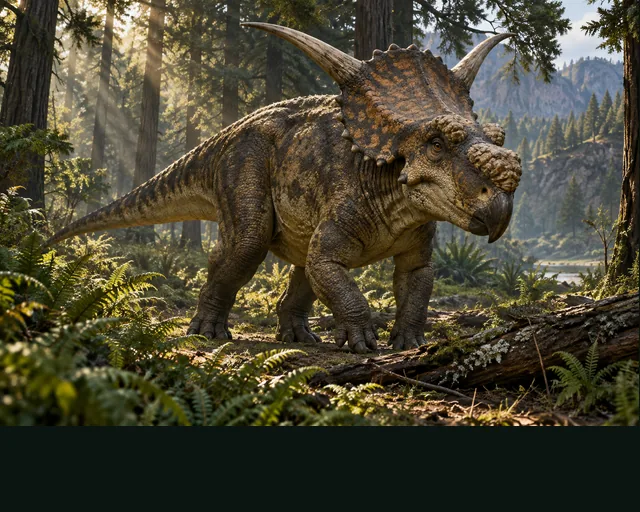
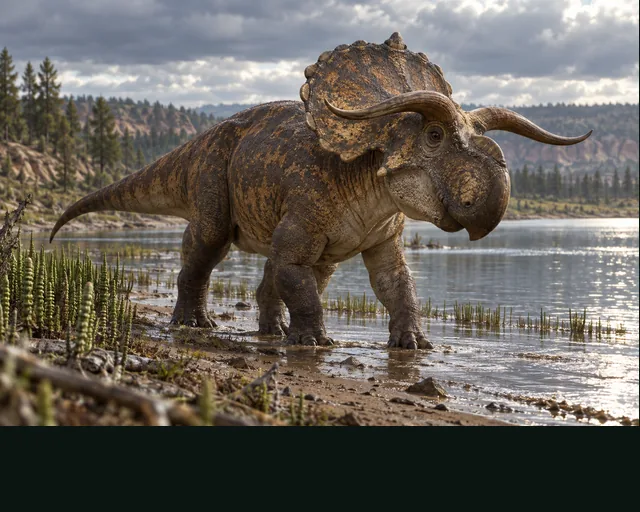
Avaceratops was a horned dinosaur from the Late Cretaceous Judith River Formation in northwestern North America.
Distinctive features and evidence
Its placement within ceratopsian diversity depends on anatomical comparisons, not simply on a small reconstructed size. The short source overview supports a restrained introductory account rather than detailed unsupported behavior.
Genus overview and research references.
Avaceratops fossil discoveries
In 1981 the fossil collector Eddie Cole found the first bones on a Montana ranch owned by Arthur Lammers. They lay scattered through the remains of an ancient stream bed, and the animal was probably swept downstream and buried in a sandbar. Peter Dodson inspected the finds that October and, during a visit in 1982, found more bones. Anthony Fiorillo led excavations from 1984, and Dodson named the animal in 1986.
The type specimen is a partial skeleton: the lower part of the skull, a left lower jaw, vertebrae, the complete shoulder girdle and most of the limb bones. A reconstruction was assembled for the Academy of Natural Sciences in Philadelphia, and a second copy of that mount went to a local history museum in Harlowton, Montana. The genus is named for Cole’s wife Ava, and the species honours the Lammers family.
Was Avaceratops really small?
Dodson thought it was an unusually small ceratopsid and estimated the type specimen at about 2.3 metres long, near adult size. A 2019 study of its bone microstructure disagreed. It found bone growing at the rapid rate expected of a young centrosaurine in its first few years, so the skeleton is probably a juvenile or subadult.
Larger fossils have been linked to it, including a second skull from 1999 with an estimated body length of 4.2 metres and brow-horn cores about 25 centimetres long. But whether that skull belongs to Avaceratops has been questioned, because of differences in the skull and in the age of the rocks, so Avaceratops is arguably known only from the type specimen. The real adult size and horn shape remain unknown.
Is Avaceratops a ceratopsid?
Yes. Dodson placed it in the Ceratopsidae, the family of big horned dinosaurs that includes Triceratops. Beyond that its position is uncertain, because a young animal tends to look more primitive than it really is and so can sit too low on a family tree. Researchers have often left it out of such analyses.
Penkalski and Dodson concluded in 1999 that it most likely sat near the base of the subfamily Centrosaurinae, though other positions were possible. A 2013 analysis found it to be the sister of Nasutoceratops, and the pair were named Nasutoceratopsini in 2016. Its frill was distinctive, with a smoothly curved squamosal bone and probably no large openings, giving it a solid frill similar to that of Triceratops.
Where did Avaceratops live and what did it eat?
Avaceratops lived in the late Campanian in what is now Montana. The surroundings are described as wet and heavily forested. Like all ceratopsians it was a plant-eater, and it probably fed on ferns, cycads and conifers, the main plants then, cutting them with its beak. That diet is reasoned from the group and the environment, not from anything preserved in this animal.
Classification and fossil record
The Paleobiology Database taxonomic record catalogues Avaceratops under Nasutoceratopsini. This is the immediate parent in that catalogue, rather than a complete list of evolutionary relationships.
The corroborated occurrence sample includes United States; those are modern discovery locations, not a complete ancient geographic range.
Research starting point
The catalogue links Avaceratops to Dodson, 1986, published in Proceedings of the Academy of Natural Sciences of Philadelphia. This identifies a research starting point; the catalogue’s citation alone does not verify every later reconstruction or species assignment.
For the meaning of taxonomic terms and how evidence is checked, see the glossary and editorial policy.
Quick answers
- Is Avaceratops a dinosaur?
- Yes. Avaceratops was a plant-eating ceratopsian dinosaur, a relative of Triceratops, from the Late Cretaceous of Montana, United States.
- What does Avaceratops mean?
- It means "Ava's horned face", a tribute to Ava Cole, whose husband Eddie found the first fossils in 1981.
- How big was Avaceratops?
- The type specimen was estimated at about 2.3 metres long, but a 2019 study suggests it was still growing, so adults were probably larger. A possible larger skull indicates about 4.2 metres.
- Is Avaceratops a ceratopsid?
- Yes. It belongs to the Ceratopsidae, probably in the subfamily Centrosaurinae and close to Nasutoceratops, but its exact position is hard to test because the main specimen is young.
- What did Avaceratops eat?
- It was a herbivore. It probably cropped ferns, cycads and conifers with its beak, though this is inferred from its group and environment.