Jurassic Dinos editorial · Updated · Source-based review
What is Anzu?
Anzu was a caenagnathid theropod from the latest Cretaceous Hell Creek Formation of North America.
Distinctive features and evidence
Several skeletons preserve both skull and body elements, offering a stronger anatomical basis than a genus known only from teeth. Its bird-like appearance connects it to oviraptorosaur diversity; appearance alone does not establish one specific diet.
Genus overview and research references.
Anzu fossil discoveries
Anzu is unusually well known for a caenagnathid, a family of toothless, bird-like theropods whose fossils are usually very incomplete. The first two partial skeletons were found in 1998 on a private ranch in South Dakota by the fossil collector Fred Nuss. A third came from near Marmarth, North Dakota, and a fragment of a lower jaw reported in 1993 was later linked to the same species. Researchers studying them separately realised in 2006 that all were one species.
Put together, the four finds give roughly three-quarters of a skeleton, with parts of most regions of the body. That is why Anzu helped to answer questions about caenagnathid anatomy that older, scrappier finds could not. Lamanna and colleagues named it in 2014, and the main fossils are kept in Pittsburgh at the Carnegie Museum of Natural History.
Why is Anzu called the “chicken from hell”?
The nickname arose because the animal combined a toothless beak and a tall head crest with a very bird-like skeleton, and its bones came from the Hell Creek Formation. Matthew Lamanna, who chose the scientific name, first wanted a Latin or Greek version of the joke but found that it translated poorly. He settled on Anzû, a bird-like figure from Mesopotamian myth.
The nickname is only a joke. Anzu was a toothless theropod dinosaur, not a chicken, and similarities to birds are partly the result of convergent evolution, where unrelated lines evolve similar features.
How big was Anzu and what did it look like?
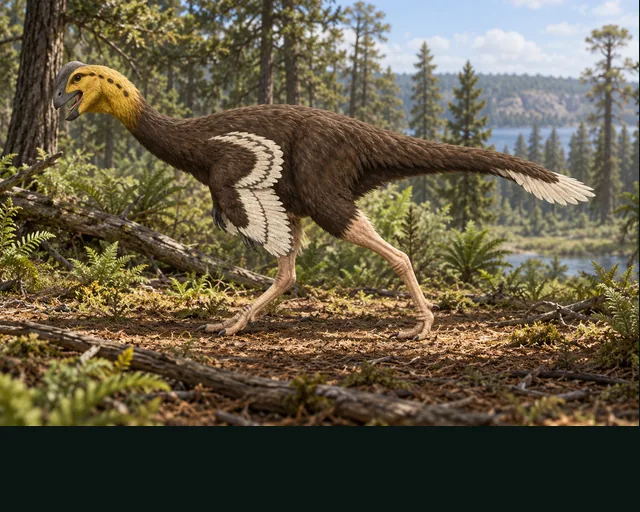
Estimates put Anzu at about 3.5 to 3.75 metres long, around 1.5 metres tall at the hips, and roughly 200 to 300 kilograms in weight, among the larger oviraptorosaurs known from North America. It had long arms ending in big curved claws, strong slim-toed legs and a fairly short tail.
Its most striking feature was a high, crescent-shaped crest on the skull, formed by the premaxillae, the front bones of the upper jaw. The crest was thin and delicate and could not have handled much stress, so scientists think it was most likely for display to others of its kind, perhaps as the crest of the modern cassowary is thought to work. That is an interpretation rather than something that can be proven from bone. Some Anzu bones also show damage: a rib that broke and healed, and a toe with signs of arthritis. But it is not known whether these came from fights or from predators.
What did Anzu eat and where did it live?
Anzu probably ate a mixed diet. The describing team suggested that it was an ecological generalist feeding on vegetation, small animals and perhaps eggs. Its beak was less heavily built than that of the Asian oviraptorids, so it may have had a different way of feeding.
The skeletons were found in mudstone laid down on ancient floodplains. Anzu and its relatives probably favoured well-watered lowlands, which would make them different from the oviraptorids of Asia, many of which lived in dry or semi-dry settings. The fossils date to the late Maastrichtian, the final stage of the Cretaceous, and Anzu is therefore among the youngest oviraptorosaurs known.
Is Anzu an oviraptorosaur?
Yes. Anzu belongs to the Oviraptorosauria and, within that group, to the family Caenagnathidae. A family-tree analysis found its closest relative to be Caenagnathus, known from a lower jaw found in Alberta, Canada. The same analysis placed Gigantoraptor and Microvenator among the early caenagnathids. The better-known Oviraptor belongs to the Asian branch, the Oviraptoridae, and Anzu suggests that North American oviraptorosaurs were more closely related to each other than to their Asian cousins.
Classification and fossil record
The Paleobiology Database taxonomic record catalogues Anzu under Caenagnathinae. This is the immediate parent in that catalogue, rather than a complete list of evolutionary relationships.
Discovery and naming history
Anzu wyliei was named in 2014 from Hell Creek Formation skeletons. Its mythological name refers to a bird-like Mesopotamian figure; its caenagnathid placement comes from anatomy and comparative research. Historical overview.
Research starting point
The catalogue links Anzu to Lamanna and Sues, 2014, published in PLoS ONE. This identifies a research starting point; the catalogue’s citation alone does not verify every later reconstruction or species assignment.
For the meaning of taxonomic terms and how evidence is checked, see the glossary and editorial policy.
Quick answers
- Is Anzu a dinosaur?
- Yes. Anzu was a caenagnathid theropod, a member of the oviraptorosaurs. Its bird-like features are thought to be convergent, and it was not a bird.
- When did Anzu live?
- Anzu lived in the late Maastrichtian, the last stage of the Cretaceous, shortly before the extinction event that ended the non-avian dinosaurs about 66 million years ago.
- How big was Anzu?
- Estimates give about 3.5 to 3.75 metres in length and 200 to 300 kilograms in weight, which makes it one of the larger oviraptorosaurs known from North America.
- What did Anzu eat?
- Scientists suggest it was a generalist that ate plants, small animals and perhaps eggs. This comes from its jaw and skeletal anatomy rather than preserved food remains.
- Why is Anzu nicknamed the chicken from hell?
- The nickname joked about its beak, crest and bird-like skeleton together with the Hell Creek Formation where it was found. It was not closely related to chickens.