Jurassic Dinos editorial · Updated · Source-based review
What is Quetzalcoatlus?
Quetzalcoatlus was a latest Cretaceous North American azhdarchid pterosaur first described from Texas wing fragments.
Distinctive features and evidence
The giant type species and the better-represented Quetzalcoatlus lawsoni should be distinguished. Anatomical work on one species cannot be transferred without qualification to the fragmentary giant, including estimates of flight performance.
Genus overview and research references.
Is Quetzalcoatlus a dinosaur?
No. Quetzalcoatlus was a pterosaur, a member of the family Azhdarchidae, a group of long-necked, toothless flying reptiles. Pterosaurs are often called “flying dinosaurs” in popular media, but dinosaurs are defined as the descendants of the shared ancestor of the two major dinosaur lineages, Saurischia and Ornithischia, and that definition leaves pterosaurs out. They are nonetheless closer relatives of dinosaurs and birds than of crocodiles or any other living reptile.
Quetzalcoatlus lived at the very end of the Age of Dinosaurs and shared its habitat with true dinosaurs. Read more about the distinction in our not-dinosaurs guide.
Quetzalcoatlus fossil discoveries
The story began in 1971 in Big Bend National Park, Texas. Douglas Lawson, then a graduate student, found a very long bone in an arroyo. Along with his supervisor Wann Langston Jr. he recognised it as a pterosaur bone because of its hollow, thin-walled interior. Further digging produced a partial left wing, which became the type specimen of Quetzalcoatlus northropi. It was far bigger than any pterosaur known at the time. Lawson announced it in 1975 and named it after the Aztec sky god and Jack Northrop, the designer of tailless aircraft.
For Quetzalcoatlus northropi the evidence is still thin: the type specimen is a wing, with only a few other bones confidently linked to it. Smaller bones, found in numbers at a site about 40 to 50 kilometres away that came to be called Pterodactyl Ridge, were first assumed to be juveniles of the same animal. Langston came to doubt this. In 2021 a large memoir by Brian Andres and colleagues named them Quetzalcoatlus lawsoni. This second species is known from more than 200 specimens, the most for any pterosaur species, including the best skull material. Another, shorter-snouted animal from the same area was named as a separate genus, Wellnhopterus.
The name itself had a legal wrinkle. Lawson’s 1975 papers did not formally describe the animal, and the name was only officially settled by the zoological naming commission in 2019.
How big was Quetzalcoatlus?
Quetzalcoatlus northropi is a contender for the biggest creature that ever took to the air, but its size has to be worked out from a single partial wing, which makes any figure uncertain. Published wingspan estimates have ranged from about 5 to nearly 26 metres, and more recent work clusters around 10 to 11 metres. Estimates of the weight vary widely too, since nothing alive has a similar body plan. Most published figures since the 2000s are about 200 to 250 kilograms, while a 2021 study estimated about 150 kilograms.
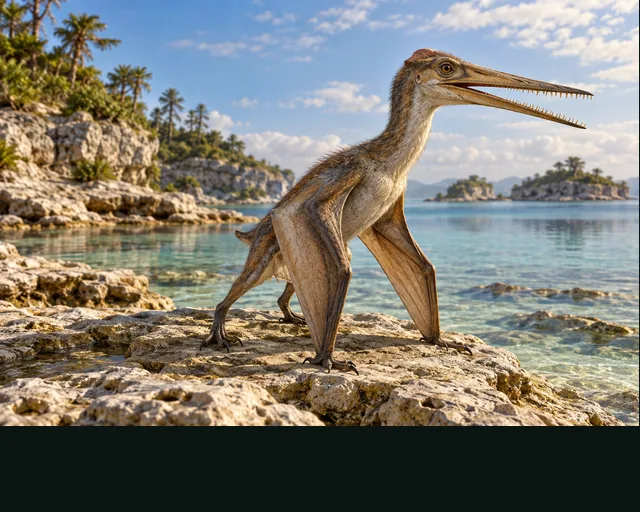
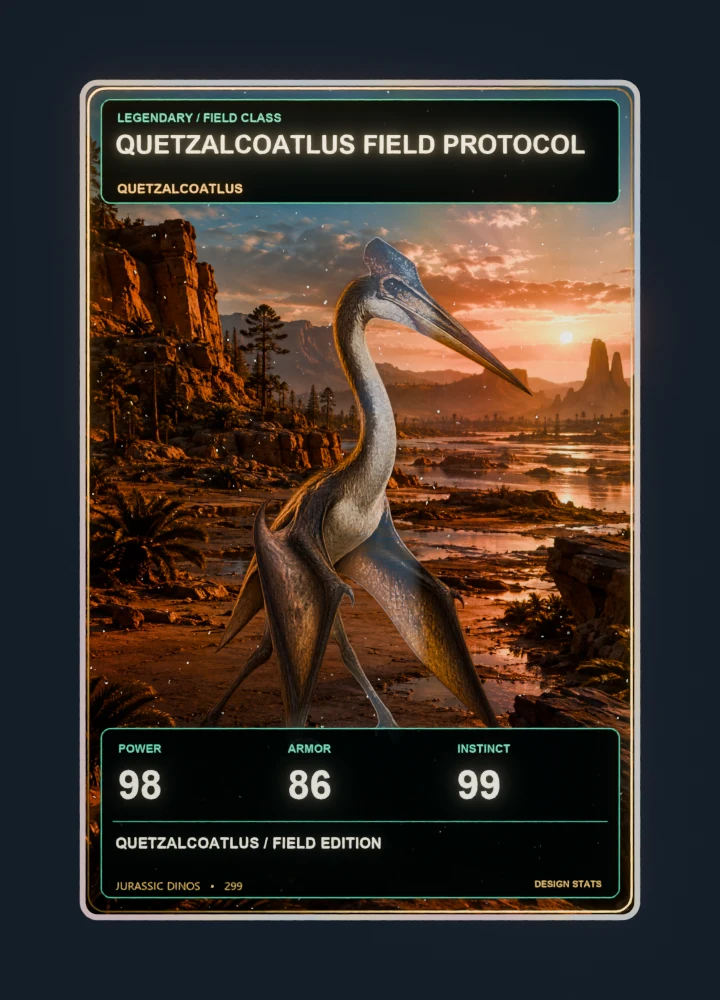
Standing on all fours, a big azhdarchid of this type is estimated to have been about 2 to 3 metres at the shoulder, with the head held at more than 4 metres, roughly the height of a giraffe. Q. lawsoni was far smaller, with an estimated wingspan around 4.5 to 5 metres and a skull about 94 to 96 centimetres long. Azhdarchids had long, slender, toothless beaks and long, stiff necks, and a small body for their wing size.
What did Quetzalcoatlus eat?
No stomach contents have been found, so scientists reason from anatomy, and several ideas have been tried. Early on, Lawson suggested that Quetzalcoatlus was a scavenger like a vulture, but its light beak and stiff neck make that unlikely. Skimming fish from the water surface, as modern skimmers do, is also unlikely, because azhdarchids lack the beak strength and neck flexibility for it.
The model that most researchers favour is called “terrestrial stalking”. It pictures an azhdarchid striding on long limbs through vegetation and picking up small animals, and fruit, with its downturned beak, in the manner of a stork or a ground hornbill. For the mid-sized species the neck structure suggests prey of up to roughly 9 to 13 kilograms at most. Q. lawsoni remains are common in ancient lake deposits, so it may have eaten small invertebrates there instead. A 2021 study noted that some azhdarchids come from marine rocks and proposed that the group was less tied to land than the stalking model implies, so the debate is still open.
Could Quetzalcoatlus fly?
Yes, according to most researchers, but how it flew is argued about. In 2010 Donald Henderson calculated a very high mass for Q. northropi and suggested it could have been flightless. That year Mark Witton and Michael Habib countered, using more suitable body proportions, that it was a capable flier and probably relied on a short powered burst followed by soaring in rising warm air. A 2022 study proposed instead that big azhdarchids took to the air only now and then, and over short distances, comparable to the heaviest flying bird alive today, the Kori bustard, while a 2021 study suggested a very powerful flier.
The launch is also debated. A well-supported view is that Quetzalcoatlus vaulted into the air from a four-legged crouch using its strong forelimbs, because its thigh bone was relatively weak compared with its upper arm bone. A 2021 paper argued for a two-legged launch, and Witton still favoured the four-legged one. On the ground, trackways from South Korea attributed to azhdarchids show they walked with limbs under the body and were comparatively good walkers for pterosaurs.
Where and when Quetzalcoatlus lived
Securely identified Quetzalcoatlus fossils come only from the Javelina Formation of Texas. The remains are from the upper part of the formation, dated to the very end of the Cretaceous, around 67 to 66 million years ago, in the Maastrichtian stage. The area was a tropical lowland floodplain with river channels whose flow rose and fell sharply, shallow lakes that may have been alkaline, and a forest of conifers and palms, some 300 to 400 kilometres from the sea of that time.
The large titanosaur Alamosaurus dominated the dinosaur fauna there, and horned dinosaurs, duck-billed dinosaurs, armoured dinosaurs and a Tyrannosaurus of uncertain species are also reported. Quetzalcoatlus is the most common vertebrate in the upper part of the formation. Researchers who studied pterosaur diversity before the end-Cretaceous extinction suggested they were still varied at that point and were wiped out abruptly, though the fossil record for pterosaurs is poor.
Quetzalcoatlus in the game
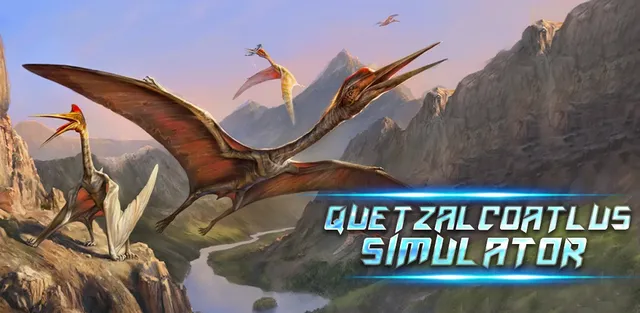
Quetzalcoatlus Fly: Sky Titan is an Android game that lets you play as a Quetzalcoatlus. Its store listing describes aerial movement, gliding and diving, a day-night cycle with changing weather, quests, and skills you can upgrade. It also names animals such as Velociraptor, Spinosaurus and Stegosaurus as rivals to face.
The listing describes Quetzalcoatlus as a flying dinosaur, but it was a pterosaur. Game encounters and abilities are entertainment and not evidence of how the animal behaved.
Classification and fossil record
The Paleobiology Database taxonomic record catalogues Quetzalcoatlus under Quetzalcoatlinae. This is the immediate parent in that catalogue, rather than a complete list of evolutionary relationships.
Discovery and naming history
Wing material recovered from Texas’s Javelina Formation in 1971 was described by Douglas Lawson in 1975 as Quetzalcoatlus northropi. The fragmentary type specimen is central to why giant wingspan estimates need explicit reconstruction assumptions. Historical overview.
The corroborated occurrence sample includes United States; those are modern discovery locations, not a complete ancient geographic range.
Research starting point
The catalogue links Quetzalcoatlus to Lawson, 1975, published in Science. This identifies a research starting point; the catalogue’s citation alone does not verify every later reconstruction or species assignment.
For the meaning of taxonomic terms and how evidence is checked, see the glossary and editorial policy.
Quick answers
- Is Quetzalcoatlus a dinosaur?
- No. Quetzalcoatlus was an azhdarchid pterosaur, a flying reptile that is a relative of dinosaurs but not a dinosaur.
- When did Quetzalcoatlus live?
- Quetzalcoatlus lived at the very end of the Late Cretaceous, in the Maastrichtian stage, with its fossils dated to about 67 to 66 million years ago.
- How big was Quetzalcoatlus?
- The big Q. northropi is estimated to have had a wingspan of about 10 to 11 metres and weighed roughly 150 to 250 kilograms, but these figures come from fragmentary bones.
- What did Quetzalcoatlus eat?
- Most researchers think it walked on the ground and picked up small animals with its toothless beak, like a stork. Other diets have been suggested, and no direct evidence of its meals has been reported.
- Where was Quetzalcoatlus found?
- Definite Quetzalcoatlus fossils come from the Javelina Formation in Big Bend National Park, Texas, in the United States.