Jurassic Dinos editorial · Updated · Source-based review
What is Dimorphodon?
Dimorphodon was an Early Jurassic European pterosaur with two contrasting tooth forms.
Distinctive features and evidence
Its name describes the dentition rather than a dinosaur relationship. Feeding interpretations have changed between fish, insects and small vertebrates, so a definite menu would disguise the research debate.
Genus overview and research references.
Dimorphodon fossil discoveries
The first bones now assigned to Dimorphodon were found by the fossil collector Mary Anning at Lyme Regis, on the Dorset coast of England, in December 1828. The partial skeleton had no skull, and in 1835 it was described as a new species of Pterodactylus, called P. macronyx for the large claws on the hand. At that time almost every pterosaur find was placed in the genus Pterodactylus.
In 1858 Richard Owen examined two more partial skeletons that did include skulls. The skull was so different that he gave the species its own genus, Dimorphodon, which was first described in 1859. The animal is not a common fossil, but other fragments turned up, including one from Aust Cliff on the Severn river, and some were bought by the American collector Othniel Charles Marsh between 1873 and 1881. A second species, D. weintraubi, was named in 1998 from Mexico, though later studies placed it among the relatives of a different pterosaur group, the anurognathids.
How big was Dimorphodon and what did it look like?
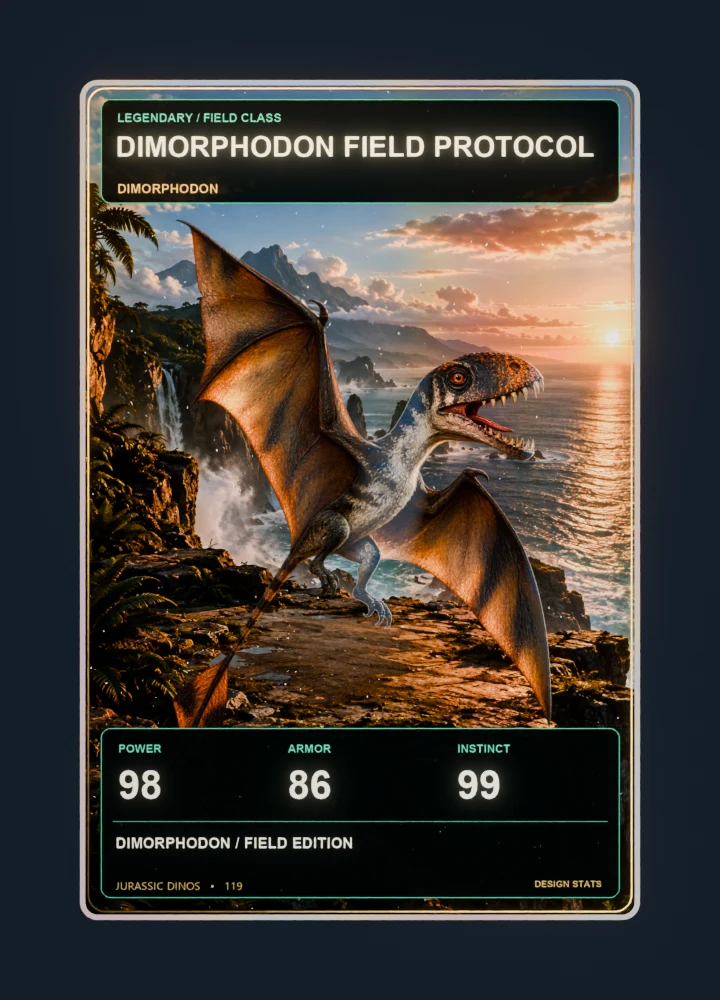
Dimorphodon was a medium-sized pterosaur by the standards of its group. Adults are described as about 1 metre long with a wingspan of around 1.45 metres. The skull was big and bulky, about 23 centimetres long, and its weight was kept down by large openings separated by thin bars of bone. Owen compared its construction to the arches of a bridge.
The tail was long and had thirty vertebrae. The first few were short and flexible, and the rest became longer and were stiffened by bony rods. Some artists add a vane to the tail tip and a puffin-like beak, but no fossil impressions confirm a tail vane, and the beak is speculative.
Is Dimorphodon a dinosaur?
No. Dimorphodon is a pterosaur, a member of the order Pterosauria, which is a separate group of flying reptiles from dinosaurs. It belongs to the family Dimorphodontidae, which Harry Seeley named in 1870. Pterosaurs are flying reptiles that form their own branch, distinct from dinosaurs, and a pterosaur wing was carried on an elongated ‘flight finger’ rather than on feathered arms. See the not-dinosaurs page for more animals that are often mistaken for dinosaurs.
What did Dimorphodon eat?
Its name refers to two shapes of teeth: four or five fang-like teeth at the front of the upper jaw, then smaller teeth behind, and in the lower jaw five longer teeth followed by many tiny flattened ones. That is unusual for a reptile.
How it fed has been argued back and forth. Buckland suggested insects, and later reconstructions often showed a fish-eater. Studies of the jaw muscles found a fast but weak bite and supported insects better than fish. Mark Witton argued that it was too big to live on insects and hunted small vertebrates, although it may still have taken large insects, and tooth-wear studies support it as a predator of vertebrates, with soft invertebrates not ruled out. The safest reading is a small-prey hunter with a varied diet.
How did Dimorphodon fly and move?
Older reconstructions imagined Dimorphodon soaring like a seabird. More recent studies suggest it was a rather poor flier, because its wings were short for its body and its skeleton was sturdy, which leaves little room for gliding. It probably made short, flapping flights like modern fowl and may have flown mainly when it had to.
On the ground, Owen and later Harry Seeley disagreed about whether it was a clumsy quadruped or an agile biped. Pterosaur trackways, the long clawless fifth toe and computer modelling led David Unwin and Sarah Sangster to favour four-legged movement. Large curved claws and a low centre of gravity suggest that it was a competent climber.
Where and when Dimorphodon lived
Dimorphodon lived in the Early Jurassic of what is now Europe, around 201 to 191 million years ago by one recent summary, and the Paleobiology Database gives an overlapping age range of about 201 to 184 million years ago. The first bones came from the Blue Lias rocks around Lyme Regis, which date from the Hettangian to Sinemurian stages. Scientists think it may have lived mainly in coastal regions.
Dimorphodon in the game
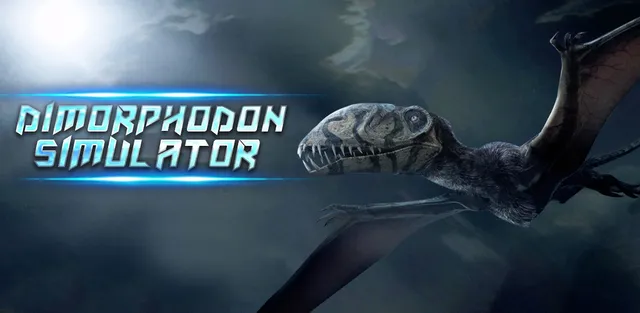
Dimorphodon Simulator is an Android flying-reptile adventure. Its store listing describes hunting, foraging, aerial exploration, a day-night and weather system, upgradeable action skills and RPG-style levelling, with quests and fights against other prehistoric animals.
Those features are entertainment. Real Dimorphodon was probably a weak long-distance flier, and the game’s abilities and battles are not scientific evidence about the animal.
Classification and fossil record
The Paleobiology Database taxonomic record catalogues Dimorphodon under Dimorphodontidae. This is the immediate parent in that catalogue, rather than a complete list of evolutionary relationships.
Discovery and naming history
Richard Owen named Dimorphodon in 1859. Its pterosaur identity provides a useful historical contrast with flying birds: similar activities can evolve in distinct reptile branches. Historical overview.
Research starting point
The catalogue links Dimorphodon to Carroll, 1988, published in the linked reference. This identifies a research starting point; the catalogue’s citation alone does not verify every later reconstruction or species assignment.
For the meaning of taxonomic terms and how evidence is checked, see the glossary and editorial policy.
Quick answers
- Is Dimorphodon a dinosaur?
- No. Dimorphodon was a pterosaur, a separate order of flying reptiles from the dinosaurs, in the family Dimorphodontidae. Pterosaurs are classified apart from both dinosaurs and birds.
- When did Dimorphodon live?
- Dimorphodon lived during the Early Jurassic, roughly 201 to 191 million years ago by one recent summary, in what is now Europe.
- How big was Dimorphodon?
- Adults are described as about 1 metre long with a wingspan of roughly 1.45 metres, and a skull about 23 centimetres long.
- What did Dimorphodon eat?
- Scientists disagree. Studies have supported insects, fish and small vertebrates, and recent work favours small vertebrates, though large insects may have been eaten too.
- Where was Dimorphodon found?
- The first fossils came from Lyme Regis in Dorset, England, with other fragments from Aust Cliff, and a second named species from Tamaulipas in Mexico that later studies treat as only a relative.