Jurassic Dinos editorial · Updated · Source-based review
What is Psittacosaurus?
Psittacosaurus was an Early Cretaceous Asian ceratopsian with a robust beak and multiple named species.
Distinctive features and evidence
Adults were bipedal, unlike many later large ceratopsids. A specimen preserving tail filaments adds direct integument evidence, while complex behavior inferred from brain proportions remains interpretation.
Genus overview and research references.
Psittacosaurus fossil discoveries
Psittacosaurus is known from an unusually rich fossil record. The first skeleton was found in 1922 in Mongolia by a driver named Wong on the American Museum of Natural History’s Third Asiatic Expedition, and Henry Fairfield Osborn named it in the early 1920s after its parrot-like beak. A second Mongolian skeleton that Osborn called Protiguanodon was later folded into the same genus. More species followed from Inner Mongolia, Siberia and China.
Hundreds of individuals are now known, including many complete skeletons. More than 200 specimens have come from China’s Yixian Formation alone, and a team led by Bolortsetseg Minjin and Jack Horner excavated nearly 100 skeletons in Mongolia in 2005 and 2006. Because every age is preserved, from hatchlings under 13 centimetres long to old adults, scientists have been able to study how Psittacosaurus grew up.
How big was Psittacosaurus?
Psittacosaurus was small, and size varied by species. The best-known, P. mongoliensis, reached about 2 metres, the Natural History Museum lists 2 metres for the genus, and P. gobiensis was only about 1 metre. Weight figures disagree: the Natural History Museum gives 50 kilograms, while published estimates for adult P. mongoliensis are over 20 kilograms. Bone studies found three-year-olds under 1 kilogram and nine-year-olds near 20 kilograms, with a lifespan of roughly 10 to 11 years.
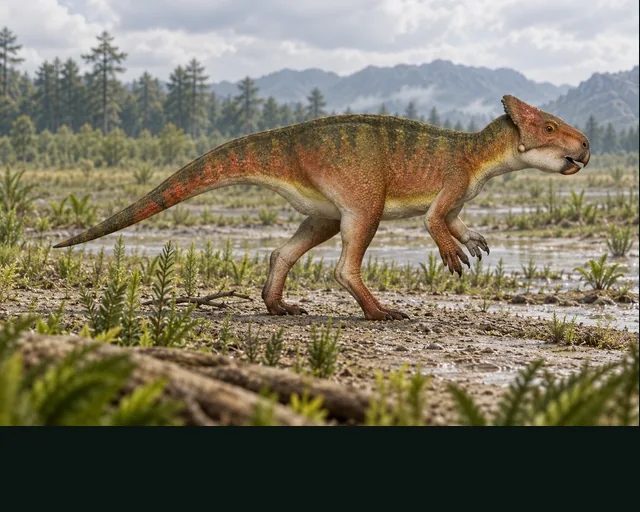
The skull was tall and short, almost round in profile in some species, with a strong beak. The hand had four fingers. Flared cheek bones formed horn-like points, but there was no neck frill and none of the big facial horns of later horned dinosaurs.
What did Psittacosaurus eat?
Psittacosaurus ate plants. Its self-sharpening teeth were good for cropping and slicing tough vegetation but not for grinding. Some skeletons contain swallowed stones, sometimes more than fifty, which may have worked like a bird’s gizzard. The Australian Museum suggests the beak could pry open cones and seeds, and the jaw joint let the lower jaw slide back and forth for a shearing action. Even very young animals show worn teeth, which suggests they fed themselves soon after hatching.
Did Psittacosaurus have feathers or scales?
One exceptionally preserved specimen, SMF R 4970, shows a body mostly covered in scales of varying size. A row of hollow, bristle-like structures about 16 centimetres long ran along the top of the tail. Some researchers compare them to the quills of Tianyulong and say they differ from theropod feathers, while another team argued they were modified scales, so their nature is debated.
A 2016 study of pigment structures in the same specimen proposed countershading, with a darker back and paler underside, plus pigment patches on the face and shoulders. This rests on one individual and one interpretation. The specimen also gave the first known cloaca and belly button of a non-bird dinosaur.
How did Psittacosaurus live?
Adults of the species studied walked on two legs, because their arms were too short to reach the ground. Limb bones from animals aged under one to ten years suggest that the front limbs grew faster early on, so youngsters may have spent time on all fours. A brain study of P. lujiatunensis found large smell-processing areas and inner-ear canals consistent with agility, and eye rings hint at activity by day and in short spells at night.
Some fossils show groups. Six animals from two broods were buried together by a volcanic mudflow, and other clusters contain only young. A slab with 34 juveniles and an adult skull was once taken as proof of parental care, but a 2013 paper showed the skull had been attached afterwards, so that claim is disputed. Juveniles were also prey: a fossil of the large early mammal Repenomamus has a young Psittacosaurus in its stomach.
Why are there so many Psittacosaurus species?
Seventeen species have been named and nine to eleven are generally accepted, the most for any non-bird dinosaur. Researchers think this mostly reflects how many specimens exist: with hundreds of skeletons, small differences can be tested, whereas most dinosaurs are known from one or a few. Species are told apart mainly by skull and tooth features, and several names have been merged. A 2025 study moved Hongshanosaurus into Psittacosaurus.
Psittacosaurus gives its name to the family Psittacosauridae, an early branch of the horned-dinosaur group Ceratopsia. It was probably not an ancestor of later groups, such as Protoceratops and Triceratops, which kept a fifth finger and a skull opening that Psittacosaurus had lost and went on to develop frills and facial horns. Its close relatives are Asian apart from Aquilops from North America.
Where and when Psittacosaurus lived
Psittacosaurus lived in Early Cretaceous Asia, with fossils from China, Mongolia, Russia and possibly Thailand. Most of its rocks date from the late Barremian to the Albian, roughly 125 to 105 million years ago, and rock of that age in East Asia is sometimes labelled the Psittacosaurus biochron because the animal is so common. The earliest known species, P. lujiatunensis, comes from the lowest beds of the Yixian Formation, whose age estimates range from about 128 to 123 million years.
Many specimens come from lake deposits. In 2010 Ford and Martin proposed that Psittacosaurus was semi-aquatic, but this remains a hypothesis.
Classification and fossil record
The Paleobiology Database taxonomic record catalogues Psittacosaurus under Ceratopsia. This is the immediate parent in that catalogue, rather than a complete list of evolutionary relationships.
The corroborated occurrence sample includes China, Russia, Mongolia, Thailand; those are modern discovery locations, not a complete ancient geographic range.
The sourced length estimate for Psittacosaurus is 1–2 metres. This is an estimate for the reconstructed animal, not a measurement shared by every individual. See the body-size discussion and linked evidence for context.
Research starting point
The catalogue links Psittacosaurus to Osborn, 1923, published in American Museum Novitates. This identifies a research starting point; the catalogue’s citation alone does not verify every later reconstruction or species assignment.
For the meaning of taxonomic terms and how evidence is checked, see the glossary and editorial policy.
Quick answers
- Is Psittacosaurus a dinosaur?
- Yes. Psittacosaurus was a plant-eating ceratopsian, an early relative of the horned dinosaurs, that lived in Asia during the Early Cretaceous. It had a parrot-like beak.
- When did Psittacosaurus live?
- Psittacosaurus lived in the Early Cretaceous, with most fossils dated to roughly 125 to 105 million years ago, and the Natural History Museum giving 120 to 100 million years.
- How big was Psittacosaurus?
- Psittacosaurus was about 1 to 2 metres long, depending on the species. Adult weight estimates range from over 20 kilograms to about 50 kilograms.
- Is Psittacosaurus a ceratopsian?
- Yes. It belongs to the ceratopsians but to an early branch called Psittacosauridae, and it had no neck frill or large facial horns.
- What did Psittacosaurus eat?
- Psittacosaurus ate plants. Its beak and self-sharpening teeth cropped tough vegetation, and swallowed stones found in some skeletons may have helped grind the food.
- Where was Psittacosaurus found?
- Psittacosaurus has been found in China, Mongolia and Russia, and possibly Thailand, in Early Cretaceous rocks such as the Yixian Formation of Liaoning, China.