Jurassic Dinos editorial · Updated · Source-based review
What is Mussaurus?
Mussaurus was an Early Jurassic Argentine sauropodomorph first recognized from very small immature skeletons.
Distinctive features and evidence
Adult specimens changed the meaning of its mouse-lizard nickname. Changes in body proportions through growth have been used to investigate posture, showing why infant dimensions should not be presented as the size of the adult animal.
Genus overview and research references.
Mussaurus fossil discoveries
The first Mussaurus fossils came from an expedition led by José Bonaparte in the 1970s to the Laguna Colorada Formation in southern Argentina. The team found nests, fossil eggs and hatchlings, which showed how these animals began life. Bonaparte and Vince described the first nest in 1979.
For decades only infants and juveniles were known. The first adult specimens were described in 2013, and some of them had already been published in 1980 under the name Plateosaurus. Later work in the same area produced more than 100 eggs and skeletons of about 80 individuals, from embryos to adults, which makes it an unusually rich site.
How big was Mussaurus?
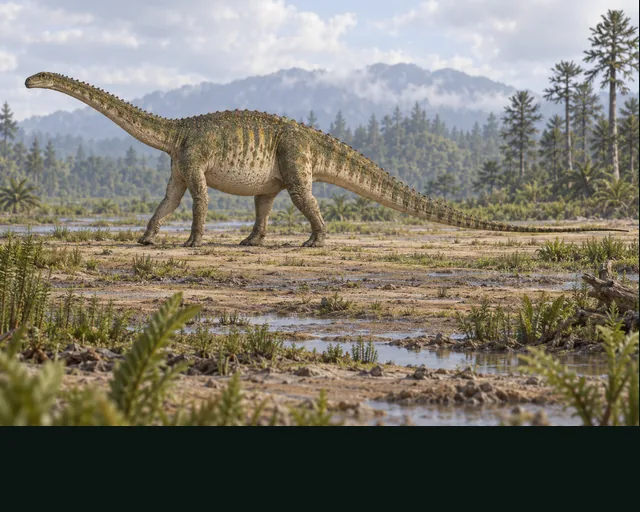
That depends on age. Infant skeletons were about 20 centimetres long and weighed roughly 53 to 77 grams, about the size of a small lizard. A 2019 growth study estimated 6.5 to 10.2 kilograms for a one-year-old, about 106 to 557 kilograms for subadults, and up to 1.2 to 1.6 tonnes for adults that could reach about 8 metres in length.
Older reference lists, including the Natural History Museum’s Dino Directory, give a much smaller length of about 3 metres. The adult figures rest on the specimens described since 2013, so check how recent any size you see is.
Did Mussaurus walk on two legs or four?
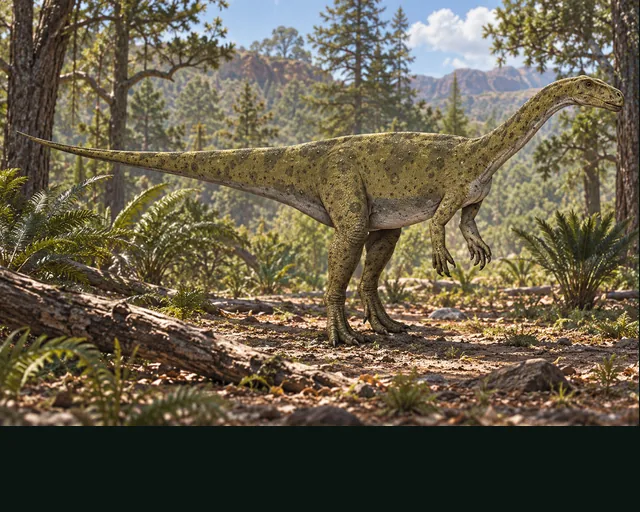
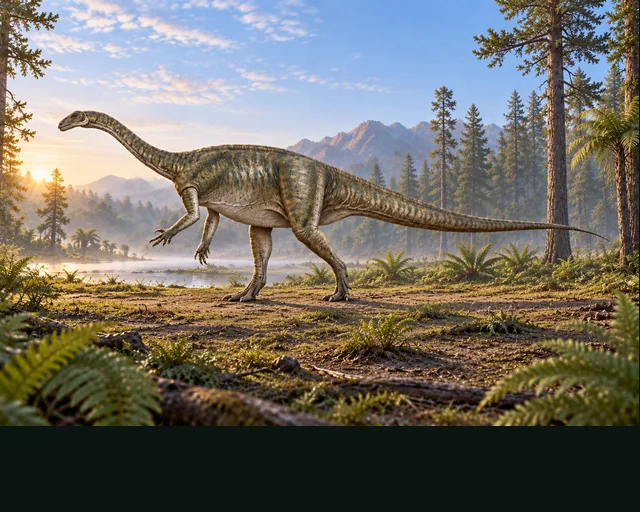
Probably both, at different ages. The 2019 study suggested that a young Mussaurus walked on all four legs. As the animal grew, its body proportions changed and the centre of mass may have shifted back toward the hips, so adults would have stood and moved on two legs.
Infants had tall skulls, short snouts and big eyes, a combination seen in the young of many animals. Adults are expected to have had longer snouts and necks, as in other early sauropodomorphs.
Did Mussaurus live in herds?
The nest-and-bone site is the main reason scientists discuss this. A 2021 account describes Mussaurus as the earliest clear evidence of complex social behaviour in dinosaurs, because eggs and animals of every age were found in one place. That would predate earlier herd records by at least 40 million years.
This is an interpretation of a fossil bed, not a directly observed behaviour. A related idea is more tentative still: the authors suggest the habit could trace back to the Triassic. Another debate concerns a possible egg-laying tissue, called medullary bone, reported in one specimen in 2013, which the researchers themselves later argued was more likely a disease-formed tissue.
When did Mussaurus live: Triassic or Jurassic?
Current accounts place Mussaurus in the Sinemurian stage of the Early Jurassic, and the rock of the Laguna Colorada Formation has been dated to about 192.8 million years ago. Some older sources, including the Natural History Museum entry, still list the Late Triassic. Sources disagree, so you may see both labels.
Mussaurus is a sauropodomorph, a relative of the later giant long-necked sauropods. Its anatomy suggests a close, possibly transitional position, which is why the 2013 adult study compared only adult bones: young animals show more primitive traits and can mislead the analysis. Close relatives and look-alikes include Plateosaurus and Anchisaurus.
Classification and fossil record
The Paleobiology Database taxonomic record catalogues Mussaurus under Sauropodiformes. This is the immediate parent in that catalogue, rather than a complete list of evolutionary relationships.
The corroborated occurrence sample includes Argentina; those are modern discovery locations, not a complete ancient geographic range.
Research starting point
The catalogue links Mussaurus to Bonaparte and Vince, 1979, published in Ameghiniana. This identifies a research starting point; the catalogue’s citation alone does not verify every later reconstruction or species assignment.
For the meaning of taxonomic terms and how evidence is checked, see the glossary and editorial policy.
Quick answers
- Is Mussaurus a dinosaur?
- Yes. Mussaurus was a plant-eating sauropodomorph dinosaur from southern Argentina, a distant relative of the giant long-necked sauropods.
- When did Mussaurus live?
- Current dating places Mussaurus in the Sinemurian stage of the Early Jurassic, with its rock about 192.8 million years old. Some older references list the Late Triassic instead.
- How big was Mussaurus?
- Infants were about 20 centimetres long, while adults are estimated at up to about 8 metres and 1.2 to 1.6 tonnes. The name refers to the babies, not the adults.
- Did Mussaurus live in herds?
- A site with over 100 eggs and about 80 individuals of all ages is the earliest clear evidence of social behaviour in dinosaurs, but it is an interpretation of fossils, not a watched behaviour.
- Where was Mussaurus found?
- Mussaurus fossils come from the Laguna Colorada Formation in Patagonia, southern Argentina.