Jurassic Dinos editorial · Updated · Source-based review
What was Jingshanosaurus?
Jingshanosaurus was an early sauropodomorph from Jurassic Yunnan in China. It belongs to the broad lineage that includes the giant sauropods, but it should not be reconstructed simply as a small version of a later long-necked giant.
What makes the fossil distinctive?
A relatively complete skeleton and skull provide information about feeding anatomy, limbs and body proportions. Having a skull associated with the body makes comparisons more secure than combining isolated bones from different animals.
Where was it found and how was it named?
The fossils were found near Jingshan, meaning Golden Hill, and the genus was formally described in 1995. Specimens had appeared in displays before the formal naming. Exhibition history and valid scientific publication are separate events, so the first public display is not necessarily the naming date.
What can we infer, and what remains uncertain?
Its relationship with Yunnanosaurus and other early sauropodomorphs has been discussed in different classifications. The older label prosauropod is useful historically but can hide a branching set of relationships. Avoid claims that Jingshanosaurus was simply the last step before sauropods or the final survivor of a neat evolutionary ladder. The skull and skeleton provide a more informative, testable comparison.
Is a displayed fossil automatically a formally named species?
No. Formal naming requires a scientific description and a designated name-bearing specimen; exhibition can happen before that process.
How can you check the evidence?
The Paleobiology Database record catalogues Jingshanosaurus under Sauropodiformes. Its linked bibliography identifies this research starting point: Y. Zhang and Z. Yang. 1995. A new complete osteology of Prosauropoda in Lufeng Basin, Yunnan, China. Yunnan Publishing House of Science and Technology, Kunming, China. Open the bibliographic record. A catalogue entry establishes the source trail; it does not independently verify every later illustration or behavioural claim.
Use the dated genus overview to follow the references behind the discovery and anatomy discussed above. When sources disagree, compare which specimen and rock layer each author studied. A reconstructed whole animal can combine original bones with comparisons to relatives; those two kinds of evidence should not be confused. The account above explains the particular limits that matter for Jingshanosaurus, rather than supplying unsupported size, speed or lifespan figures.
Read the image and keep exploring
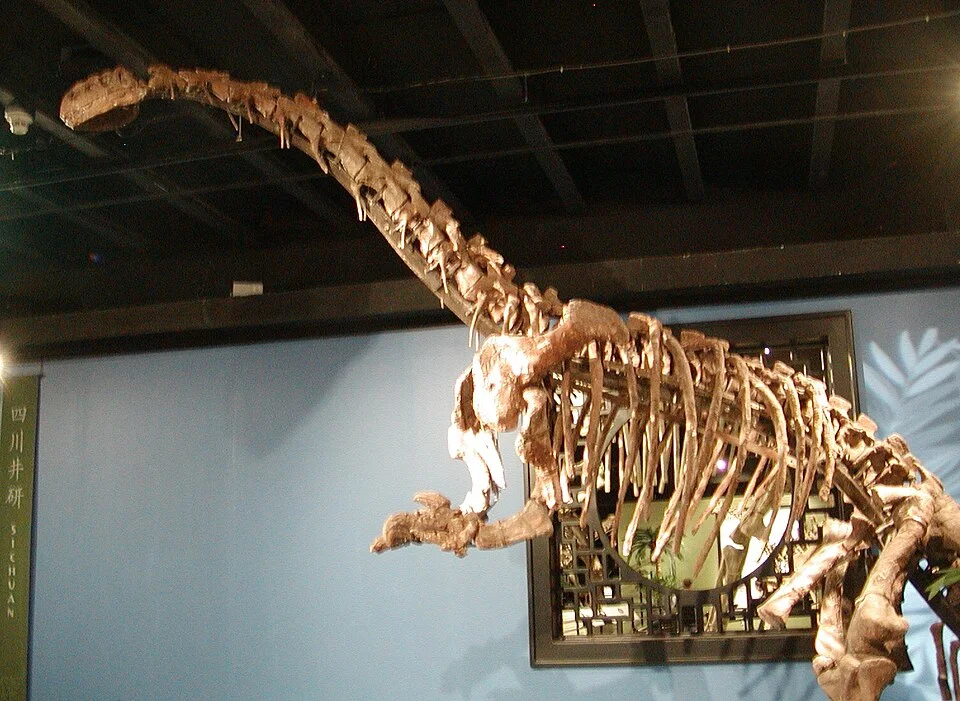
The Jingshanosaurus skeletal mount presents an early sauropodomorph, with a skull and long neck visible above the body. A displayed specimen or skeletal mount can include restored parts. Its appearance should be read alongside the original specimen description.
Compare Lufengosaurus, Massospondylus. Find more names in the J index and explore sauropodomorph field notes. The glossary explains unfamiliar fossil terms.
Quick answers
- Where have Jingshanosaurus fossils been found?
- The discoveries discussed here come from China. Modern place names describe discovery locations, not a complete ancient geographic range.
- When did Jingshanosaurus live?
- It is placed in the Jurassic period. See the discovery discussion for qualifications about the particular rock layers and dating.
- Where can I compare Jingshanosaurus with related dinosaurs?
- Follow the related field notes below. Comparisons explain shared anatomy; they do not imply that all the animals lived together.