Jurassic Dinos editorial · Updated · Source-based review
What is Goyocephale?
Goyocephale was a Late Cretaceous Mongolian pachycephalosaur known from a disarticulated partial skeleton.
Distinctive features and evidence
The skull and associated body material underpin its description. A member of the thick-headed lineage need not preserve the same adult dome shape as Pachycephalosaurus, and missing anatomy should remain visible in reconstructions.
Genus overview and research references.
Goyocephale fossil discoveries
Goyocephale entered the literature in 1982, in a description led by Altangerel Perle with Polish and Mongolian co-authors. The type species, Goyocephale lattimorei, honours Owen Lattimore. It rests on a single disarticulated skeleton from Mongolia that includes most of the skull and lower jaws, part of a forelimb and hindlimb, some of the pelvis and a few vertebrae. Only the first neck vertebra, the sacrum and the first tail vertebrae are known from the backbone, so most of the neck and trunk are missing.
The Natural History Museum lists this animal at about 2 metres long. That figure comes from one incomplete skeleton, so treat it as a rough estimate. Dating is also loose: the museum gives about 81 to 75 million years ago, while other sources use somewhat different ranges, so this page does not give a single date. New skeletons would help show how big adults grew and what the flat skull roof means.
What did Goyocephale look like?
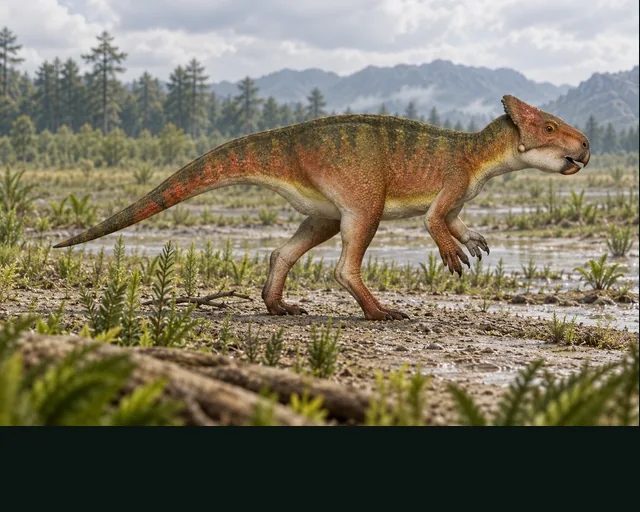
The skull roof is flat rather than domed. Along its rear edge were many small bony bumps, which are thought to have been the bases of little horns, and this is where the name “decorated head” comes from. Unlike what you might expect from a plant-eater, the front of the jaws carried large, fang-like teeth in the premaxilla, the bone at the snout tip. A gap followed, and then came ordinary triangular cheek teeth. The lower jaw had a similar pattern, with one fang-like front tooth followed by low triangular teeth.
The limb and hip bones are well preserved and have the typical pachycephalosaur design. The upper arm bone is strongly bowed, the toes carried triangular claws that were not strongly curved, and at least three toes are preserved on the foot. The Natural History Museum describes Goyocephale as a plant-eater, but the tooth pattern shows that its diet cannot be taken for granted.
Is Goyocephale a pachycephalosaur, and how is it related to Homalocephale?
Yes. Goyocephale is a primitive member of the pachycephalosaurs, the thick-headed ornithischians that include Pachycephalosaurus. It was first grouped with Homalocephale in a family called Homalocephalidae because both have flat skull roofs. The two differ in body proportions, in the shape of an opening at the back of the skull, and in the teeth.
Many later analyses find that Homalocephalidae is not a natural group. In those results, the flat-headed genera are simply successive branches near the base of the pachycephalosaur tree, leading toward Prenocephale and the domed forms. One analysis did recover Goyocephale and Homalocephale as close relatives and as the most advanced pachycephalosaurs. That arrangement would fit an origin in North America followed by movement to Asia, but it remains only one of the proposed trees.
Classification and fossil record
The Paleobiology Database taxonomic record catalogues Goyocephale under Pachycephalosauria. This is the immediate parent in that catalogue, rather than a complete list of evolutionary relationships.
The corroborated occurrence sample includes Mongolia; those are modern discovery locations, not a complete ancient geographic range.
Research starting point
The catalogue links Goyocephale to Perle and Maryanska, 1982, published in Acta Palaeontologica Polonica. This identifies a research starting point; the catalogue’s citation alone does not verify every later reconstruction or species assignment.
For the meaning of taxonomic terms and how evidence is checked, see the glossary and editorial policy.
Quick answers
- Is Goyocephale a dinosaur?
- Yes. Goyocephale was a small ornithischian dinosaur, a pachycephalosaur, known from one partial skeleton found in Mongolia.
- What does Goyocephale mean?
- The name means "decorated head", from Mongolian and Greek roots, and refers to the small bony bumps along the back edge of its skull roof.
- Did Goyocephale have a dome?
- No. Its skull roof was flat, with small bumps at the rear. The same flat-roof feature is seen in Homalocephale, and scientists still debate what it means.
- Where was Goyocephale found?
- Goyocephale fossils come from Mongolia. Only a single disarticulated skeleton, described in 1982, is known.