Jurassic Dinos editorial · Updated · Source-based review
What is Prenocephale?
Prenocephale was a small Late Cretaceous pachycephalosaur from Mongolia’s Nemegt Formation.
Distinctive features and evidence
Comparisons with Homalocephale are important because skull shape and growth stage affect classification. A concise account can explain that relationship without asserting an observed head-butting behavior.
Genus overview and research references.
Prenocephale fossil discoveries
The type specimen was found by the Polish-Mongolian Paleontological Expedition at the Nemegt locality in Mongolia, in a sandstone layer of the Nemegt Formation. It is a well-preserved skull with back vertebrae, ribs, the hip region, thigh bones and tail vertebrae. More specimens have been recovered from three other localities in the same formation: Bügiin Tsav, Guriliin Tsav and Tsaagan Khushuu.
Like many pachycephalosaurs, Prenocephale is known mostly from skulls and a few small bones, so reconstructions of its body copy the pattern seen across the group, rather than being based on a complete skeleton.
What did the head of Prenocephale look like?
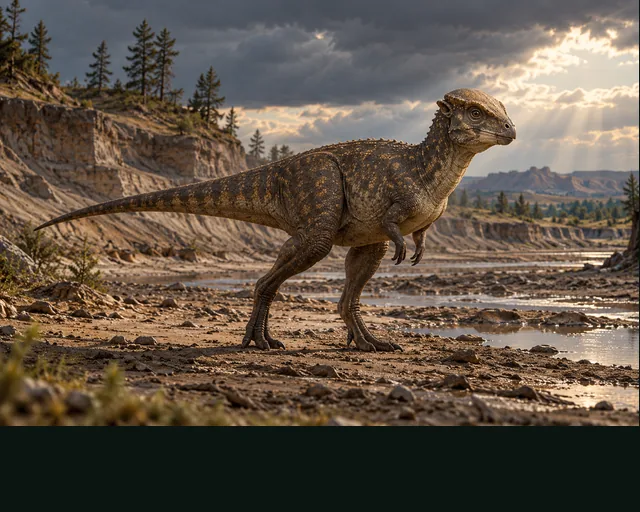
The head had a rounded, sloping dome with a row of small bony spikes and bumps. This is different from Homalocephale, which had a flat, wedge-shaped skull. The skull is close to that of Stegoceras, but the openings on the top of the skull behind the eyes, called the supratemporal fenestrae, are closed in Prenocephale, and it lacks some grooves seen in Stegoceras.
Adults were about 2.2 to 2.4 metres long, and a mass of about 40 kilograms has been given. As for the body, pachycephalosaurs in general are reconstructed as stout, with short forelimbs, a short thick neck and long hind legs, but that is an inference.
Is Homalocephale a young Prenocephale?
That idea was proposed, because Homalocephale lacks a dome and was found at the same place and in the same time interval. New Prenocephale specimens, including a juvenile, have since suggested the two are different. Even if the Homalocephale type specimen is a juvenile, it still seems to represent a separate genus. The question matters because flat-headed pachycephalosaurs may sometimes be young, dome-headed animals, as has been suggested for Pachycephalosaurus.
Did Prenocephale head-butt?
Nobody knows. For the group as a whole, the thick dome has been debated for decades. One idea is that pachycephalosaurs rammed each other head to head, and another is that they struck each other in the flank, or that the dome was used for display or species recognition. Studies of damaged domes in other pachycephalosaurids found signs of injury in about a fifth of them, which supports some kind of combat. Those results come from the family as a whole, so what Prenocephale itself did with its dome remains a hypothesis.
Where and when Prenocephale lived
Prenocephale lived in the Late Cretaceous in Mongolia, and the Natural History Museum gives a range of about 80 to 66 million years ago. The Nemegt Formation has never been dated directly, and has traditionally been assigned to the late Campanian to Maastrichtian. Its rocks show ancient rivers, lakes and floodplains, with a wetter climate than the older formations beneath it, and some forest cover. One description of Prenocephale places it in upland forests, which is not how the formation as a whole is usually pictured, so details of its habitat remain open.
Classification and fossil record
The Paleobiology Database taxonomic record catalogues Prenocephale under Eupachycephalosauria. This is the immediate parent in that catalogue, rather than a complete list of evolutionary relationships.
The corroborated occurrence sample includes Mongolia; those are modern discovery locations, not a complete ancient geographic range.
The sourced length estimate for Prenocephale is 2.2–2.4 metres. This is an estimate for the reconstructed animal, not a measurement shared by every individual. See the body-size discussion and linked evidence for context.
Research starting point
The catalogue links Prenocephale to Maryańska and Osmólska, 1974, published in Palaeontologia Polonica. This identifies a research starting point; the catalogue’s citation alone does not verify every later reconstruction or species assignment.
For the meaning of taxonomic terms and how evidence is checked, see the glossary and editorial policy.
Quick answers
- Is Prenocephale a dinosaur?
- Yes. Prenocephale was a small pachycephalosaur, a dome-headed plant-eating dinosaur, that lived in Mongolia during the Late Cretaceous.
- How big was Prenocephale?
- Adults were about 2.2 to 2.4 metres long, with an estimated mass of around 40 kilograms. The body size is estimated from limited remains.
- Where was Prenocephale found?
- In the Nemegt Formation of Mongolia, at the Nemegt locality and at Bügiin Tsav, Guriliin Tsav and Tsaagan Khushuu.
- Is Homalocephale the same as Prenocephale?
- Probably not. Homalocephale was once suggested to be a juvenile Prenocephale, but new specimens suggest that it is a separate genus.
- Did Prenocephale head-butt?
- Not known. The dome of pachycephalosaurs may have been used in combat or for display, but there is no direct evidence of how Prenocephale used its head.