Jurassic Dinos editorial · Updated · Source-based review
What is Dunkleosteus?
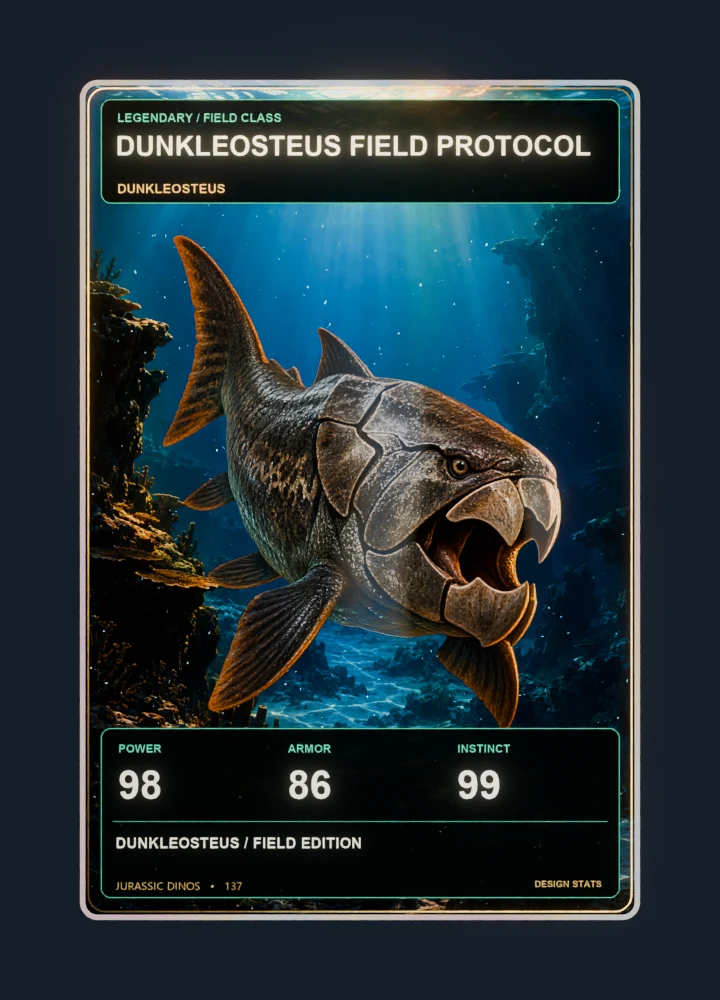
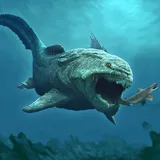
Dunkleosteus was a Late Devonian armored fish, best known for the species Dunkleosteus terrelli.
Distinctive features and evidence
Much of the familiar reconstruction depends on the preserved head and trunk armor. The largely missing rear body makes length estimates sensitive to comparisons and methods; it was a placoderm, rather than a shark or dinosaur.
Genus overview and research references.
Dunkleosteus fossil discoveries
Jay Terrell, who ran a hotel and collected fossils as a hobby, found the first specimens in 1867 in cliffs along Lake Erie in Ohio. He gave them to John Strong Newberry of the Ohio Geological Survey, who described them in 1873 under the name Dinichthys herzeri. Within a couple of years it was clear that more than one large fish was present, and Newberry named the more common one Dinichthys terrelli after the collector. A fire in 1873 destroyed most of Terrell’s original collection.
The genus name Dunkleosteus was not introduced until 1956, when Jean-Pierre Lehman honoured David Dunkle, a curator at the Cleveland Museum of Natural History. That museum holds the largest collection of the genus in the world, including the specimen CMNH 5768, a big, well-preserved D. terrelli that has been copied in casts for many other museums.
How big was Dunkleosteus?
Size is more uncertain than most books suggest. The head and front of the body were covered by bony plates that fossilised well, but the rear of the body rarely survived. Only about 5 per cent of specimens have more than a quarter of the skeleton preserved, so scientists have borrowed the hind end from smaller relatives such as Coccosteus, which leads to very different results.
Estimates for the best-known species, D. terrelli, have ranged from about 4.1 to 10 metres, but a recent detailed study of body shape suggested about 3.4 metres for typical adults and roughly 4.1 metres for very large ones. Skulls reached about 60 to 70 centimetres. Weight estimates also differ, from about 665 kilograms in one study to well over a tonne in another that assumed a deeper, wider body. Treat all of these as estimates, and the longest ones as poorly supported.
Is Dunkleosteus a dinosaur or a shark?
Neither. Dunkleosteus was a placoderm, a group of armoured jawed fishes whose name means ‘plate-skinned’. It belonged to the arthrodires, or ‘jointed-neck’ fishes, in the family Dunkleosteidae. Placoderms are a separate class from the chondrichthyans, the group that includes sharks, and from the bony fishes that make up most living species. It was also a fish from the Devonian, a time well before the first dinosaurs of the Triassic, so it is not a dinosaur or any other kind of reptile. See our not-dinosaurs page for other animals people often confuse with dinosaurs.
Its armour had both a hard outer layer and a marrow-filled inner layer, more like the bone of land animals than of most bony fishes. The famous thickness of 5 to 8 centimetres applies only to the plate at the back of the skull, and the armour over the rest of the body was usually less than 3 centimetres thick.
What did Dunkleosteus eat?
Dunkleosteus had blade-like cutting edges on its jaws, and a jointed mechanism linking the skull, the body armour and the lower jaw allowed the mouth to open quickly. Computer models published by Anderson and Westneat suggested a very fast opening and strong bite, and they proposed that it could break the armour of ammonites and fellow placoderms.
In 2025 Engelman and colleagues questioned both the suction and the bite-force claims, arguing that the models did not match the real anatomy and that the skull contained more cartilage than assumed. They think the jaw plates resemble those of fishes that pursue prey and tear it up. The fossils themselves show that it ate other fish: remains of fish bones, some partly digested, are often found with Dunkleosteus, and teeth of an early cartilaginous fish found with one specimen were probably regurgitated stomach contents. A few bones also carry damage said to come from the jaws of another Dunkleosteus.
Where and when Dunkleosteus lived
Dunkleosteus lived in the open waters of the Late Devonian, about 382 to 358 million years ago. The Paleobiology Database records the genus across a slightly broader span, from the Givetian to the Famennian stage. Fossils have been reported from Russia, Morocco, Belgium and Poland as well as Canada and the United States, with many from the Ohio Shale along Lake Erie.
About ten species have been named, but only a few are accepted by every researcher. The best-known, D. terrelli, occurs from Ohio to Tennessee and California, while D. raveri was a small species of perhaps one metre. Scientists regard the genus as a ‘wastebasket’ for large dunkleosteoid placoderms, so the name may cover several lineages. Other non-dinosaur fish in this encyclopedia include Helicoprion and, from the Jurassic, Leedsichthys.
Dunkleosteus in the game
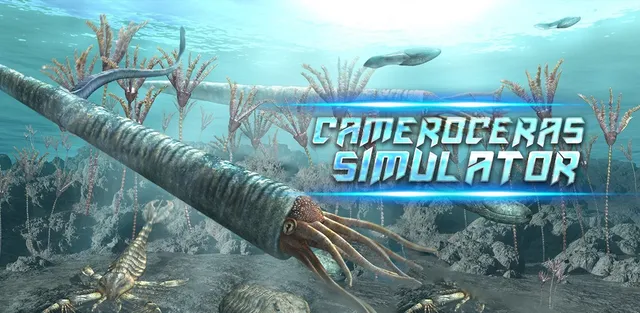
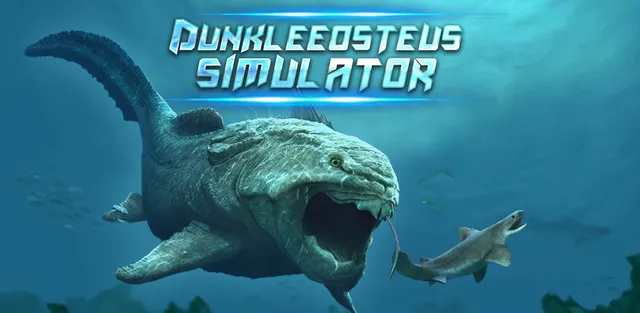
Dunkleeosteus Simulator is an Android prehistoric-fish game. Its store listing describes exploring a large world, keeping health and energy up, weather and day-night cycles, upgradeable skills and fights with other animals. The same fish also appears in the listing of Cameroceras: Ocean Dino Sim 3D, which names it among the sea creatures a player can meet.
Both are entertainment. The games’ fights, abilities and settings, which mix animals from different eras, are not scientific evidence about how Dunkleosteus lived.
Classification and fossil record
The Paleobiology Database taxonomic record catalogues Dunkleosteus under Dunkleosteidae. This is the immediate parent in that catalogue, rather than a complete list of evolutionary relationships.
The corroborated occurrence sample includes United States, Canada; those are modern discovery locations, not a complete ancient geographic range.
Research starting point
The catalogue links Dunkleosteus to Sepkoski, 2002, published in Bulletins of American Paleontology. This identifies a research starting point; the catalogue’s citation alone does not verify every later reconstruction or species assignment.
For the meaning of taxonomic terms and how evidence is checked, see the glossary and editorial policy.
Quick answers
- Is Dunkleosteus a dinosaur?
- No. Dunkleosteus was a placoderm, an armoured jawed fish that lived in the Late Devonian, long before the first dinosaurs of the Triassic.
- When did Dunkleosteus live?
- Dunkleosteus lived during the Late Devonian, about 382 to 358 million years ago, in open marine waters.
- How big was Dunkleosteus?
- Estimates for D. terrelli range from about 4 to 10 metres, but the most detailed recent study suggests roughly 3.4 metres for typical adults and about 4.1 metres for very large ones.
- Is Dunkleosteus a shark?
- No. Dunkleosteus belonged to the placoderms, a separate group of armoured fishes, and not to the chondrichthyans, the group that includes sharks.
- What did Dunkleosteus eat?
- It was a predator that ate other fish. Bone and tooth remains found with fossils support this, though scientists now debate how it bit and whether it used suction.
- Where was Dunkleosteus found?
- Fossils have been reported from North America, Poland, Belgium, Morocco and Russia, with many from the Ohio Shale near Lake Erie.