Jurassic Dinos editorial · Updated · Source-based review
What is Helicoprion?
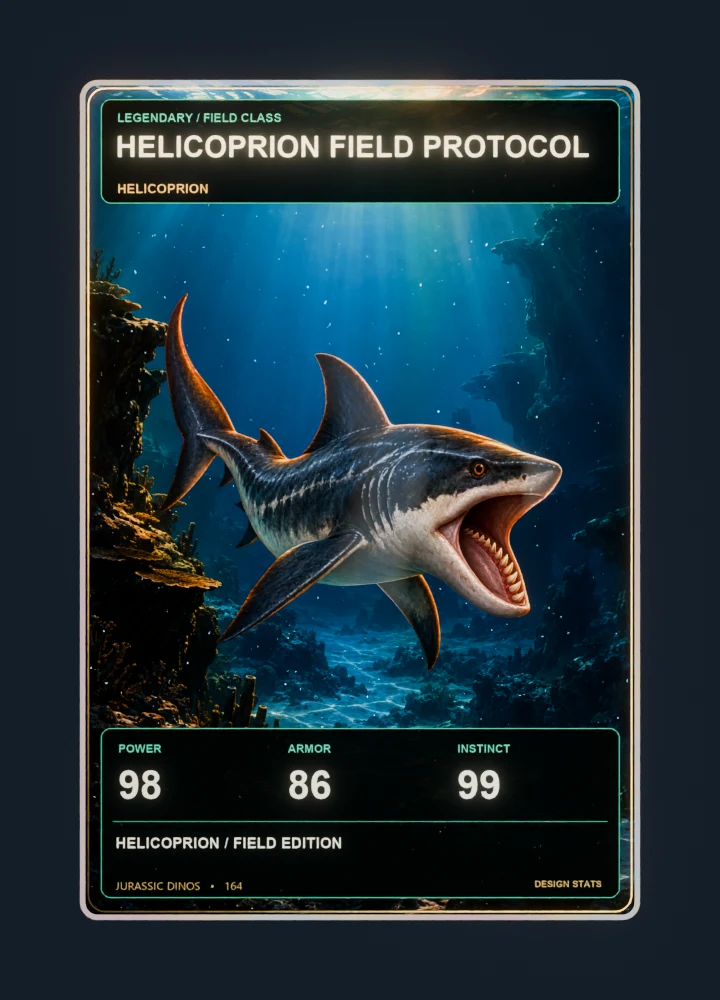
Helicoprion was a Permian cartilaginous fish famous for a spiral tooth whorl.
Distinctive features and evidence
It belongs to an extinct group related within Holocephali, the broader lineage containing living chimaeras. Calling it shark-like describes appearance, while the tooth whorl is a more direct guide to its distinctive fossil evidence.
Genus overview and research references.
Helicoprion fossil discoveries
Nearly all Helicoprion fossils are tooth whorls, spirals of dozens of fused teeth, because the cartilage skeleton rarely survives. The first known specimen was a partial whorl found in Western Australia by a gold prospector, a Mr Davis, and was described by Henry Woodward in 1886 as a species of Edestus, a related fish. Better material came from a quarry near Krasnoufimsk in Russia, sent by Alexander Bessonov to Alexander Karpinsky, who named Helicoprion in 1899. In 1940 Curt Teichert described much more complete fossils of the Australian species.
The largest concentrations come from Idaho and Russia. A key specimen from Idaho, found in a mine in 1950, preserved the jaw cartilage, and CT scans published in 2013 by Leif Tapanila and colleagues revealed the jaws in three dimensions. The best Russian specimen was stolen in 1998 and later recovered with the help of a fossil dealer.
What was the Helicoprion tooth whorl for?
For more than a century scientists argued about where the whorl belonged. Early ideas treated it as a defensive spine, a fin spine, part of a curled tail, or a structure curling out from the upper jaw. By the mid-1900s it was generally placed in the lower jaw, and the CT scans of the Idaho specimen confirmed that it sat in the lower jaw, braced by a block of cartilage.
The spiral is a growth pattern: new teeth were added to the whorl as the animal grew, instead of old ones being replaced, so the structure kept getting bigger. Modelling by Jason Ramsay and colleagues in 2015 suggested that the front teeth snagged prey, the middle ones speared it and the rear ones pushed it down the throat. The lack of tooth wear suggests it ate soft-bodied animals, since hard shells would slip out. Ramsay’s team also suggested it could pull the soft body of an ammonoid or nautiloid out of its shell.
Is Helicoprion a shark or a dinosaur?
Helicoprion is neither a dinosaur nor a true shark. It was a cartilaginous fish, and Helicoprion is placed in the extinct order Eugeneodontiformes, within the group Holocephali, which today is represented only by chimaeras, also called ratfish. Features of the jaw suspension in the Idaho skull confirmed this placement, although the link to living chimaeras is very distant. It lived in the Permian, long before the first dinosaurs of the Triassic. The body was probably streamlined and tuna-like rather than ratfish-like, which is why it is often called shark-like. See our not-dinosaurs page for other prehistoric animals that are not dinosaurs.
Most of the body is guesswork. Only the jaw region is mineralised, so scientists use smaller relatives with more complete skeletons to estimate fins and shape. Those relatives lacked pelvic and anal fins.
How big was Helicoprion?
Nobody knows exactly, because no complete body has been found. Estimates scale up from the whorl and from smaller relatives and give a wide range of about 5 to 12 metres. In 2009 Oleg Lebedev suggested that animals with a whorl 35 to 40 centimetres across might reach 5 to 8 metres, similar to a basking shark. The largest whorl known measures 56 centimetres across and would have come from an animal at least 7 metres long, and Tapanila has proposed 9.7 to 12 metres for the biggest individuals. Treat all of these as estimates.
Where and when Helicoprion lived
Helicoprion lived in the Early and Middle Permian, about 290 to 270 million years ago by a recent summary, while the Paleobiology Database lists occurrences from about 299 to 254 million years ago, which reflects that the exact stratigraphic level of some specimens is unknown. Fossils turn up in marine rocks around the world, including the United States, Russia, Australia, China, Japan, Mexico and Norway.
The Idaho fossils come from the Phosphoria Formation, which formed in a deep inland sea, and the Russian ones from rocks in the Ural Mountains. The large number of specimens in Idaho may mean that area was a nursery or hunting ground. Scientists consider Helicoprion a likely top predator of its habitat. Only three species are now accepted out of about ten that have been named, following a 2013 revision, and the genus did not vanish in a mass extinction but probably in a gradual background loss, for reasons unknown. Another animal of the same period is Dimetrodon, although that was a land-dwelling synapsid and not a fish.
Helicoprion in the game
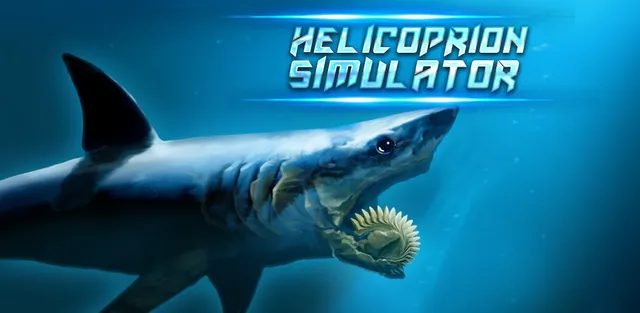
Helicoprion: Shark Dino Sim is an Android prehistoric-fish adventure built around a character with a spiral tooth whorl. Its store listing describes hunting fish and sea creatures, levelling up, quests and a day-night cycle, and it places the whorl in the lower jaw, which agrees with current research. Helicoprion also appears in the listings of games such as Ichthyosaurus: Ocean Dino Sim.
The listing calls the animal a shark, but scientists place it in a different branch of cartilaginous fishes. Whatever the game shows, such as fights with sea reptiles or spiral-tooth attacks, is entertainment, not scientific evidence about Helicoprion.
Classification and fossil record
The Paleobiology Database taxonomic record catalogues Helicoprion under Helicoprionidae. This is the immediate parent in that catalogue, rather than a complete list of evolutionary relationships.
The corroborated occurrence sample includes Australia, Russia; those are modern discovery locations, not a complete ancient geographic range.
Research starting point
The catalogue links Helicoprion to Karpinsky, 1899, published in Verhandlungen der Kaiserlichen Russischen Mineralogischen Gesellschaft zu St. Petersburg, Zweite Series. This identifies a research starting point; the catalogue’s citation alone does not verify every later reconstruction or species assignment.
For the meaning of taxonomic terms and how evidence is checked, see the glossary and editorial policy.
Quick answers
- Is Helicoprion a dinosaur?
- No. Helicoprion was a cartilaginous fish that lived in the Permian, long before the first dinosaurs, and is related to chimaeras rather than to reptiles.
- When did Helicoprion live?
- Helicoprion lived in the Early to Middle Permian, about 290 to 270 million years ago according to one recent summary.
- How big was Helicoprion?
- Estimates range from about 5 to 12 metres, scaled from tooth whorls and smaller relatives, because no complete body is known.
- Is Helicoprion a shark?
- Not a true shark. It was a shark-like cartilaginous fish in the group Holocephali, which today includes only chimaeras, and the relationship to them is distant.
- What was the Helicoprion tooth whorl for?
- The whorl sat in the lower jaw and is thought to have snagged and cut soft-bodied prey such as cephalopods, possibly pulling them from their shells.
- Where was Helicoprion found?
- Fossils come from marine rocks worldwide, with the most in Idaho in the United States and the Ural Mountains of Russia, and others from Australia, China, Japan and elsewhere.