Jurassic Dinos editorial · Updated · Source-based review
What is Dimetrodon?
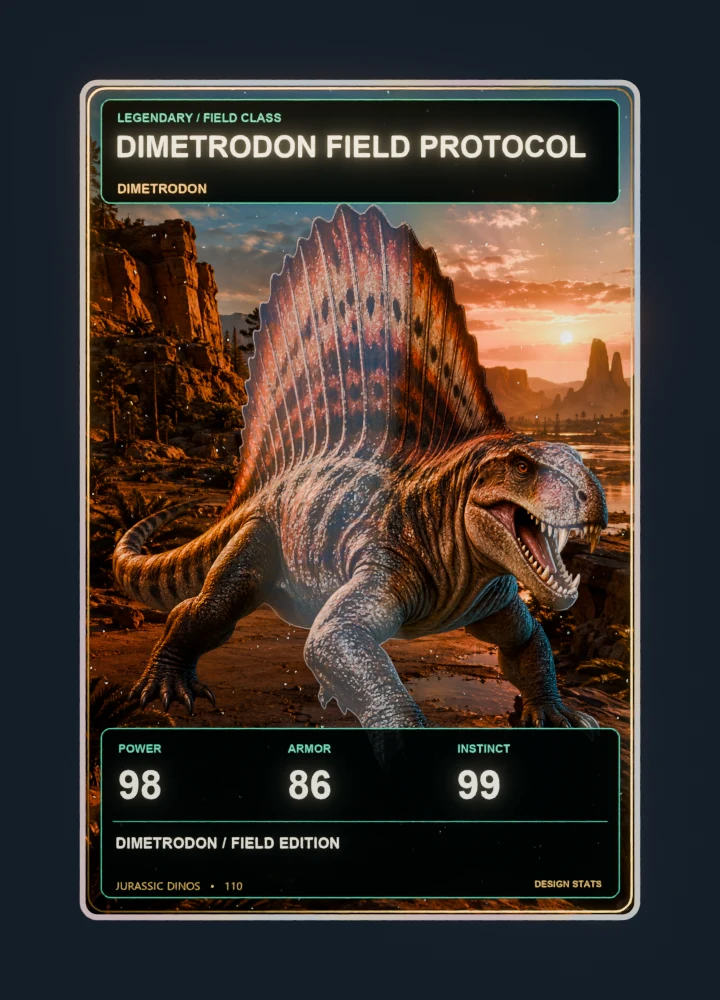
Dimetrodon was a sail-backed Permian synapsid, belonging to the lineage that also includes mammals.
Distinctive features and evidence
Its differentiated teeth and tall vertebral spines are distinctive skeletal features. It lived before dinosaurs appeared, and proposed sail functions should be treated as hypotheses rather than a single established explanation.
Genus overview and research references.
Dimetrodon fossil discoveries
Most Dimetrodon fossils come from the Red Beds of Texas and Oklahoma, where collectors sent bones to the American palaeontologist Edward Drinker Cope in the 1870s. Cope used the name Dimetrodon in 1878 for three species, although a species he had called Clepsydrops limbatus, published a year earlier, was later moved into the genus. Other early collectors included Jacob Boll, W. F. Cummins and Charles H. Sternberg.
The oldest known specimen is older than any of these. A jaw bone found on Prince Edward Island in 1845 was described in 1854 under the name Bathygnathus and was only recognised as Dimetrodon in 2015, which is why a formal ruling was needed to protect the better-known name. Later work by E. C. Case and by Alfred Romer and Llewellyn Price sorted out the many species that had been named from scrappy material. Finds in Utah, Arizona, New Mexico and Ohio followed, and in 2001 a small species from Germany showed that the animal also lived in Europe.
How big was Dimetrodon?
Size depends heavily on the species. Researchers give a range of roughly 1.7 to 4.6 metres in length for most species and about 28 to 250 kilograms in body weight. The smallest known species, D. teutonis from Germany, was only around 60 centimetres long, while D. grandis reached about 3.2 metres.
The tail made up a large share of the body length and had around 50 vertebrae, but early skeletons were missing most of it. Because only the first few tail bones were known, many scientists in the late 1800s pictured a short tail. A nearly complete tail was not described until 1927.
What was the Dimetrodon sail for?
The sail was made of tall spines growing upward from the back vertebrae, probably covered in soft tissue in life. Under the microscope, the lower part of each spine has a rough surface for muscle attachment, while the upper part is smoother and grooved, as if it had once been exposed. Some spines show healed breaks, which suggests that living tissue with a blood supply covered them.
What the sail did is still debated. Early ideas included camouflage and a sail to catch the wind. In 1940 Romer and Price proposed that it helped the animal warm itself in the morning sun, later models added cooling, and the results were mixed. More recent work questions this: small species also had large sails, and close relatives had very low crests. A 2010 study found that the sail grew faster than expected for heat control, which supported display to rivals or mates as the main driver. Scientists treat these ideas as hypotheses, and the sail may have served several purposes.
Is Dimetrodon a dinosaur?
No. Dimetrodon is a synapsid, a member of the branch of animals that includes mammals. Its skull has a single opening on each side behind the eye, the feature that defines synapsids, while dinosaurs belong to the other great branch, the sauropsids, which also includes living reptiles and birds. Dimetrodon belongs to the family Sphenacodontidae, which is close to the line of therapsids that led to mammals, but it is not an ancestor of any mammal.
It also lived in the wrong era. Dimetrodon died out in the Permian, tens of millions of years before the first dinosaurs of the Triassic. You can see how it compares with other non-dinosaurs on our not-dinosaurs page.
What did Dimetrodon eat?
The jaws carried teeth of different sizes: large pointed teeth like canines, big incisors at the front and small teeth farther back. The teeth were teardrop-shaped, and in most species had fine serrations along their edges. They looked like tiny cracks, and unlike the serrations of a dinosaur such as Albertosaurus they lacked a rounded void at the base that spreads the stress. A 2014 study suggested that serrations appeared and teeth grew sharper as the prey in the same habitats grew larger.
Dimetrodon was probably one of the top predators of its habitat, feeding on fish and four-legged animals. Likely prey in the Texas rocks includes amphibians, and the shark Xenacanthus is also listed among its food. One burrow held three young Diplocaulus that carry tooth marks matching Dimetrodon. The German species weighed too little to attack the large plant-eaters found there and probably ate small animals and insects.
Where and when Dimetrodon lived
Dimetrodon lived in the Early Permian and the start of the Middle Permian, roughly 294 to 271 million years ago by one recent summary. The Paleobiology Database lists its occurrences between the Asselian and Roadian stages, which span about 299 to 267 million years. Its fossils come from the United States, Canada and Germany, which were then parts of a single landmass called Euramerica.
Most Texas finds come from lowland wetlands and river deltas. The palaeontologist Everett Olson compared that setting with the Florida Everglades. The German site was upland and drier. Dimetrodon disappeared as the diversity of its group of early synapsids declined across the Early to Middle Permian; scientists still debate how sudden this was, and the last species, D. angelensis, survived into the Middle Permian.
Dimetrodon in the game
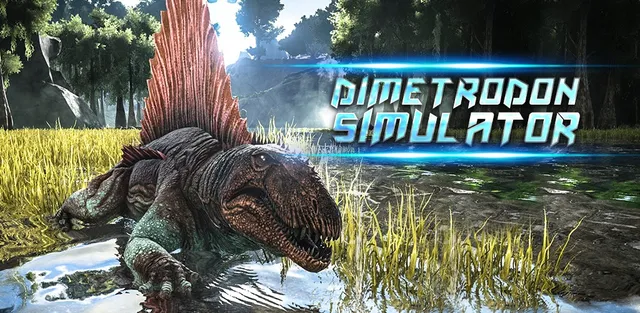
Dimetrodon Simulator is an Android game described in its store listing as a sail-backed prehistoric animal adventure with exploration, battles, weather and survival resources. Players can customise the character, level up and unlock skills, and the listing says it is set on a Jurassic island with dinosaurs such as T. rex.
That setting is entertainment. Dimetrodon lived long before any of those dinosaurs, and the game’s animations, abilities and fights are not scientific evidence about how the animal behaved.
Classification and fossil record
The Paleobiology Database taxonomic record catalogues Dimetrodon under Sphenacodontinae. This is the immediate parent in that catalogue, rather than a complete list of evolutionary relationships.
Discovery and naming history
The genus was established in 1878, with many discoveries from the Texas and Oklahoma red beds. Subsequent species and geographic finds broadened the record; they do not change its placement on the synapsid branch outside Dinosauria. Historical overview.
The corroborated occurrence sample includes United States, Germany; those are modern discovery locations, not a complete ancient geographic range.
Research starting point
The catalogue links Dimetrodon to Cope, 1878, published in Proceedings of the American Philosophical Society. This identifies a research starting point; the catalogue’s citation alone does not verify every later reconstruction or species assignment.
For the meaning of taxonomic terms and how evidence is checked, see the glossary and editorial policy.
Quick answers
- Is Dimetrodon a dinosaur?
- No. Dimetrodon was a synapsid, part of the group that includes mammals, and it died out in the Permian tens of millions of years before dinosaurs first appeared.
- When did Dimetrodon live?
- Dimetrodon lived in the Early Permian and early Middle Permian, roughly 294 to 271 million years ago according to one recent summary of the fossil record.
- How big was Dimetrodon?
- Most species were about 1.7 to 4.6 metres long and an estimated 28 to 250 kilograms, with the German species much smaller at about 60 centimetres.
- What was the sail on Dimetrodon's back for?
- Scientists are not certain. Ideas include warming and cooling the body and display to rivals or mates, and recent studies lean towards display, but the sail may have had several uses.
- Where was Dimetrodon found?
- Mostly in the Red Beds of Texas and Oklahoma, with other finds in the western United States, Ohio, Prince Edward Island in Canada and Germany.