Jurassic Dinos editorial · Updated · Source-based review
What is Leedsichthys?
Leedsichthys was a large Jurassic pachycormid fish known from marine deposits on several continents.
Distinctive features and evidence
Its name honors collector Alfred Nicholson Leeds. Incomplete remains and species revisions complicate size comparisons; it belongs among ray-finned fishes rather than marine reptiles, despite appearing alongside them in prehistoric games.
Genus overview and research references.
Is Leedsichthys a dinosaur?
No. Leedsichthys was a fish, a member of the ray-finned fishes (the bony fishes) and of the extinct family Pachycormidae. It breathed with gills and swam in the sea, and it has nothing to do with the dinosaur or marine-reptile groups. It is sometimes grouped with prehistoric sea monsters because it lived in the Jurassic, alongside marine reptiles such as pliosaurs and Plesiosaurus relatives, but those animals are reptiles and it is not.
The confusion has a history. Several times in the 19th and 20th centuries, big pieces of Leedsichthys were mistaken for armour from a stegosaurian dinosaur. For example, in 1887 plate-like fragments from Peterborough, England, were reported as back plates of a stegosaur called Omosaurus, and the error was corrected by the American palaeontologist Othniel Marsh in 1888. A similar mix-up happened again with finds in Germany. You can read more about animals that are often taken for dinosaurs on our not-dinosaurs page.
Leedsichthys fossil discoveries
The first big collection came from clay pits near Peterborough, where the farmer and collector Alfred Nicholson Leeds dug up huge fish fossils in the 1880s. Arthur Smith Woodward described them in 1889 and called the species Leedsichthys problematicus, the second word a reference to how difficult the broken bones were to interpret. The type specimen, from the Oxford Clay Formation, is a collection of more than a thousand separate elements, mostly pieces of fin rays, from one animal about 165 million years old.
In 2001 students found another large specimen at the Star Pit near Peterborough, and it was excavated between 2002 and 2004 by a team led by Jeff Liston. It was nicknamed Ariston. Remains of more than seventy individuals are now known, mostly fragmentary, from England, France, Germany, Chile and Argentina. A second species named in 1999 from Chile, Leedsichthys notocetes, was later judged to be indistinguishable from the type species, partly because its supposed distinguishing marks were caused by erosion.
How big was Leedsichthys?
Leedsichthys is the largest known ray-finned fish, but its exact length has been revised repeatedly. The skeleton was only partly bone: the vertebrae and the front of the skull stayed as cartilage and were not fossilised, so there is no backbone to measure. Woodward estimated about 9 metres in 1889. Later scaling from the gill basket pushed popular figures to 30 metres or more.
Jeff Liston’s detailed studies brought the number down. The Ariston specimen has pectoral fins only about a metre apart, which shows a narrow body, and linear scaling from the gills was criticised because gills grow disproportionately. In a 2013 study, Liston and colleagues estimated the largest specimen at about 16.5 metres long, and a 2018 estimate by Ferron and colleagues put its mass at about 45 tonnes. These are single published estimates and the figures could change again with new finds. Growth rings suggest individuals needed 21 to 25 years to reach such lengths and lived for several decades.
What did Leedsichthys eat?
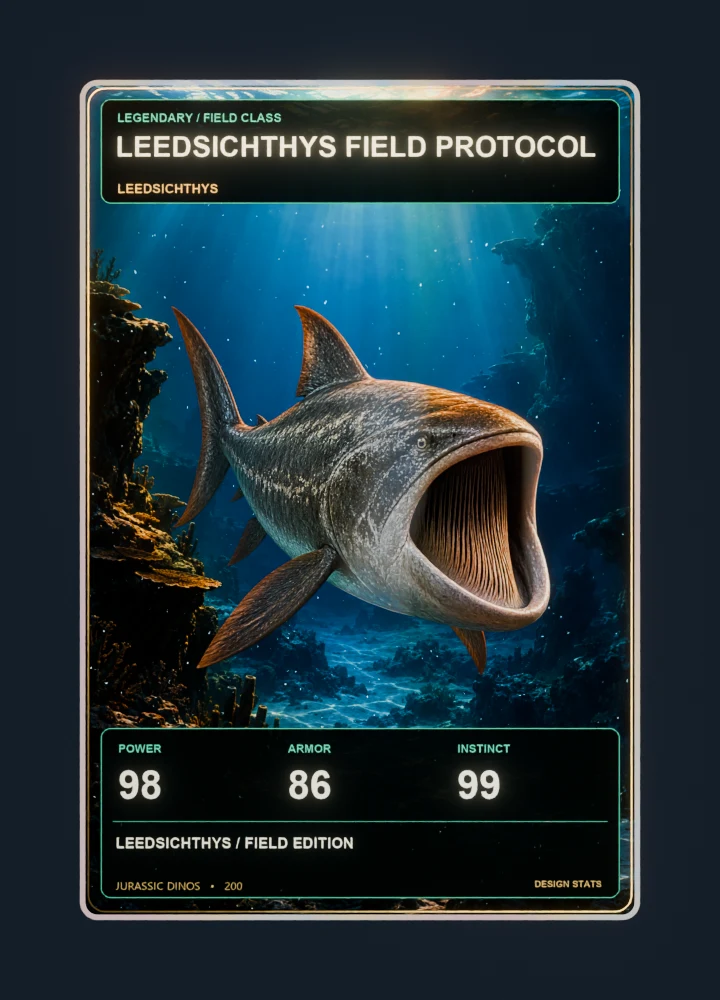
Leedsichthys was a filter feeder. Its jaws had no teeth. Instead, the gill arches carried rows of long, comb-like gill rakers, 3 to 12 centimetres long, which strained plankton from the water as it flowed through the mouth and over the gills. Careful study of well-preserved French specimens showed that the rakers were fringed with tiny bony plates, a structure not previously known in any fish, living or extinct. Zooplankton, the drifting small animals, seem to have been the main food. Whether it also took algae is unclear.
The way it fed is a matter of discussion: it may have simply swum with its mouth open, or pumped water through its gills. Jeff Liston suggested in 2010 that some furrows in ancient sea-floor mud in Switzerland, once credited to plesiosaurs, could instead have been made by Leedsichthys spouting water to disturb food in the sediment. This remains a hypothesis. Plankton-feeding giants evolved repeatedly: relatives such as Bonnerichthys and Rhinconichthys carried the same lifestyle into the Cretaceous.
Was Leedsichthys hunted?
There is evidence of an attack, although little else is known. A 2022 study of a Leedsichthys tail fin described bony calluses on the fin rays showing that the bone had healed after damage, which the authors read as a survived attack by a large marine reptile. The same seas contained big predators such as the pliosaur Liopleurodon, although the study does not name the attacker.
An earlier claim that a marine crocodile relative, Metriorhynchus, had bitten a living Leedsichthys was reassessed in 2007, when the bone was judged unhealed, which fits scavenging better. This shows how easily one broken bone can be misinterpreted.
Where and when Leedsichthys lived
Leedsichthys swam in Jurassic seas from the Callovian stage of the Middle Jurassic, around 165 million years ago, into the Late Jurassic. Fossils come from the Callovian of England and northern Germany, the Callovian and later Kimmeridgian of France, and the Oxfordian of Chile, with a single gill raker from Argentina dated slightly later, to the early Tithonian. Together, these records cover at least five million years and both the northern and southern hemispheres.
Where Leedsichthys fits among fishes is still discussed. Pachycormids are often seen as very early relatives of the teleosts, the group that includes most living bony fishes, and a 2022 study calls Leedsichthys a stem-group teleost. In another view they lie outside that group. One cladistic analysis found Asthenocormus to be its closest relative within the family.
Leedsichthys in the game
Leedsichthys Simulator is an Android game where you play the giant fish. The store listing describes hunting sea creatures to keep up health and energy, exploring an underwater world, levelling up with action skills, and battling marine rivals including Spinosaurus, Plesiosaurus and Mosasaurus.
The hunting and attacking are game inventions. The real Leedsichthys was a toothless plankton-eater, and the listed opponents lived at different times from it, so the game should be read as fiction and not as a picture of Jurassic life.
Classification and fossil record
The Paleobiology Database taxonomic record catalogues Leedsichthys under Asthenocorminae. This is the immediate parent in that catalogue, rather than a complete list of evolutionary relationships.
The corroborated occurrence sample includes France; those are modern discovery locations, not a complete ancient geographic range.
Research starting point
The catalogue links Leedsichthys to Sepkoski, 2002, published in Bulletins of American Paleontology. This identifies a research starting point; the catalogue’s citation alone does not verify every later reconstruction or species assignment.
For the meaning of taxonomic terms and how evidence is checked, see the glossary and editorial policy.
Quick answers
- Is Leedsichthys a dinosaur?
- No. Leedsichthys was a giant ray-finned fish of the family Pachycormidae. Fish are not dinosaurs, and it was not a marine reptile either.
- When did Leedsichthys live?
- It lived in the Middle to Late Jurassic. The type specimen from the Oxford Clay is about 165 million years old, and the genus is recorded across at least five million years.
- How big was Leedsichthys?
- Estimates have shrunk from over 30 metres to about 16.5 metres for the largest known specimen. No backbone was preserved, so every figure is an estimate.
- What did Leedsichthys eat?
- It filtered plankton, mainly small animals, from the water with comb-like gill rakers. It had no teeth, so it was not a hunter of large prey.
- Where was Leedsichthys found?
- Fossils come from England, France, Germany, Chile and Argentina. The first big finds were in clay pits near Peterborough in England in the 1880s.