Jurassic Dinos editorial · Updated · Source-based review
What is Plesiosaurus?
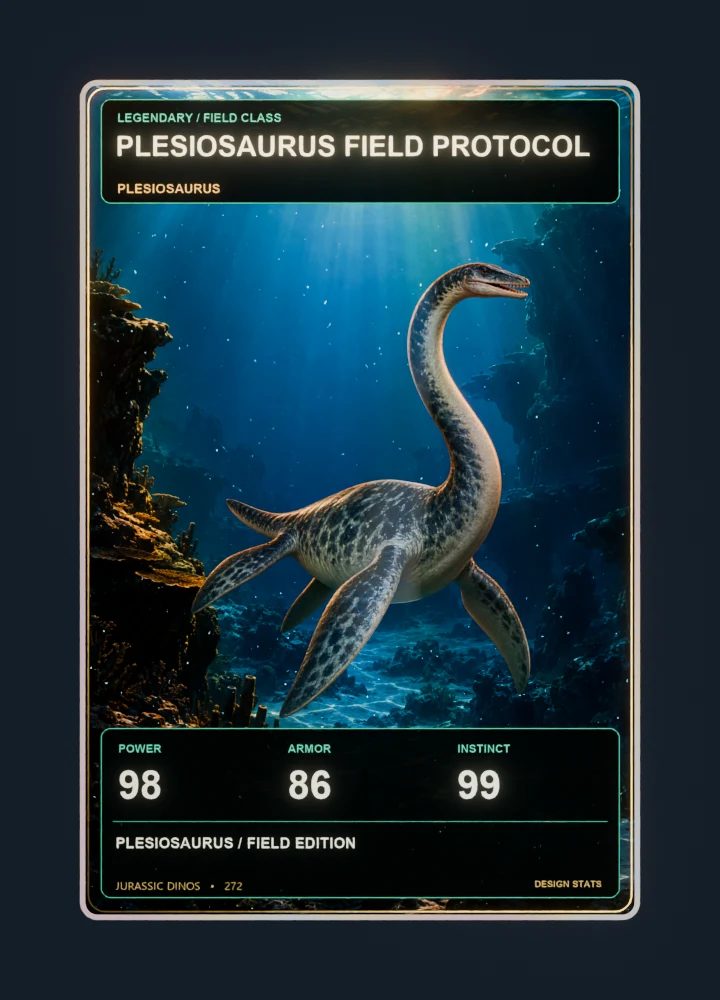
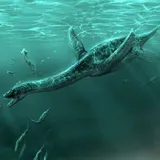
Plesiosaurus was an Early Jurassic marine reptile with a small head, long neck and four large paddles.
Distinctive features and evidence
Relatively complete English Lias skeletons support its anatomy. The genus is narrower than the entire plesiosaur group, and former species reassigned to other genera should not all remain in its fossil range.
Genus overview and research references.
Is Plesiosaurus a dinosaur?
No. Plesiosaurus was a marine reptile, a member of the plesiosaurs (the order Plesiosauria), which belong to a larger reptile group called Sauropterygia. Scientists place plesiosaurs, ichthyosaurs and mosasaurs outside the dinosaur group, even though all of them lived in the Mesozoic. Dinosaurs lived on land, while plesiosaurs were an entirely separate branch of reptiles that had returned to the sea and turned their arms and legs into flippers.
People often say “plesiosaur” when they mean any prehistoric sea monster, so the word is worth using carefully. Our not-dinosaurs guide explains how marine reptiles, pterosaurs and early mammal relatives differ from true dinosaurs.
Plesiosaurus fossil discoveries
Plesiosaurus was among the first extinct reptiles to be recognised as something new. In 1821 William Conybeare and Henry De la Beche described the genus from partial remains collected in southern England, including a skeleton from the collection of Colonel Thomas James Birch. They coined the name to signal that the animal seemed closer to an ordinary reptile than the ichthyosaurs found a few years earlier.
The best early specimen came in December 1823, when the fossil collector Mary Anning found a nearly complete skeleton near Lyme Regis in Dorset. Conybeare described it in 1824 and gave it the species name dolichodeirus, meaning “long neck”. That find, rather than the 1821 fragments, serves as the type specimen. The 1824 paper was read at the same Geological Society meeting at which Megalosaurus became the first dinosaur to be named. Professor William Buckland, looking at the skeleton, compared it to a sea serpent threaded through a turtle.
Quarrying in the Lias rocks around Lyme Regis kept turning up more skeletons until the early twentieth century, which is why Plesiosaurus is known from fairly complete material.
How big was Plesiosaurus?
Plesiosaurus was a medium-sized plesiosaur. Published figures for the genus put the length of adults at roughly 2.9 to 3.5 metres, about the length of a small car. The head was small compared with other plesiosaurs and the body was broad and turtle-like, with a short tail.
The neck was long and slender. Individual specimens preserve about 38 to 42 neck vertebrae, so the neck had a large number of short joints rather than a few very long bones. Four paddles did the swimming. The front pair was long and narrow, and in adults the back pair was clearly smaller than the front pair. Studies of plesiosaurs in general suggest that the tall spines on their vertebrae limited how far the neck could bend, so the swan-like pose seen in older drawings is probably exaggerated.
What did Plesiosaurus eat and how did it live?
The teeth are simple, slightly curved cones with fine ridges, and they point forward, especially near the tip of the jaws. Together with the pointed, scoop-shaped lower jaw, they look suited to snapping up small, slippery animals. Researchers think Plesiosaurus ate belemnites (squid-like shelled animals), fish and similar prey, although no stomach contents are reported for the genus in the sources we used.
Most reconstructions have it swimming with its paddles, since the tail was too short to push it along effectively. Plesiosaurs as a group breathed air and gave birth to live young rather than laying eggs, and Plesiosaurus is also reported to have done the same. One suggestion is that a long neck made it hard to accelerate smoothly, so it may have waited for prey to come close instead of chasing it. That is a proposal about how the body worked, not a documented behaviour.
Where and when Plesiosaurus lived
Securely identified Plesiosaurus fossils come only from the Lyme Regis area of Dorset, in rocks of the Lias Group. Most are from the upper Blue Lias, the “Shales with Beef” and the lower Black Ven Marls, which date to the early part of the Sinemurian stage of the Early Jurassic. A few specimens come from later in the Sinemurian, and one skull of uncertain age may be older still, from around the boundary of the Triassic and Jurassic.
Plesiosaurus appears to be the most common plesiosaur in the English Lias. The ichthyosaurs, including Ichthyosaurus, had been found in the same rock layers a few years before Plesiosaurus was named. Much later marine reptiles such as Mosasaurus belong to yet another group and lived in the Late Cretaceous, long after the plesiosaur lineage first appeared.
Why Plesiosaurus is a “wastebasket” name
For much of the nineteenth and twentieth centuries Plesiosaurus served as a catch-all label. Naturalists named hundreds of species from many countries and from much of the Mesozoic, often from single bones, and put them in the genus. Careful review has shown that the later Jurassic and Cretaceous species do not belong in it, and that only one English species, P. dolichodeirus, is correctly assigned.
Some other Early Jurassic species were moved into separate genera, for example Hydrorion and Seeleyosaurus. The genus is therefore much narrower than the popular idea of a “plesiosaur”. Famous long-necked animals such as Elasmosaurus, with its 70-plus neck vertebrae, belong to later and separate lineages inside the wider plesiosaur group.
Plesiosaurus in the game
Plesiosaurus Simulator is an Android game in which you play as a Plesiosaurus on a Jurassic island. According to its store listing it features survival needs such as health, energy and water, an open world with a day-night cycle and weather, quests, skills and upgrades, and fights against other animals. Plesiosaurus also appears as a creature to meet in ocean games from the same studio, such as Leedsichthys Simulator and Ichthyosaurus: Ocean Dino Sim.
Treat the abilities, fights and other animals in these games as entertainment. They are not evidence of how Plesiosaurus behaved, and the listing for the Plesiosaurus game even places it alongside animals from other periods.
Classification and fossil record
The Paleobiology Database taxonomic record catalogues Plesiosaurus under Plesiosauroidea. This is the immediate parent in that catalogue, rather than a complete list of evolutionary relationships.
Research starting point
The catalogue links Plesiosaurus to de la Beche and Conybeare, 1821, published in Transactions of the Geological Society of London, series 1. This identifies a research starting point; the catalogue’s citation alone does not verify every later reconstruction or species assignment.
For the meaning of taxonomic terms and how evidence is checked, see the glossary and editorial policy.
Quick answers
- Is Plesiosaurus a dinosaur?
- No. Plesiosaurus was a marine reptile, a plesiosaur in the group Sauropterygia, and is not part of the dinosaur group.
- When did Plesiosaurus live?
- Plesiosaurus lived in the Early Jurassic. Its best-known fossils come from early Sinemurian rocks of the Lias Group in southern England.
- How big was Plesiosaurus?
- Published figures put adults at roughly 2.9 to 3.5 metres long, with a small head, a neck of about 40 vertebrae, a broad body and four paddles.
- What did Plesiosaurus eat?
- Researchers think it ate belemnites, fish and other small prey, based on its needle-like teeth and scoop-shaped lower jaw, but no stomach contents are known for it.
- Where was Plesiosaurus found?
- Securely identified Plesiosaurus fossils come from the Lyme Regis area of Dorset, England, where Mary Anning found the first complete skeleton in 1823.