Jurassic Dinos editorial · Updated · Source-based review
What was Staurikosaurus?
Staurikosaurus pricei was an early dinosaur from the Late Triassic of southern Brazil. Its name refers to the Southern Cross constellation, and the genus was named by Edwin Colbert in 1970. The fossils come from the Santa Maria Formation, an important setting for investigating the early diversification of dinosaurs.
Why study an old discovery again?
A 2009 redescription revisited the name-bearing specimen after additional preparation exposed new details. Preparation is the careful work of revealing fossil material within the surrounding rock. A specimen discovered decades earlier can therefore still provide information that was not available in its first description.
The researchers found that some previously reported characters were absent or could not be confirmed because of preservation. This is part of scientific testing, rather than simply a disagreement over labels. An observation needs to be distinguishable from a damaged surface, a missing region or a feature inferred by comparison with a different dinosaur.
Where does it belong in the family tree?
The study supported a close relationship between Staurikosaurus and Herrerasaurus, grouping them as herrerasaurids. It also discussed features supporting saurischian and theropod affinities, while stressing the difficulty of evaluating many characters in an incomplete specimen. Saurischian refers to a broad dinosaur branch, not a claim that this individual was the ancestor of every later predator.
Early dinosaur relationships are particularly sensitive to which features can actually be assessed. More complete relatives can help researchers frame comparisons, but their anatomy should not silently become new observations in the incomplete animal. A proposed relationship and a directly preserved feature have different evidential roles.
What does the image add?
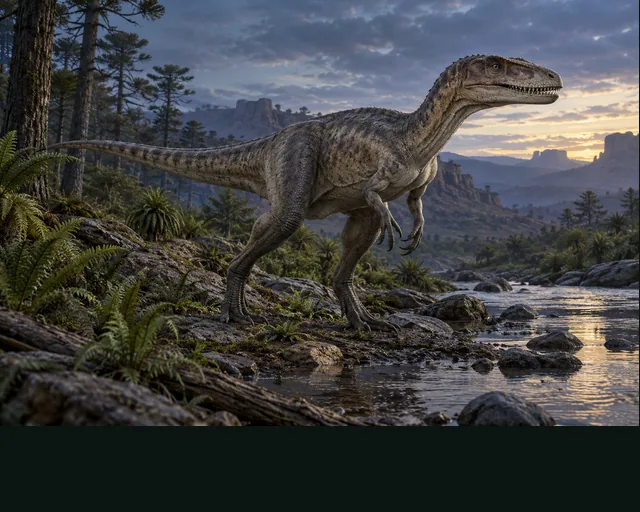
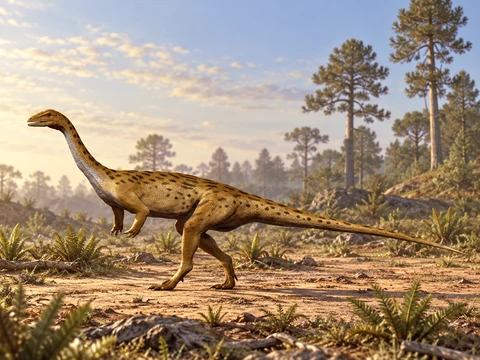
The illustration makes the animal easier to imagine, following a complete living Staurikosaurus artwork by Nobu Tamura. That source explicitly treats the missing body reconstruction as highly hypothetical. Its low head, grasping forelimbs, long hindlegs and tapering tail therefore provide an artistic interpretation rather than a complete preserved exterior.
Exact hand and foot details, colours and the modest neck accent are not established by the picture. The original human scale silhouette was omitted and was not used to derive a precise size. Compare Herrerasaurus and Saturnalia for other early South American dinosaurs, then explore the S directory to follow more discoveries and their sources.
Quick answers
- Where did Staurikosaurus live?
- Southern Brazil during the Late Triassic.
- What does its name refer to?
- The Southern Cross constellation.
- Which dinosaur was closely related in the reviewed analysis?
- Herrerasaurus from Argentina.
- Are the hands and colours in the picture certainly known?
- No. The complete reference explicitly treats missing anatomy as hypothetical.