Jurassic Dinos editorial · Updated · Source-based review
What was Saturnalia?
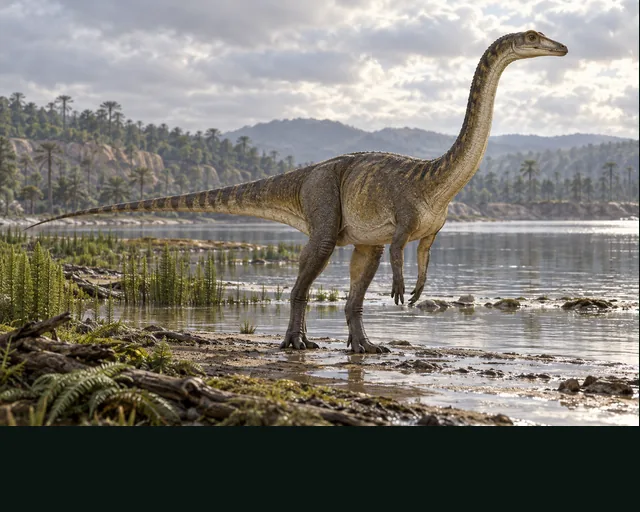
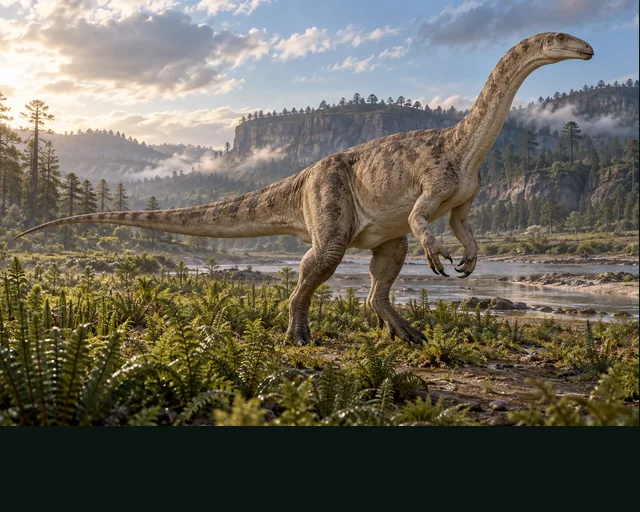
Saturnalia tupiniquim was an early sauropodomorph from Late Triassic southern Brazil. Its fossils came from the Santa Maria Formation, in rocks assigned to the Carnian stage. It belonged to the lineage that later produced giant sauropods, but its lightly built restored body was very different from those enormous four-legged animals.
How can CT scans help study a fossil skull?
A 2017 study used computed tomography, or CT, to investigate the braincase of one specimen. CT methods allow researchers to examine internal structures without simply breaking a fossil open. The resulting information can be used to model spaces enclosed by the preserved bones.
An endocast is a representation of an internal cavity. A braincase endocast provides clues about the space associated with the brain and related structures. It is not the original brain tissue, and the amount of detail available depends on which bones and regions actually survived.
Was the entire brain cavity reconstructed?
No. The study’s endocast represents the posterior part of the cavity. The preserved material did not supply the same information for the forebrain and midbrain. The researchers also left some uncertain structures unreconstructed instead of treating ambiguous openings as complete evidence.
That makes the limitations part of the result, not an inconvenience to hide. A partial reconstruction can answer useful comparative questions without providing an intelligence score, a full sensory map or a photograph of the animal’s thoughts. The surrounding bones and the missing soft organ are different kinds of evidence.
What did it suggest about sauropodomorph evolution?
The authors compared a region associated with controlling movements of the eyes, head and neck across early sauropodomorphs and later sauropods. Their interpretation placed an initial reduction in that region before a fully quadrupedal stance developed. They also discussed a possible connection with changes toward more restricted herbivory.
Those are evolutionary hypotheses, not an exact menu for the discovered individual. Our illustration follows an approved complete living Saturnalia artwork rather than the CT model or bone images. Colour, skin and restored proportions remain artistic; the reference’s human silhouette is not used as measurement evidence. Compare Plateosaurus and Massospondylus, then browse the S directory.
Quick answers
- Where did Saturnalia live?
- Southern Brazil during the Late Triassic.
- What is an endocast?
- A reconstruction of an internal cavity, such as the space inside a braincase.
- Was the entire brain preserved?
- No. The studied evidence represents part of the brain cavity.
- Did the analysis prove an exact diet?
- No. It proposed evolutionary links rather than a preserved menu.