Jurassic Dinos editorial · Updated · Source-based review
What was Spinophorosaurus?
Spinophorosaurus nigerensis was a sauropod from Middle Jurassic Niger. Its original 2009 description documented two individuals and provided valuable evidence for early sauropod anatomy. Even the more complete specimen had missing regions, so the phrase nearly complete should not be read as every bone of one whole animal being present.
Does its name prove it had tail spikes?
No. The name reflected an original interpretation of certain bones as spike-bearing osteoderms. Osteoderms are bony structures formed in the skin. A later conference report reexamined those structures and interpreted them instead as clavicles, bones of the shoulder region.
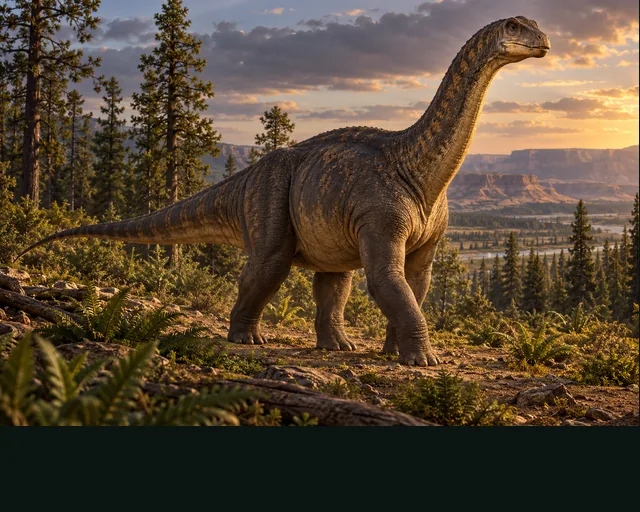
This is a useful reminder that a scientific name can preserve the history of an idea after the interpretation changes. Naming and anatomical testing are separate processes. The revised proposal should also be described honestly as a published conference report, rather than being inflated into a different kind of study. Our selected complete living reference has a smooth tapering tail, and no spikes were added merely to match the name.
Could it feed high in trees?
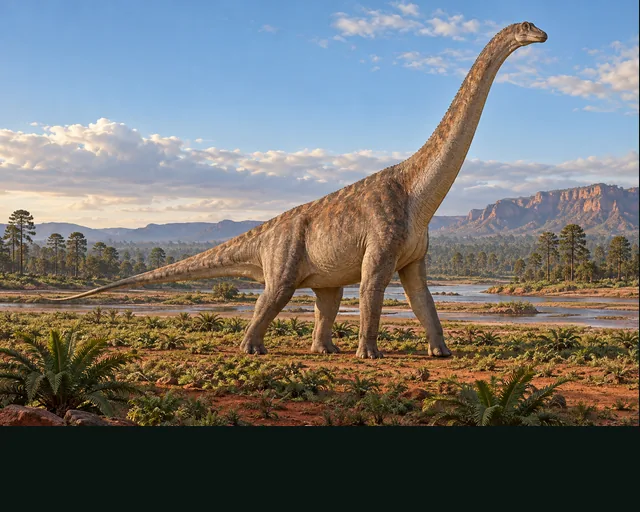
A 2020 digital reconstruction supported a relatively elevated neck and tall shoulders, and interpreted its anatomy as suitable for high browsing. Browsing means feeding on vegetation such as leaves and shoots. This gives researchers a way to investigate which parts of a plant canopy an animal might have reached.
A model of possible reach is not a filmed feeding event. Results depend on the reconstructed joints, missing soft tissues and assumptions about posture. It would therefore be misleading to describe a precise favourite feeding height or an unchanging neck position from the picture alone.
How was the illustration selected?
The approved IJReid artwork shows a complete large animal together with a smaller juvenile. Only the large complete individual was used as a reference here. The juvenile is partly hidden, so it could not independently satisfy the requirement for an unobstructed whole-animal reference.
Our generated image retains the adult reference’s small blunt head, rising long neck, tall shoulders, substantial body, four legs and tapering tail. Fine skin, colours and scene remain artistic decisions. It does not combine different individuals’ measurements into a claimed exact adult size. Compare Camarasaurus and Giraffatitan, then explore the S directory for other sauropods.
Quick answers
- Where did Spinophorosaurus live?
- The region now called Niger during the Middle Jurassic.
- Does its name prove that it had tail spikes?
- No. The proposed spike bones were later reinterpreted as clavicles.
- Was high browsing actually filmed?
- No. It is a functional interpretation based on reconstructed anatomy.
- Why is only one animal shown?
- Only the complete adult in the approved reference was used; its partly hidden juvenile was excluded.