Jurassic Dinos editorial · Updated · Source-based review
What was Spiclypeus?
Spiclypeus shipporum was a chasmosaurine ceratopsid, a member of the horned dinosaur group, from Late Cretaceous Montana. Its fossils came from the lower Coal Ridge Member of the Judith River Formation. The describing study placed that setting in the Campanian stage and introduced the genus in 2016.
What made its head distinctive?
The study highlighted brow horncores that project sideways, along with an unusual combination of frill ornaments. Some of the inner ornaments curled forward from the back edge of the frill. Horncore refers to the bony support of a horn; a restored living horn also requires interpretation of its external covering.
Those details are more useful for identification than simply saying that the animal had a big frill. A brow horn and an ornament around the edge of the frill occupy different anatomical positions. Keeping those structures distinct helps avoid turning every spiky horned dinosaur into a version of Triceratops with extra points added at random.
Can a fossil reveal disease?
The paper described marked changes in the humerus, the upper-arm bone. Remodeling, irregular surfaces and an abscess cavity were interpreted as evidence of chronic infection. Chronic means long-lasting, rather than a brief injury that healed immediately.
The researchers discussed possible explanations, but the exact infectious organism was speculative. This does not justify a certain diagnosis of one named disease or a detailed story about a fight that caused it. A bone can preserve a biological response without recording the complete chain of events leading to that response.
Does the image show everything that was found?
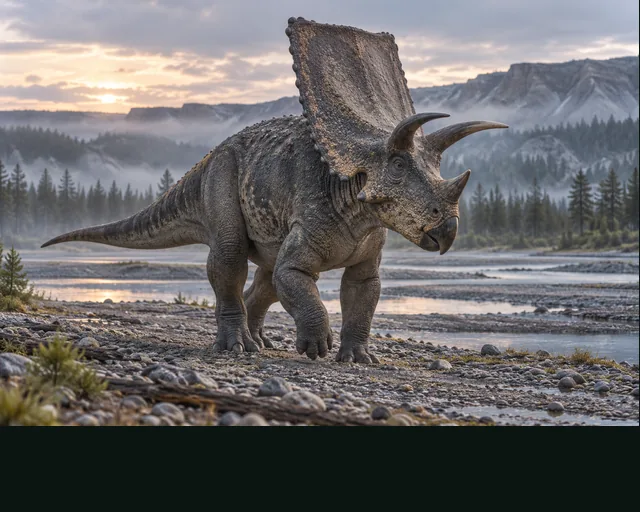
No. Our illustration follows a complete living Spiclypeus restoration by Nobu Tamura, which presents a whole animal rather than a map of preserved material. It retains the beaked head, sideways brow horns, ornate frill, robust four-legged body and tapering tail. All tips and feet remain within the frame.
The source artwork’s bristly covering and colourful frill markings are artistic possibilities, not newly established fossil feathers or measured pigments. The same limitation applies to fine skin and missing soft tissues. Compare Chasmosaurus and Triceratops for separate ceratopsid accounts, then explore the S directory to discover more horned dinosaur names.
Quick answers
- Where did Spiclypeus live?
- The region now called Montana during the Late Cretaceous.
- What was unusual about its horns?
- Its brow horncores projected sideways, and some frill ornaments curled forward.
- Did its fossil show signs of disease?
- The study interpreted unusual upper-arm bone changes as chronic infection.
- Are the illustration’s bristles fossil evidence?
- No. They are speculative details in the approved complete restoration.