Jurassic Dinos editorial · Updated · Source-based review
What was Sonorasaurus?
Sonorasaurus thompsoni was a sauropod from the Turney Ranch Formation of Arizona. Its identity, relationships and geological setting were reassessed in a detailed study that combined direct fossil examination, bone histology and work around the quarry. The authors supported it as a distinct dinosaur with brachiosaurid relationships.
What kind of landscape did it inhabit?
The study challenged an earlier coastal or estuarine interpretation. Sedimentary and plant evidence instead supported a relatively dry inland evergreen woodland on low-relief terrain, with strongly variable rainfall. Evergreen describes plants that retain foliage rather than shedding all of it in one annual season; it does not mean that the landscape was always wet.
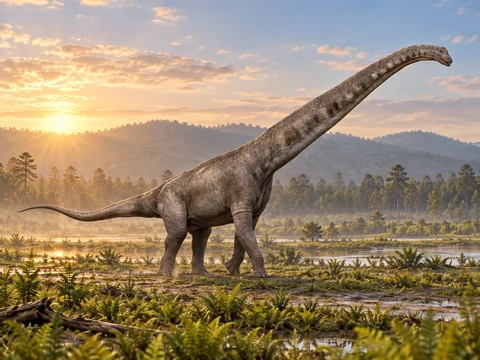
Environmental reconstructions bring several observations together. Sediments record how material accumulated, and plant fossils add information about vegetation. Neither provides a photograph of the entire ancient landscape. Our dry woodland clearing is an independent illustration compatible with that broad interpretation, not a reconstruction of every tree around the fossil individual.
Can its bones reveal how it grew?
Bone histology investigates microscopic bone structure. The reassessment interpreted the known specimen as approaching adult size and having grown relatively slowly and unevenly compared with other sauropods. That finding concerns evidence from the studied individual rather than a measured growth diary for every Sonorasaurus.
A growth estimate is also different from an exact body-length record. To reconstruct a living animal’s full dimensions, researchers must consider missing parts and body proportions as well as maturity. This account therefore avoids mixing uncertain numerical estimates from different reconstructions into a single apparently precise size.
How precisely can we date it?
The study placed the quarry near the Albian-Cenomanian boundary using combined geological evidence. Older zircon grains within sediment did not simply supply a direct deposition date: grains can have formed before being transported into a later deposit. Their history and the age of the surrounding sediment are related but different questions.
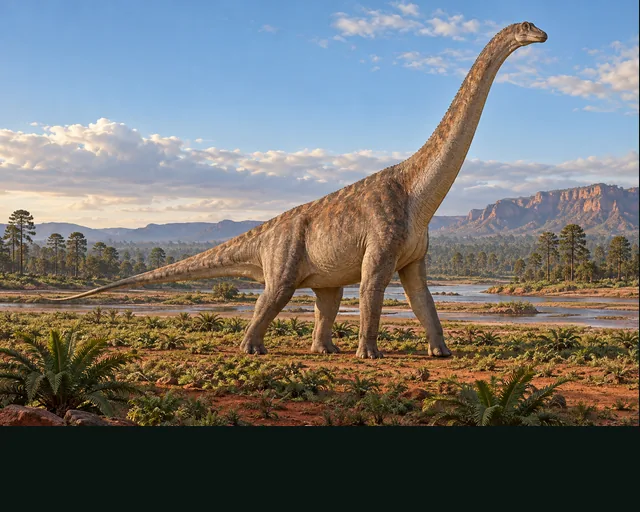
Our picture follows Dmitry Bogdanov’s complete named restoration, retaining the tall curved neck, substantial four-legged body and long tail. Small neck and back spines, colours and missing soft tissues remain artistic interpretations. Compare Giraffatitan and Sauroposeidon for separate sauropod accounts, then explore the S directory.
Quick answers
- Where was Sonorasaurus found?
- The Turney Ranch Formation of Arizona, USA.
- Did the reassessment support it as a distinct dinosaur?
- Yes. The authors supported its validity and brachiosaurid relationships.
- Was its habitat simply a coastal swamp?
- The study instead supported semiarid inland evergreen woodland.
- Are the pictured neck spines directly established here?
- No. Those details come from the complete artistic reference.