Jurassic Dinos editorial · Updated · Source-based review
What was Sauroposeidon?
Sauroposeidon proteles was a giant sauropod from Early Cretaceous North America. Its original material came from the Antlers Formation of southeastern Oklahoma, in rocks discussed as Aptian-Albian in the describing research. Its extraordinary neck vertebrae made it an important example for understanding how very large animals could support long necks.
How could air spaces help a giant neck?
Cervical vertebrae are the bones of the neck. A 2000 study described extensive pneumatic structures in those of Sauroposeidon. Pneumatic means associated with air: instead of being uniform solid blocks, these bones contained elaborate internal spaces related to the respiratory system.
Researchers compared those structures with the air-sac systems of birds. Such comparisons help explain how a strong framework can contain substantial empty space. They do not mean that a dinosaur’s neck was an unsupported balloon. The arrangement of bone around the spaces still mattered to its strength, mass and movement.
Is its classification unchanged since its discovery?
The original paper described Sauroposeidon as a brachiosaurid and interpreted its neck within that framework. That is the historical interpretation used in that publication, rather than a promise that every later analysis gives precisely the same family assignment.
Relationships and referrals of additional material are separate questions from the anatomy of the original neck fossils. A new analysis can change a proposed relationship without making the observed air spaces disappear. Equally, a trackway or a different sauropod skeleton should not automatically be labelled Sauroposeidon merely because it was large and lived in broadly similar times.
How certain is the whole-body picture?
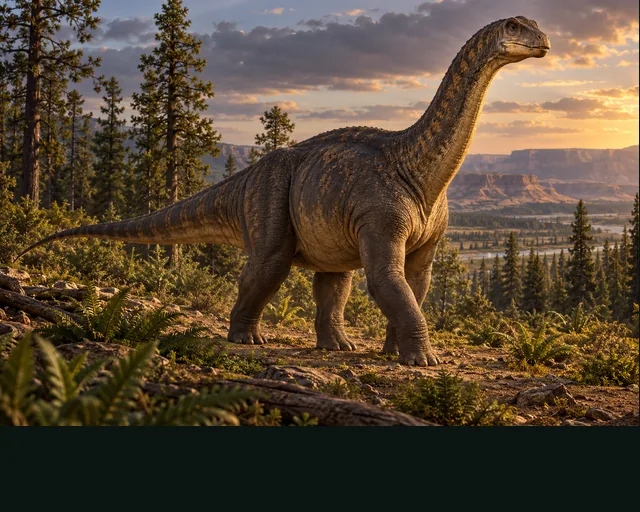
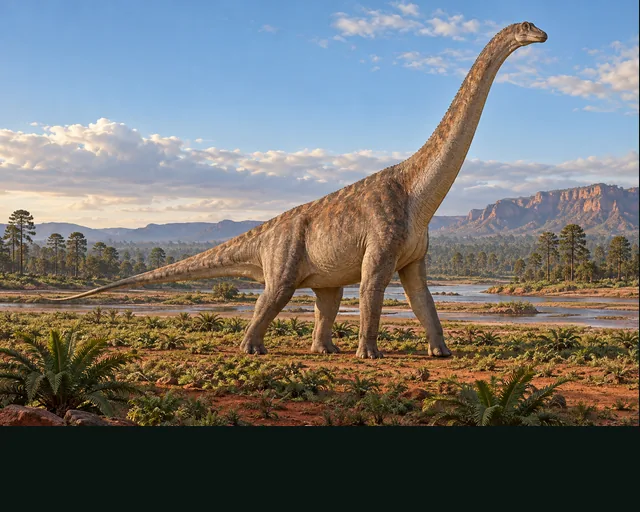
Our illustration follows an approved complete living restoration specifically identified as Sauroposeidon. It shows a small head, very long raised neck, substantial four-legged body and tapering tail. The artist’s original human silhouette was not used as a measuring device or copied into our scene.
The resulting picture is an artistic interpretation, not a photograph of a complete discovered animal. Overall standing height, soft tissues, colours and the surrounding landscape require decisions beyond the particular fossils discussed here. We therefore avoid an exact height record or a precise body-mass claim. Compare Giraffatitan and Camarasaurus for separately sourced sauropod accounts, then explore the S directory.
Quick answers
- Where was the original Sauroposeidon material found?
- In the Antlers Formation of southeastern Oklahoma.
- What are cervical vertebrae?
- The bones forming the neck portion of the backbone.
- Were its vertebrae simply solid blocks?
- No. The study describes extensive air-related spaces inside them.
- Does the picture prove an exact standing height?
- No. A whole-body reconstruction depends on additional assumptions.