Jurassic Dinos editorial · Updated · Source-based review
What was Sonidosaurus?
Sonidosaurus saihangaobiensis was a sauropod from Late Cretaceous Inner Mongolia, China. Its name refers to the Sonid area. The describing study introduced it as a titanosaurian sauropod, and the Natural History Museum identifies it as a plant eater. Its fossil record is far less complete than a full living illustration might suggest.
What was actually described?
The original 2006 paper listed parts of the backbone, ribs, a chevron and much of the pelvis from the only specimen then discussed. The backbone material included dorsal, sacral and caudal vertebrae. These terms refer to the back, hip-associated region and tail respectively, rather than three separate animals.
A chevron is a bone associated with the underside of the tail, while the pelvis forms the hip region. Knowing those terms helps explain why a specimen can preserve substantial information about its body without supplying a complete head, neck and set of limbs. A long scientific bone list should not be mistaken for a complete nose-to-tail skeleton.
How can partial remains identify a dinosaur?
The authors described distinctive combinations of ridges and supporting sheets of bone in vertebrae and the ilium, part of the hip. Such structures can be compared with corresponding features in other sauropods. Identification depends on those comparisons, not simply on a fossil being large or having come from a particular country.
Two fossils can be informative in different ways even when neither is complete. One might preserve a skull and another a well-documented hip region. The important question is which observations overlap and support a proposed distinction or relationship. Missing material limits some conclusions without removing all the information that survives.
How should we read the picture?
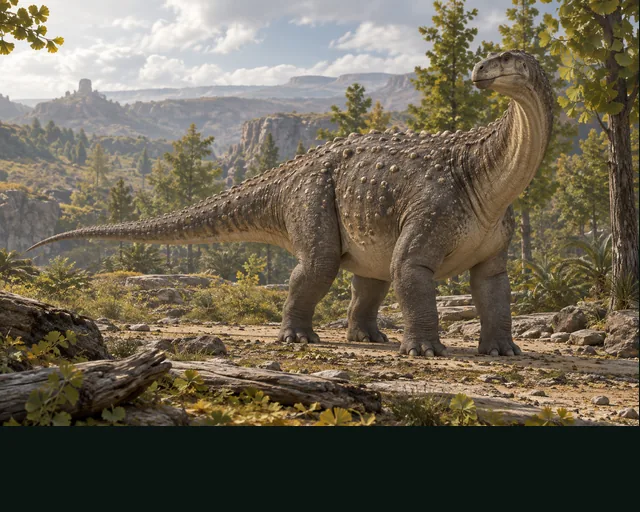
Our illustration follows Andrey Atuchin’s complete living Sonidosaurus restoration. Its small head, moderately long curved neck, heavy four-legged body and tapering tail provide an accessible whole-animal interpretation. Low rounded bumps along the back are part of that artwork, not a claim here that a complete protective armor pattern was fossilised.
Skin, colours and the river terrace remain artistic as well. A shared locality with another dinosaur would not by itself prove that the two interacted. Compare Saltasaurus and Camarasaurus for separate sauropod accounts, then browse the S directory.
Quick answers
- Where did Sonidosaurus live?
- The region now called Inner Mongolia, China.
- What does its name refer to?
- The Sonid area associated with its discovery.
- Was a complete head-to-tail animal described?
- No. The original material chiefly includes parts of the backbone, ribs and pelvis.
- Does the picture establish a preserved coat of armor?
- No. Its dorsal bumps belong to the approved artistic reconstruction.