Jurassic Dinos editorial · Updated · Source-based review
What was Sinraptor?
Sinraptor dongi was a large carnivorous theropod from Late Jurassic China. Its original description concerned a skeleton from the Shishugou Formation in the Junggar Basin of Xinjiang. Although its name includes raptor, it belongs to an allosauroid lineage rather than being identified as a member of Velociraptor’s family on the basis of its name.
How complete was its skeleton?
The original paper described the skeleton as well preserved and nearly complete, but explicitly noted that much of the tail and most of the arms were missing. Those qualifications belong together. Nearly complete is a useful summary of a specimen, not a statement that every bone or body region survives equally well.
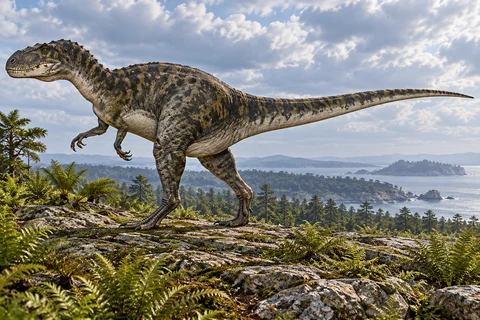
That is why an impressive skeleton can still leave important uncertainties in a life restoration. A complete image shows a tail tip and functioning hands even when those exact regions are incompletely represented in the specimen being discussed. Our image uses a separately approved complete living Sinraptor artwork rather than asking fossil photographs to supply a missing exterior.
What can teeth reveal?
A later study examined the dental anatomy of the Sinraptor dongi type specimen. It described combinations of tooth shape and serrated cutting edges and compared the dentition with other theropods, finding particular similarities to Allosaurus. Serrations are small tooth-edge projections, comparable in a general mechanical sense to the cutting edge of a serrated tool.
These details can help researchers compare animals and investigate feeding adaptations. They do not provide an exact list of prey, an observed hunting sequence or proof that every scratch on a fossil was produced by a particular predator. A plausible mechanical interpretation is different from a preserved meal.
Why do family labels change?
The describing paper proposed the family name Sinraptoridae. Later literature can use different terminology or group boundaries as datasets and classifications develop. That does not create a second Sinraptor animal or justify duplicate pages for historical classification labels. We use the broader allosauroid description here while linking each study to its own conclusions.
The illustration retains the named reference’s deep head, grasping forelimbs, strong hindlegs and long tail. Skin, colours and the forest opening remain artistic. Compare Allosaurus and Metriacanthosaurus, then browse the S directory for other Jurassic predators.
Quick answers
- When did Sinraptor dongi live?
- The Late Jurassic, following the describing study.
- Where was its type material found?
- The Shishugou Formation of Xinjiang, China.
- Were its entire arms and tail preserved?
- No. The original description reports substantial missing portions.
- Does raptor make it a dromaeosaurid?
- No. It is an allosauroid theropod, not a name-based assignment to Velociraptor’s family.