Jurassic Dinos editorial · Updated · Source-based review
What was Metriacanthosaurus?
Metriacanthosaurus parkeri was a meat-eating theropod from Late Jurassic England. Its genus name means moderately-spined lizard. The animal is known from an incomplete fossil record, so a realistic full-body picture needs to be read alongside a clear account of what was actually preserved.
What does postcranial mean?
The Natural History Museum describes a partial postcranial skeleton. Postcranial means behind the head: it refers to the body skeleton rather than the skull. That statement matters because a restored predator’s face often becomes the feature people remember most easily.
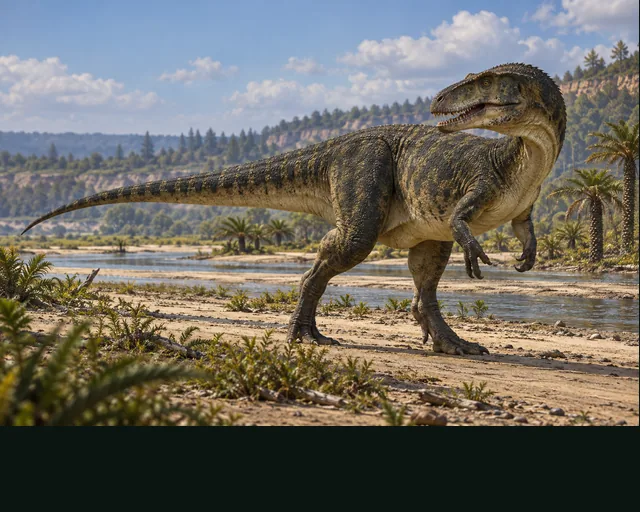
A detailed painted head is not proof that its skull was found. The face in our image follows an approved complete living restoration specifically labelled Metriacanthosaurus, while retaining that source artwork’s uncertainty. Improving the lighting or skin texture cannot transform an interpreted head into newly preserved fossil evidence.
Why is the old name Megalosaurus mentioned?
Alick Walker’s 1964 publication proposed Metriacanthosaurus as a new genus for the species previously called Megalosaurus parkeri. Moving a species to a different genus can express a revised assessment of its anatomical distinctness. It does not create another independent species for every historical combination of the same name.
Historical papers also contain ideas that later research has changed. The fact that a naming act remains relevant does not mean that every broader classification proposed in the same publication should be copied into a modern account. Here we separate the documented introduction of the genus from those older evolutionary hypotheses.
Does the name imply an enormous sail?
No. Moderately-spined is a name, not an instruction to add a dramatic fin to the living animal. The approved restoration has a substantial trunk and long tail rather than an oversized sail. Nor can the name establish its exact colour, behaviour or favourite prey.
Our new scene introduces the named animal with grasping arms, strong hindlegs and a complete tapering tail. Colours, low head ridges and the precise setting remain artistic choices. Compare Megalosaurus and Allosaurus for separately documented predators, then browse the M directory. Keep the preserved material, naming history and living reconstruction distinct as you explore.
Quick answers
- Where did Metriacanthosaurus live?
- The region now known as England.
- What does its name mean?
- Moderately-spined lizard.
- Does the museum report a preserved skull?
- It describes only a partial skeleton from behind the head.
- Was the genus once assigned to Megalosaurus?
- The historical naming paper introduced it for the species previously called Megalosaurus parkeri.