Jurassic Dinos editorial · Updated · Source-based review
What was Sinosauropteryx?
Sinosauropteryx was a small meat-eating theropod from Early Cretaceous northeastern China. It is especially famous for a covering of slender hairlike filaments. These fossils helped change the familiar picture of all non-avian dinosaurs as bare, scaly reptiles, although filaments do not automatically mean an animal had wings or could fly.
Why do individual specimens matter?
A genus name on a museum label connects a fossil with a taxonomic interpretation. Researchers can revise that interpretation as comparisons improve. The physical fossil remains the same, but the name used for it, and therefore the biography to which its evidence belongs, may change.
In 2025, a study described another Sinosauropteryx species, S. lingyuanensis, and the separate genus Huadanosaurus. It identified specimen IVPP V14202 as the name-bearing Huadanosaurus specimen. Keeping those records separate prevents an attractive older story from combining observations that researchers no longer assign to the same genus.
Do we know its exact colours?
A 2010 pigment study discussed melanosomes, tiny structures associated with colour, in fossil feathers and filaments. Its Sinosauropteryx-labelled figure concerned IVPP V14202, the specimen later named Huadanosaurus. We therefore do not use that particular result to declare that every Sinosauropteryx was conclusively reddish brown.
This does not mean that all research on tail banding or other Sinosauropteryx specimens disappears. It means that a precise claim needs a traceable connection between the studied material and its current identification. Pattern, pigment chemistry and a complete painted colour scheme are related questions, but they are not interchangeable observations.
What about food and the illustration?
The museum describes Sinosauropteryx as carnivorous. More detailed accounts of preserved meals need the same specimen check as colour claims. We avoid transferring particular mammal remains from a reassigned specimen into an unquestioned menu for this genus, or turning one meal into a lifetime feeding schedule.
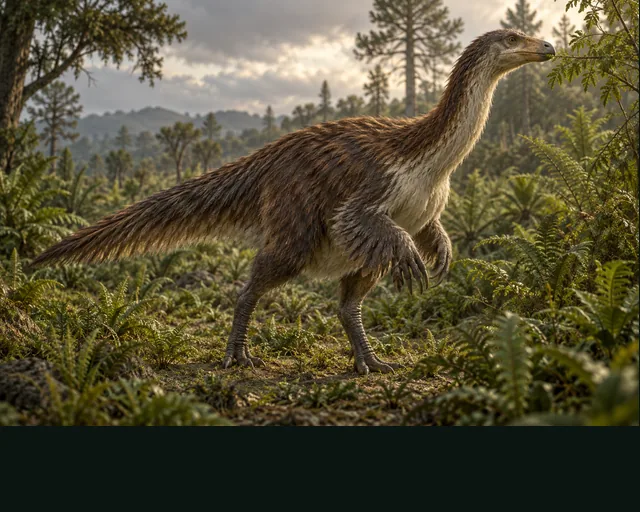
Our image follows a complete museum restoration with a narrow head, very short arms, long hindlegs, filamentous covering and a long banded tail. Its warm brown and cream palette is labelled as artistic rather than a universal measured colour. The setting is independently designed. Compare Compsognathus and Beipiaosaurus for separate accounts, then explore the S directory.
Quick answers
- Where did Sinosauropteryx live?
- Early Cretaceous northeastern China.
- Did it have flight wings?
- The characteristic covering discussed here consists of hairlike filaments, not proof of flight wings.
- Is its entire colour pattern certainly known?
- No. Colour inferences must be checked against particular specimens and later reassignments.
- Does Huadanosaurus simply provide extra Sinosauropteryx facts?
- No. The 2025 study named it as a separate genus.