Jurassic Dinos editorial · Updated · Source-based review
What was Siamraptor?
Siamraptor suwati was a carnivorous theropod described in 2019 from northeastern Thailand. Its fossils came from the Khok Kruat Formation in Nakhon Ratchasima Province. The describing study placed it within Carcharodontosauria, an allosauroid branch that includes several well-known large predatory dinosaurs.
Does raptor mean the same group every time?
No. Raptor is a word used in many dinosaur names, not a reliable family label by itself. Siamraptor was not identified as a dromaeosaurid merely because its name ends like Velociraptor. Researchers established its proposed relationships by comparing anatomical characters across a dataset.
The original analyses placed Siamraptor near an early branching position within Carcharodontosauria. The broader branch name should not be confused with the narrower family Carcharodontosauridae. Related terms can describe different levels of a family tree, just as a large branch can contain several smaller branches.
Was an entire animal discovered?
The name-bearing specimen is a posterior portion of the right lower jaw. Additional cranial and body material was referred to the species from multiple individuals. These fossils supplied useful overlapping comparisons, but they do not constitute a single complete articulated animal.
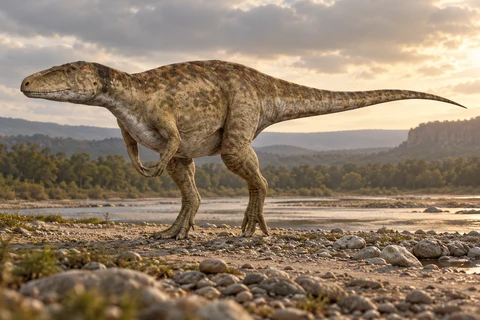
That distinction prevents a reconstructed skeleton or living illustration from being mistaken for the exact arrangement of everything found together. A whole-body image necessarily presents a broader interpretation than an isolated jaw or partial vertebra can directly establish. Our illustration follows a separately approved complete living Siamraptor artwork; skeletal figures were not used to invent missing exterior anatomy.
What can the rocks and bones reveal?
The study adopted an Aptian age for the Khok Kruat Formation while discussing limits to its dating. We therefore use Early Cretaceous rather than pretending that the fossil comes with an exact calendar year. Its geological discussion interprets river-related deposits, which provide environmental context rather than a photograph of the animal’s last day.
The authors also described notable air-related structures in cranial and backbone material. Such internal anatomy is evidence about the skeleton, not a reason to show a hollow-looking animal or make it capable of flight. Colours, skin and exact restored proportions remain artistic. Compare Allosaurus and Aerosteon as separately sourced theropods, then explore the S directory.
Quick answers
- Where was Siamraptor discovered?
- Nakhon Ratchasima Province, Thailand.
- Was one complete skeleton found?
- No. The study described incomplete material representing multiple individuals.
- What was its name-bearing fossil?
- An associated posterior portion of the right lower jaw.
- Does raptor in its name make it a Velociraptor relative?
- No. The study placed it among carcharodontosaurians, a different theropod branch.