Jurassic Dinos editorial · Updated · Source-based review
What was Shuvuuia?
Shuvuuia deserti was a small alvarezsaurid theropod from Late Cretaceous Mongolia. Its name means bird, but a name describing a birdlike appearance does not make it a modern bird. Its remarkable combination of a slender head, tiny forelimbs and long legs has encouraged researchers to investigate how it might have lived.
Could it hunt in darkness?
A 2021 study compared fossil structures associated with vision and hearing across theropod dinosaurs and living animals. The authors interpreted their results as evidence for nocturnal sensory specializations in alvarezsauroids. Nocturnal means active mainly at night. They proposed especially sensitive, owl-like hearing for Shuvuuia.
Such research uses anatomical proxies: measurable structures that can provide indirect clues about a function. It does not measure a living dinosaur’s hearing in a laboratory. A proposed connection between anatomy and behaviour therefore depends on the comparative method and assumptions used to interpret the fossils.
Why is the hearing comparison debated?
A 2025 reassessment questioned the barn-owl analogy. Its authors argued that the metric used to compare inner-ear dimensions, together with an assumption about the structure of the ear, did not securely establish the proposed performance. They cautioned against treating one skeletal feature as a complete test of hearing ability.
This disagreement does not make the fossils useless. It identifies the step between observing a structure and interpreting its function that needs further testing. We describe nocturnal hunting as a research interpretation, and exceptional owl-level hearing as a disputed claim, rather than presenting either a recreated sound recording or a settled sensory score.
What about food and appearance?
The Natural History Museum suggests that Shuvuuia may have eaten termites. That possibility is not evidence that it consumed nothing else, and a short clawed arm alone does not document a particular feeding event. This account leaves an exact diet unresolved.
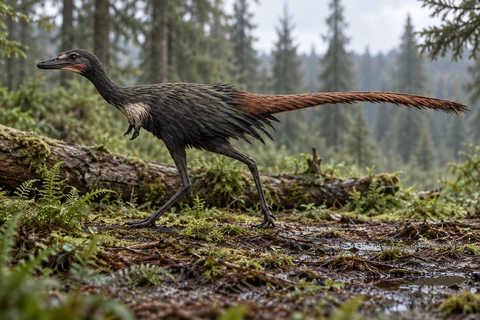
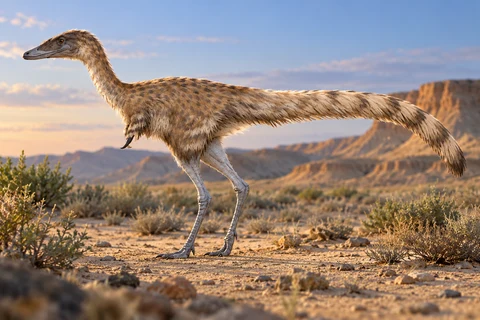
Our illustration follows the museum’s complete living restoration, showing tiny forelimbs with dominant claws, a feathered body, long legs and a slender tail. The dusk setting is an artistic choice, not additional evidence for the nocturnal hypothesis. Colours and fine plumage patterns remain interpretive. Compare Albertonykus and Jaculinykus, then explore the S directory.
Quick answers
- Where did Shuvuuia live?
- Mongolia during the Late Cretaceous.
- Was it a modern bird?
- No. It was an alvarezsaurid theropod dinosaur.
- Is owl-level hearing a settled fact?
- No. A later study challenged that interpretation.
- Did it certainly eat only termites?
- No. That feeding suggestion is not an exclusive proven diet.