Jurassic Dinos editorial · Updated · Source-based review
What was Jaculinykus?
Jaculinykus yaruui was an alvarezsaurid theropod from Late Cretaceous Mongolia. Its 2023 description brought together two especially interesting clues: a very reduced hand and a fossil resting in a bird-like curled position. Together, they make this dinosaur a useful introduction to the difference between anatomy and behaviour.
What was unusual about its hand?
The described hand has two fingers: a greatly enlarged first digit and a much smaller second one. In the authors’ comparison, it differs from the three-fingered Shuvuuia and the one-fingered Linhenykus. This is a comparison of hand construction, not a claim that those genera were simply a parent, child and grandchild in one straight line.
Numbering fingers helps researchers specify exactly what they are comparing. Saying “tiny arms” describes an overall impression; identifying which digits are present asks a more precise question. Small structures can matter even when they are hard to see in a life-size display or a wide landscape illustration.
Was the dinosaur really asleep?
The nearly complete, articulated skeleton preserves a curved neck and tail with the hindlegs folded beneath the body. The study interprets that arrangement as a sleeping posture comparable with birds and other feathered theropods.
An articulated skeleton has bones retaining their natural connections. That makes posture especially informative, but the researchers are still interpreting a preserved arrangement rather than watching an ancient animal breathe. It is useful to keep the observation and the proposed explanation in separate sentences. The fossil posture also does not, by itself, tell us the animal’s whole daily timetable.
Why is our illustration standing up?
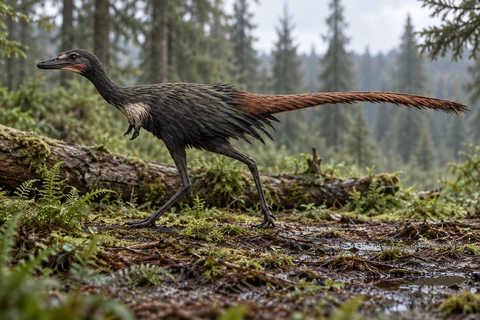
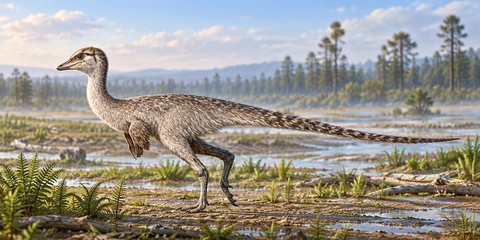
The complete reference artwork by Dinoguy2 depicts a living Jaculinykus with a small head, long neck, short arms, long legs and a feather-covered tail. Our independent desert-edge scene follows those visible proportions while making the whole animal easy to inspect. The standing pose was chosen for the picture; it does not replace the sleeping evidence.
Compare the short arms in Albertonykus and Bannykus, then browse names beginning with J. Ask which questions each fossil can answer, and which details still belong to an artist’s interpretation.
Quick answers
- Where did Jaculinykus live?
- Late Cretaceous Mongolia.
- How many hand fingers did it have?
- Two, with very unequal sizes.
- Why is sleep mentioned?
- Its curled fossil posture suggests sleep.
- Does the standing illustration document behaviour?
- No; the new pose is artistic.