Jurassic Dinos editorial · Updated · Source-based review
Why did Albertonykus have such small arms?
Albertonykus was an alvarezsaurid theropod from Late Cretaceous Canada. Alvarezsaurs include some very unusual dinosaurs: lightly built hind limbs contrast with short, strongly specialised forelimbs. The known Albertonykus material includes limb bones from more than one individual, rather than a complete living outline.
Longrich and Currie’s description appeared in a 2009 journal volume. It concerns material from the Horseshoe Canyon Formation of Alberta, including the Albertosaurus bonebed at Dry Island Provincial Park. The small bones add another kind of dinosaur to a site famous for much larger predators.
Does a shared bonebed prove a predator’s meal?
No. Finding bones of different animals together does not by itself show who ate whom. A bonebed can gather material through several processes, including movement and burial after death. A feeding relationship would need additional evidence.
This distinction is especially useful when a small dinosaur occurs alongside a famous carnivore. It is tempting to write an exciting chase scene, but the shared locality is a geological observation, not a recording of that encounter.
Why did researchers suggest wood-nesting termites?
The original paper interpreted the short forelimbs as suited to digging into insect nests, but too short for ordinary burrowing. The authors considered which social insects were plausible targets and proposed termites living within wood as a possible food source.
They also examined fossil wood from the formation and found borings resembling termite galleries. These traces made the idea more plausible in that environment. They did not provide a preserved Albertonykus stomach full of termites or demonstrate that termites were its only food.
What makes this a testable hypothesis?
A useful hypothesis connects several observations and suggests what further evidence could support or challenge it. Here, forelimb function and insect traces in wood are separate clues. New discoveries could strengthen the connection or suggest another use for the anatomy.
It is therefore more accurate to say that wood-nesting termites were a proposed target than to present an exact menu as established fact. We do not assign a precise daily intake, maximum speed or adult mass from the reconstruction.
What is artistic in the picture?
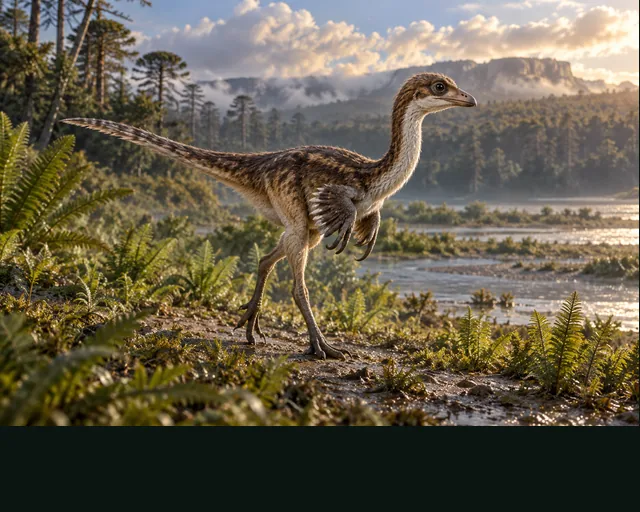
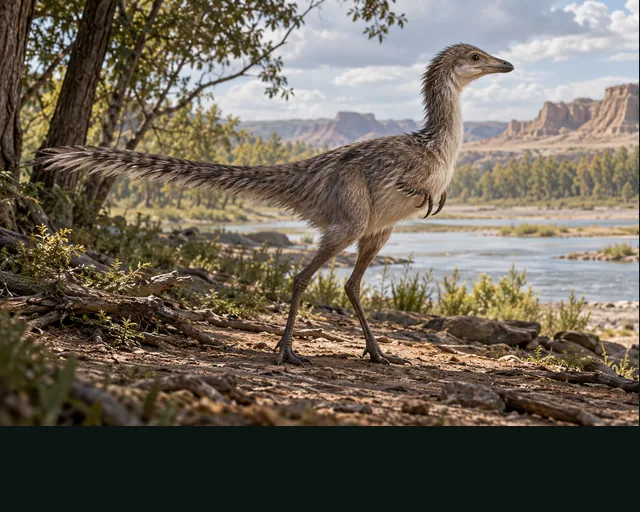
Our image follows Connor Ashbridge’s complete restoration specifically named Albertonykus borealis. The narrow head, feathered body, tiny arms, long legs and tail follow that artwork. Colours and feather detail remain interpretive. The domestic-hen scale figure in the reference is not included and is not used to calculate measurements.
Explore Mononykus and Alvarezsaurus, or return to the A–Z directory under A.
Quick answers
- Did Albertonykus certainly eat only termites?
- No. Wood-nesting termites were a proposed food source supported by several indirect clues.
- Why did researchers examine fossil wood?
- Termite-like borings tested whether plausible prey lived in that environment.
- Does sharing a bonebed prove Albertosaurus ate it?
- No. Associated fossils alone do not demonstrate a particular feeding event.
- Is the hen shown in the reference included?
- No. It is a scale illustration and is neither generated as part of the scene nor used to calculate body measurements.