Jurassic Dinos editorial · Updated · Source-based review
What was Seitaad?
Seitaad ruessi was an early sauropodomorph from Early Jurassic southern Utah. Its remains came from the Navajo Sandstone, a rock unit famous for ancient wind-blown sand deposits. It belonged to the broader lineage that later included enormous sauropods, although it was not simply a small copy of a fully quadrupedal giant.
How was the skeleton preserved?
The 2010 describing study reported a partially articulated skeleton. Articulated means that some bones remained in their original anatomical relationship rather than being completely scattered. This arrangement can preserve useful information about how an animal was buried, alongside clues supplied by the surrounding sediment.
The authors interpreted the specimen as having been buried after death near the base of a collapsed dune foreset. A foreset is an inclined layer formed as sand accumulates down a dune’s sloping face. Their interpretation does not establish that the animal was swallowed alive by quicksand. A dramatic story should not replace the actual evidence and its stated limitations.
Which parts were missing?
The paper explains that the skull, neck series and tail region, along with other portions, were presumed to have eroded away before discovery. Erosion removes material as rocks weather and break down. An articulated section of skeleton therefore does not mean that an entire articulated animal was recovered.
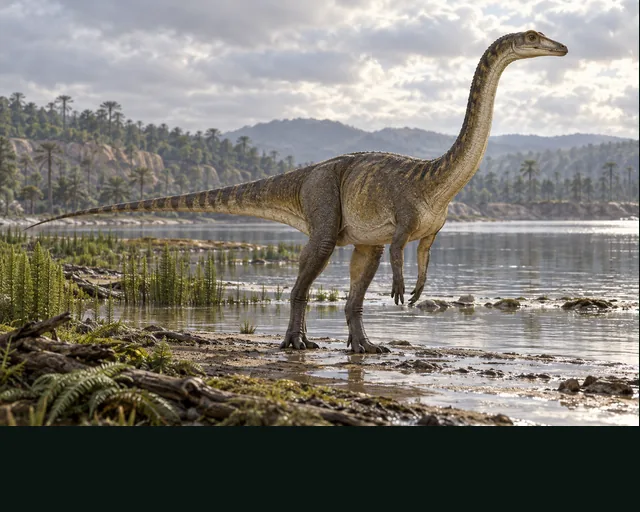
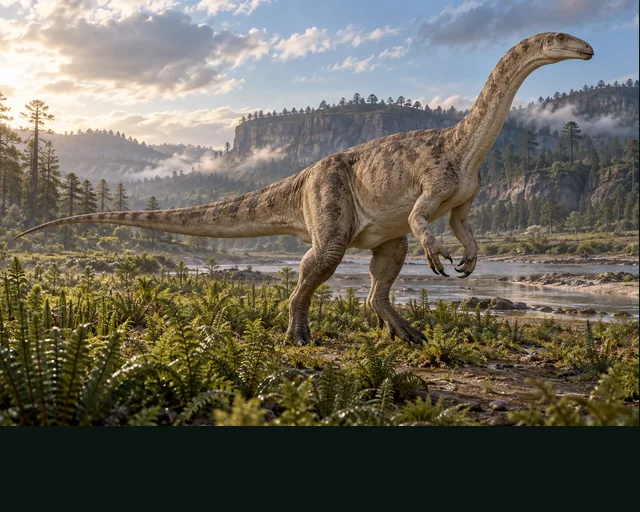
This distinction is especially important when looking at the picture. The illustration follows an approved complete living Seitaad restoration, which supplies its interpreted head, long curved neck, grasping forelimbs, hindlegs and tapering tail. Those missing exterior regions were not invented by asking a generator to extrapolate from bone photographs.
Where does it fit in the family tree?
The describing study tested its relationships using alternative datasets. The analyses linked it with different early sauropodomorph branches, involving plateosaurid or massospondylid relatives. We therefore describe its broader position without pretending that the paper settled a single narrow family assignment beyond doubt.
Our independent sandy scene does not copy the shoreline shown in the reference artwork, and neither landscape should be treated as a photograph of the fossil locality. Colours and soft tissues remain interpretive. Compare Plateosaurus and Massospondylus, then visit the S directory for more accounts of early dinosaur evolution.
Quick answers
- Where was Seitaad found?
- Southern Utah in the Navajo Sandstone.
- Was it a giant later sauropod?
- No. It was an earlier sauropodomorph relative of that lineage.
- Did the study prove it was buried alive?
- No. It interpreted burial after death.
- Were its head and whole tail preserved?
- No. The paper explains that these regions were missing.