Jurassic Dinos editorial · Updated · Source-based review
What was Segisaurus?
Segisaurus halli was a small theropod dinosaur from Early Jurassic Arizona. Its fossils came from the Navajo Sandstone. Although its restored body is slender and lightly built, the original evidence is a partial skeleton rather than a complete animal preserved from nose to tail.
Why does the date need checking?
A 2005 research paper specifically describes Segisaurus as an Early Jurassic dinosaur. Its original publication is recorded by the Smithsonian, and the study revisits the holotype, the name-bearing specimen. We follow that primary research context here rather than repeating an inconsistent period label from an older summary.
Scientific accounts can disagree because of new evidence, historical conventions or simple mistakes in a short information box. The useful response is to identify the source behind a statement. A confident-looking date is not automatically more reliable merely because it appears beside an illustration.
What does the skeleton tell us, and what is missing?
The Natural History Museum describes the remains as a partial postcranial skeleton. Postcranial means behind the head, so the term concerns body bones rather than a discovered skull. The museum also notes that a fully grown skeleton has not been found in the material it describes.
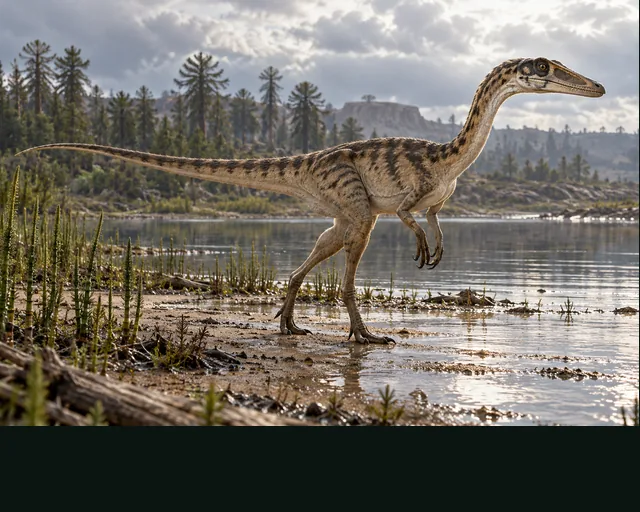
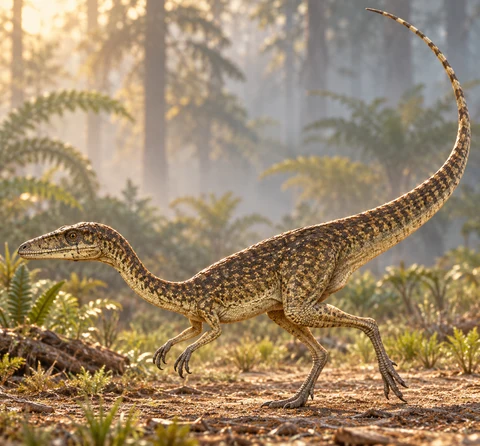
That limits confident claims about exact adult dimensions. A small preserved individual does not, on its own, settle the maximum size of every adult in a species. Equally, a detailed reconstructed face should not be mistaken for a directly preserved Segisaurus skull. Our full-body illustration follows a separately approved living restoration carrying the animal’s name; it was not invented from the partial fossil skeleton.
What might it have eaten?
The museum identifies Segisaurus as carnivorous and suggests that insects may have formed part of its diet. May matters: a proposed feeding possibility is not a recovered daily menu, and it does not establish that the animal ate insects exclusively.
The illustration shows a narrow uncrested head, short grasping arms, long hindlegs and a tapering tail, following the complete reference. Its mottled colours, tiny skin details and sandy clearing remain artistic decisions. Neither its alert pose nor the surrounding plants demonstrate hunting behaviour preserved in a fossil. Compare Coelophysis and Procompsognathus for other early theropod accounts, then explore the S directory.
Quick answers
- When did Segisaurus live?
- The Early Jurassic, following the original research account.
- Where were its fossils found?
- The Navajo Sandstone of Arizona, USA.
- Was a complete skull discovered?
- The reviewed museum account describes a partial body skeleton rather than a skull.
- Did it definitely eat only insects?
- No. Insect eating is a suggestion, not a proven exclusive menu.