Jurassic Dinos editorial · Updated · Source-based review
What was Procompsognathus?
Procompsognathus triassicus was a small carnivorous theropod from Late Triassic Germany. The Natural History Museum describes the known specimen as badly crushed. That preservation problem makes this animal a useful example of why a complete-looking picture can be much more straightforward than the fossil evidence behind it.
Why do crushed fossils cause difficulties?
Compression can distort proportions and obscure the surfaces where bones meet. Researchers must separate original anatomical features from changes caused during burial and fossilisation. A ridge, bend or apparent connection cannot automatically be treated as part of the living animal.
These problems become especially important when asking whether nearby elements belong to the same individual or even the same kind of animal. Being stored together under one historical specimen label does not independently prove that every piece has the same identity. Careful anatomical comparison is needed to test that association.
What did the 1992 reassessment argue?
Paul Sereno and Rupert Wild interpreted the postcranial skeleton as theropod material but argued that the associated skull and some referred elements belonged to a crocodylomorph. Postcranial means behind the skull. Their study challenged a historical combination of material rather than simply declaring that every fossil concerned was non-dinosaurian.
This is presented as the argument of that study, not an assertion that all later interpretation is unanimous. It demonstrates why a skull-shaped object and a body skeleton need separate identification before being combined. A polished restored face cannot resolve the original association by looking convincing.
Does its name connect it directly to Compsognathus?
The name means before Compsognathus, but a name is not a demonstrated ancestor-descendant relationship. The two genera have their own fossil records and geological contexts. Similar wording does not make them stages of one species, and each needs a separate account.
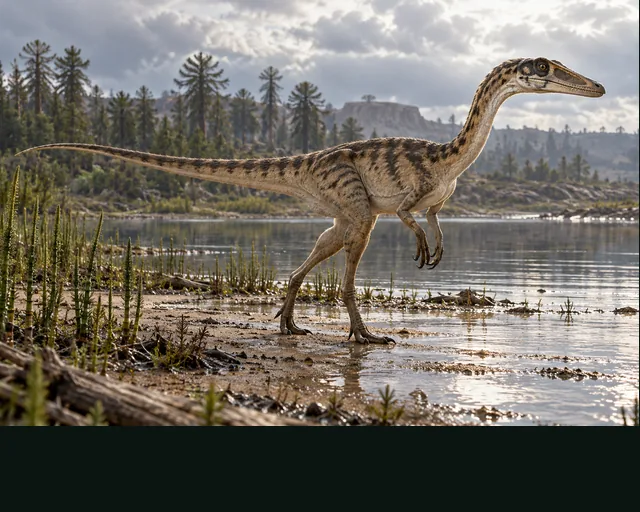
Our illustration follows a complete living restoration specifically labelled Procompsognathus. It retains the reference’s slender neck, grasping forelimbs, long hindlegs and narrow tail; the restored head, colours and soft tissues remain interpretations. It was not generated from the crushed skeleton. Compare Coelophysis and Compsognathus, then visit the P directory for other discoveries and their evidence.
Quick answers
- Where did Procompsognathus live?
- The region now known as Germany.
- Why is the specimen difficult to interpret?
- It is badly crushed, and the association of some material has been challenged.
- Did the 1992 study reject every part as non-dinosaur?
- No. It identified the postcranial skeleton as theropod.
- Does before Compsognathus prove it was the direct ancestor?
- No. The meaning of the name does not establish ancestry.