Jurassic Dinos editorial · Updated · Source-based review
What was Secernosaurus?
Secernosaurus koerneri was a plant-eating hadrosaurid from Late Cretaceous Argentina. Hadrosaurids are often called duck-billed dinosaurs because of their broad beaked mouths. The nickname does not mean that they were ducks, or that the feeding habits of modern ducks can simply be copied into their biographies.
The Natural History Museum identifies Secernosaurus as the first hadrosaurid discovered in South America. This is a historical milestone in the discovery record, not a claim that it was the first member of the group ever to live on the continent. Discovery order and evolutionary arrival are different questions.
Why do names need careful checking?
South American hadrosaur fossils have been compared and reassigned as new material became available. A modern revision distinguished Secernosaurus koerneri from Bonapartesaurus rionegrensis and material historically called Kritosaurus australis. Similar regional occurrences do not make all those names interchangeable.
This matters when following older research. A title using a familiar genus name does not guarantee that every studied specimen would receive that name under a later interpretation. Before moving a result about a braincase, skeleton or evolutionary relationship into a species account, the identity of the actual material needs checking. This page therefore does not transfer an older endocranial reconstruction to S. koerneri without that connection being established.
What can these dinosaurs reveal about geography?
Hadrosaur discoveries in South America help researchers investigate the distribution and relationships of dinosaurs across continents. Comparing their anatomical features can produce hypotheses about family branches and possible movements between land areas.
A proposed route is not an observed journey. Similarity, geological age and changing geography must be considered together, and different analyses can test different explanations. A fossil found in Argentina also does not automatically establish the distribution of another named hadrosaur found elsewhere in South America.
How was the illustration made?
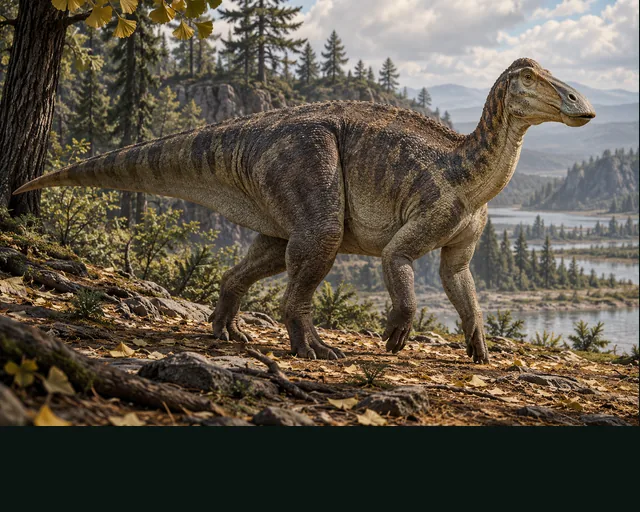
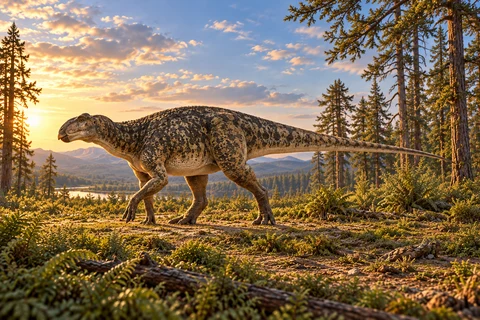
Our image follows Connor Ashbridge’s complete, specifically labelled Secernosaurus restoration. It preserves the reference’s low crestless beaked head, substantial body, supporting forelimbs, strong hindlegs, long tail and low dorsal skin ridge. Those visible choices belong to an artistic reconstruction, rather than a claim that every soft-tissue detail has been preserved.
Colours and the river terrace were independently designed. Compare Edmontosaurus and Kritosaurus as separate hadrosaur accounts, and explore the S directory to follow other names and their sources.
Quick answers
- Where did Secernosaurus live?
- Argentina during the Late Cretaceous.
- What kind of dinosaur was it?
- A plant-eating hadrosaurid, often called a duck-billed dinosaur.
- Does a duck-billed name make it a modern duck?
- No. It is a descriptive nickname for a very different dinosaur group.
- Can every old Secernosaurus study be combined without checking?
- No. Specimen identifications and taxonomic revisions must be checked first.