Jurassic Dinos editorial · Updated · Source-based review
What was Kritosaurus?
Kritosaurus navajovius was a plant-eating hadrosaurid, or duck-billed dinosaur, from Late Cretaceous North America. Its familiar reconstructed face is only part of the story. The more revealing question is which fossils researchers can confidently assign to that name.
Why do old specimen labels need checking?
A detailed reassessment published online in 2013 and in a 2014 journal issue revised the anatomy and relationships of Kritosaurus. Many fossils previously referred to the genus could not be positively retained. One supported exception, from the Cerro del Pueblo Formation, extended the reviewed species record into northern Mexico.
That is why an old country list or a large display label should not be treated as the final word. A name can remain useful while the collection of fossils assigned to it becomes more carefully defined. Removing a doubtful assignment is a gain in precision, rather than a loss of interest in the fossil itself.
Which parts of the skull mattered?
The revised diagnosis combines features of the upper jaw, cheek region, forehead and nasal bones. It also compares openings in the skull. The eye socket is not the only opening in a dinosaur skull, so an opening behind it should not be mistaken for an extra eye.
Comparisons like these are more specific than saying that two painted faces share a “Roman nose.” A reconstruction can suggest an overall profile, while a diagnosis asks whether several preserved features consistently distinguish the material. Those two activities are related, but they are not interchangeable.
What should you notice in our illustration?
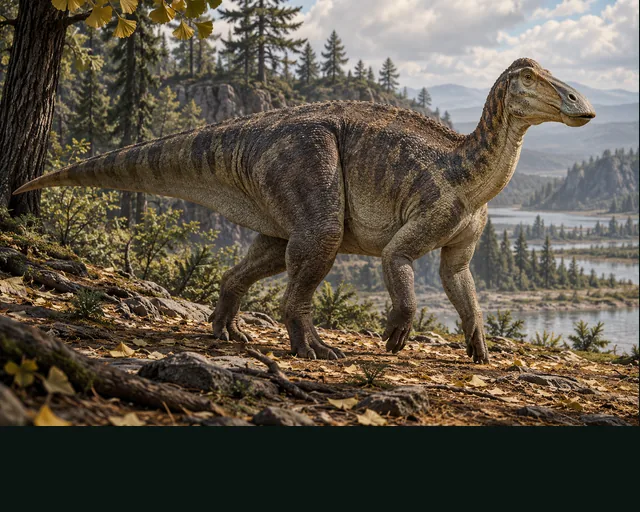
Our picture follows the explicitly named complete Kritosaurus restoration published by the Natural History Museum. Look at the broad beak, raised nasal profile, strong hindlegs and long tail. The missing external details of that restored outline remain interpretations; the new colour pattern and woodland lighting do not provide additional anatomical evidence.
The image is useful for recognising and discussing the subject, while the linked research explains why particular specimens receive its name. Compare Bactrosaurus and Edmontosaurus as separately documented duck-billed-dinosaur accounts. Then continue through names beginning with K, checking which fossil record each account actually describes.
Quick answers
- What is the species discussed here?
- Kritosaurus navajovius.
- Do all old Kritosaurus labels remain valid?
- No. The reviewed study reassessed many assignments.
- Which country gained a supported record in that study?
- Northern Mexico.
- Is the illustrated nose a complete fossil photograph?
- No. It follows the museum’s living reconstruction.