Jurassic Dinos editorial · Updated · Source-based review
What was Sanxiasaurus?
Sanxiasaurus modaoxiensis was a neornithischian dinosaur from Middle Jurassic China. Its fossils came from the Xintiangou Formation of Yunyang, in Chongqing. The describing publication introduced it as a new taxon based on a partial postcranial skeleton, making the nature of that evidence central to understanding the animal.
What does postcranial tell us?
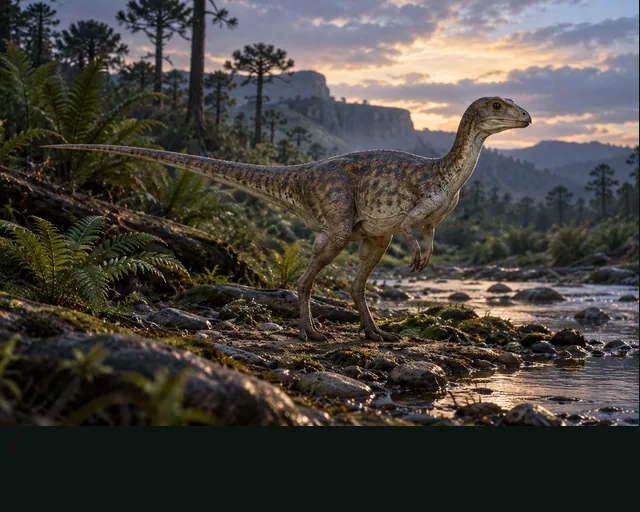
Postcranial means behind the head. It describes the body skeleton rather than a preserved skull. A reader should therefore not assume that the detailed face in a full-body illustration is a direct copy of a discovered Sanxiasaurus head.
A partial body skeleton can still provide useful information about relationships. Researchers compare anatomical features with those of other animals, looking for meaningful combinations rather than demanding that every specimen preserve the same bones. The limitations concern which questions can be answered, not whether an incomplete fossil has any scientific value.
What is a neornithischian?
Neornithischia is a branch within Ornithischia, the broader bird-hipped dinosaur group. Bird-hipped is a traditional anatomical term; it does not mean that these animals were simply modern birds or that their group name proves the ancestry of living birds. Similar-sounding terms can refer to different parts of a family tree.
The original paper presented Sanxiasaurus as an early Asian record of that branch. Such a historical assessment belongs to the evidence available when the study appeared. Later discoveries or revised dating can change earliest-known rankings without changing the identity of the original fossil.
What remains interpretive in the picture?
Our image follows a complete named Sanxiasaurus artwork with a low beaked head, compact body, short arms, long hindlegs and tapering tail. Its bristly covering and colours are features of the reference artist’s interpretation. This account does not report a preserved Sanxiasaurus feather coat or use body bones to invent a missing exterior.
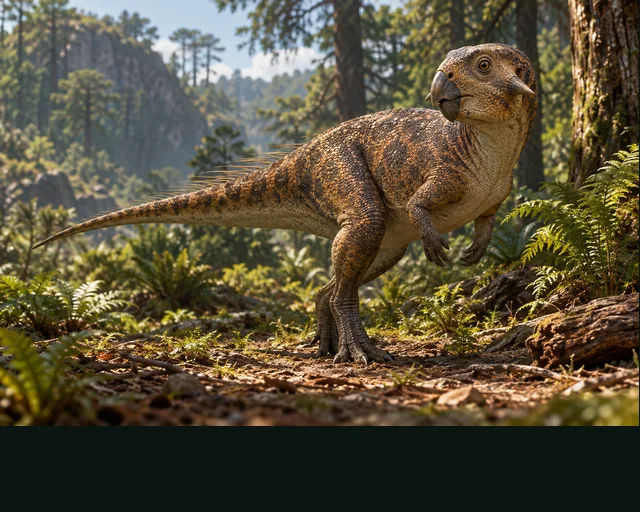
Nor does the reviewed material justify a precise adult size or detailed menu here. Leaving an unsupported field unknown is more informative than borrowing a confident number from a different dinosaur. Compare Lesothosaurus and Psittacosaurus for separate ornithischian accounts, then browse the S directory for more names and their individual sources.
Quick answers
- Where was Sanxiasaurus found?
- Yunyang in Chongqing, China.
- When did it live?
- During the Middle Jurassic, according to the describing study.
- What does postcranial mean?
- Behind the head, referring to the body skeleton rather than the skull.
- Are the picture’s bristles directly established by this account?
- No. They belong to the approved artistic restoration.