Jurassic Dinos editorial · Updated · Source-based review
What was Sanjuansaurus?
Sanjuansaurus gordilloi was a herrerasaurid dinosaur from Late Triassic Argentina. Its partial skeleton came from Carnian-age rocks of the Ischigualasto Formation in the country’s northwest. Herrerasaurids include some of the early dinosaurs used to investigate how the major dinosaur branches first diversified.
How did researchers distinguish it?
The original description identified a combination of features in the neck and back vertebrae, shoulder region and pelvis. For example, it described distinctive sideways projections on some vertebrae. A transverse process is a bony projection extending away from a vertebra, rather than an external skin ornament.
The diagnosis also considered the pubis, one of the main pelvic bones. Several anatomical regions can contribute to identifying an animal even when the skeleton is incomplete. A diagnosis does not require a spectacular horn or crest, and a distinctive feature need not be visible in a living reconstruction.
Where does it fit in the family tree?
The 2010 analysis placed Sanjuansaurus with Herrerasaurus and Staurikosaurus in Herrerasauridae. It recovered that group near the base of Theropoda, while noting that the wider evolutionary position of herrerasaurids had varied among studies. Here the herrerasaurid identity is clear, and the broader placement is presented in its analytical context.
Early-diverging does not mean half-formed or inferior. These were complete animals living in their own ecosystems. A branch near the beginning of a family tree is not automatically a proven direct ancestor of every later dinosaur, either.
What did the discovery say about early communities?
The describing study emphasised that Sanjuansaurus occurred alongside several other early saurischians in the lower part of the formation. That pattern suggests diversification was already under way, rather than a landscape containing only one generalised dinosaur type. Different lineages can share a broad time and place while retaining distinct anatomy and evolutionary histories.
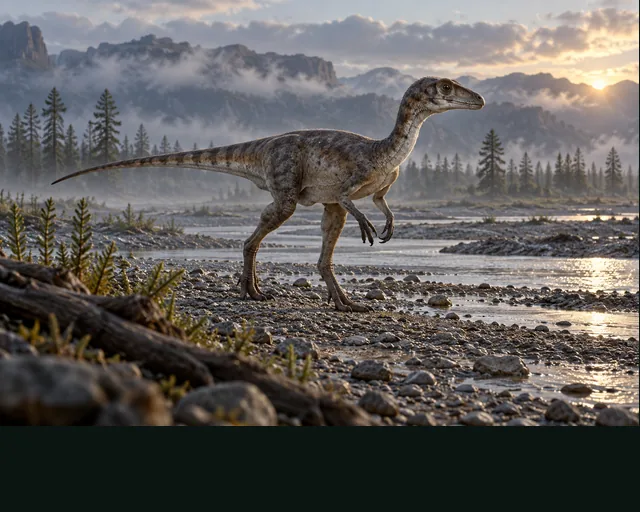
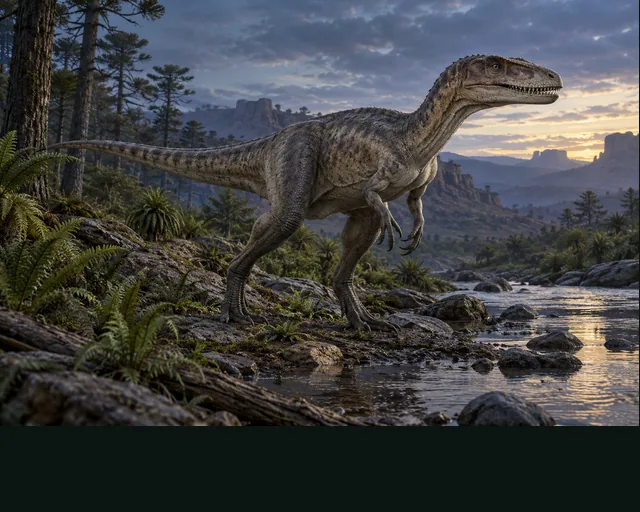
Our image follows a complete named Sanjuansaurus restoration for the low elongated head, grasping forearms, strong hindlegs and long tail. Skin, colour and missing soft tissues remain artistic interpretations rather than a body generated from bone photographs. Compare Herrerasaurus and Eoraptor, then browse the S directory for their separate evidence and sources.
Quick answers
- Where did Sanjuansaurus live?
- Northwestern Argentina during the Late Triassic.
- Which formation preserved it?
- The Ischigualasto Formation.
- Was it a herrerasaurid?
- The original analysis placed it with Herrerasaurus and Staurikosaurus in that group.
- Does early dinosaur mean one uniform primitive species?
- No. The described community already contained several distinct dinosaur lineages.