Jurassic Dinos editorial · Updated · Source-based review
What was Rinchenia?
Rinchenia mongoliensis was an oviraptorid theropod from Late Cretaceous Mongolia. Its restored appearance is memorable for a tall crest and deep beak. However, the Natural History Museum describes only a skull and fragmentary postcranial material, so a complete feathered animal remains a reconstruction rather than an intact discovery.
What does postcranial mean?
Postcranial refers to the skeleton behind the head. Knowing a skull well does not automatically establish the shape of every limb, the full tail or the arrangement of feathers. Different regions of one animal can therefore have very different levels of certainty.
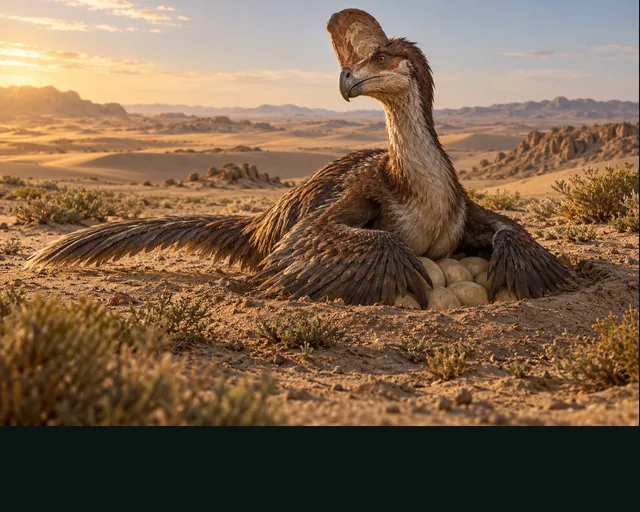
Our new image follows a complete living Rinchenia artwork by PaleoNeolitic, with an upright neck, feathered body and tapering tail. The crest’s soft-tissue outline, feather distribution and colour remain interpreted. A clear view of the complete reference prevents missing parts being invented during image production, but it does not turn that artwork into additional fossil evidence.
Why was a later diagnosis useful?
A 2018 review of Nemegt Basin oviraptorosaurs provided an explicit diagnosis of Rinchenia. A diagnosis sets out the anatomical features used to distinguish a taxon. Revisiting older discoveries in this way helps researchers compare them consistently with more recently described animals.
That work also examined the broader diversity of oviraptorosaurs in the region. Several related animals can coexist without being interchangeable, and a shared beak or crest does not justify transferring one species’ skeleton, nest or behaviour to another. Each name remains linked to its own specimens.
What can we say about food and habitat?
The museum lists Rinchenia as omnivorous, a broad category involving animal and plant foods. It is not an exact menu. The regional review discussed dietary niche partitioning, the possibility that related animals used different resources, alongside their fossil distribution.
Occurrence patterns can also reflect uneven collecting, changing localities or differences through time. They should not be treated as a direct observation of particular animals feeding together. This account therefore avoids staging an unsupported meal or nest scene. Compare Oviraptor and Citipati for separate oviraptorid accounts, then explore the R directory for other discoveries and their sources.
Quick answers
- Where did Rinchenia live?
- The region now known as Mongolia.
- Was a complete feathered skeleton found?
- The museum describes a skull and fragmentary body material, not a preserved complete coat.
- Does omnivorous provide an exact menu?
- No. It is a broad dietary category.
- Do fossil occurrence patterns prove each animal ate different foods?
- No. Ecological interpretation must also consider sampling and time.