Jurassic Dinos editorial · Updated · Source-based review
What was Rhoetosaurus?
Rhoetosaurus brownei was a plant-eating sauropod from the region now called Queensland, Australia. Its partial skeleton was found near Roma, and the species name honours Arthur Browne, who helped bring the discovery to scientific attention. The dinosaur was named in 1926, but research on its context continued long afterward.
Why do different sources give different ages?
Older summaries often place Rhoetosaurus broadly in the Middle Jurassic. A 2019 study refined the geological context and interpreted the material as younger, within a Late Jurassic framework. It also confirmed an origin in the Walloon Coal Measures.
The researchers reported a maximum depositional age interpreted as no older than the early Oxfordian. A maximum depositional age constrains when sediment could have accumulated. It is not the exact date on which an individual dinosaur died, so a single precise-looking number should not be presented as a known birthday for the fossil.
Why does the rock context matter?
Knowing which formation contains a fossil helps researchers compare it with other discoveries through time and across regions. If its age or rock unit is uncertain, an evolutionary story built around it may also need revision. Improving the context can therefore be as important as describing another anatomical feature.
This does not make the animal a new species every time the estimated age changes. The fossil evidence and its name remain connected while interpretations of when and where it was buried improve. Historical summaries should be read alongside the later research rather than silently combined into one contradictory date range.
How much of the living appearance is known?
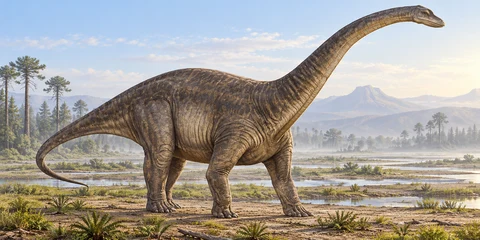
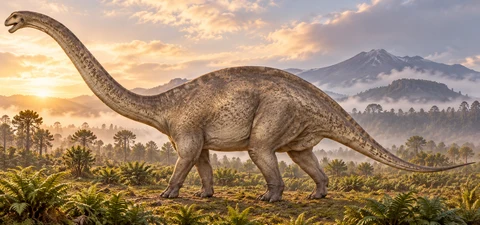
The museum accounts describe a partial skeleton, not an intact animal with skin. Our illustration follows the complete named Rhoetosaurus artwork by Anne Musser published by the Australian Museum. The restored head, four supporting limbs and full tail introduce the animal without implying that every part of that outline was preserved.
The new scene retains a small head, moderately long forward-rising neck, deep rounded body and tapering tail. It does not derive missing anatomy from bones or use another sauropod as a substitute. Head details, colour, posture and soft tissues remain artistic interpretations. Compare Barapasaurus and Patagosaurus, then explore the R directory for other independently researched accounts.
Quick answers
- Where was Rhoetosaurus found?
- Near Roma in Queensland, Australia.
- Was a whole animal preserved?
- The museum accounts describe a partial skeleton.
- Does a maximum depositional age give the exact day it died?
- No. It constrains geological context rather than dating an individual death precisely.
- Which image supplied this new reconstruction?
- The complete named Anne Musser illustration published by the Australian Museum.