Jurassic Dinos editorial · Updated · Source-based review
What was Patagosaurus?
Patagosaurus fariasi was a plant-eating sauropod from Jurassic Patagonia, Argentina. Its name links the animal with that region. The fossils have long been important for studying early sauropods, but renewed examination shows why a familiar name does not mean every question about the material has already been settled.
Why return to the type specimen?
A 2021 revision focused on the holotype, the specimen that anchors the species name. It came from Cerro Condor North in the Cañadon Asfalto Formation. The material includes much of the axial skeleton, parts of the pelvis and a right femur. Axial refers to the central skeleton, including the backbone.
Starting with the name-bearing specimen gives researchers a clear reference for evaluating other fossils. If bones collected elsewhere were assigned to Patagosaurus mainly because they looked broadly similar, that assignment can be tested against a more detailed diagnosis. A diagnosis is a combination of features distinguishing the animal from relevant comparisons.
Did all the referred material belong to one species?
The research institution’s announcement explains that historically referred material likely includes remains of at least one other sauropod. This does not make the original discovery disappear. Instead, separating the material may reveal diversity previously hidden under one name.
It also prevents a composite skeleton from being treated as a single individual. Combining incomplete fossils can be helpful when properly justified, but the identity of each element remains a question that needs evidence. A large collection and a securely identified single species are not automatically the same thing.
What are pneumatic spaces?
The revised description identifies openings in some vertebrae connected with internal chambers. Such features are called pneumatic when associated with an air-filled system. They inform comparisons of sauropod anatomy without proving that an enormous four-legged animal could fly.
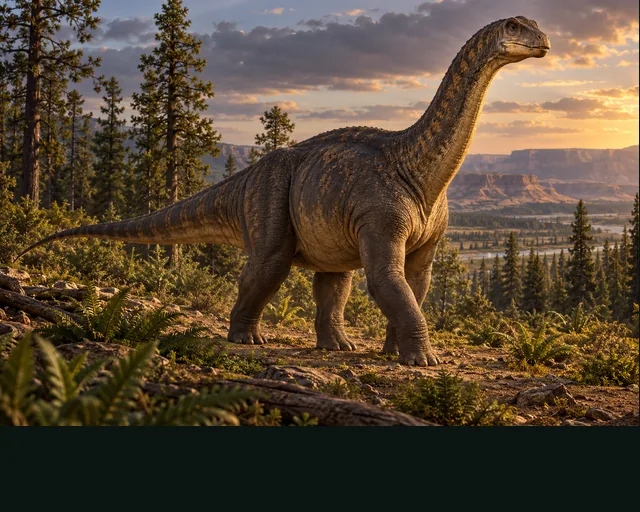
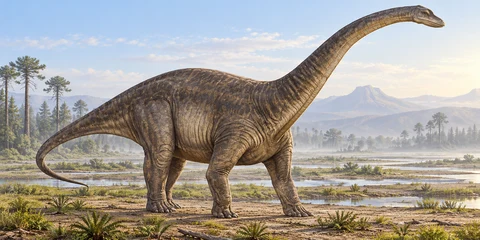
Our complete image follows an approved named living restoration, with a small head, moderately long neck, deep trunk and long tail. Skin, colour and precise posture remain artistic; the illustration is not a new reconstruction derived from vertebral photographs. Compare Barapasaurus and Camarasaurus, then explore the P directory for independently documented sauropods and their sources.
Quick answers
- Where did Patagosaurus live?
- The region now called Patagonia in Argentina.
- What is a holotype?
- The name-bearing specimen used to anchor a species.
- Do all historically referred bones necessarily belong to it?
- No. The research announcement explains that some likely represent another sauropod.
- Do air spaces in a bone imply that the dinosaur could fly?
- No. Pneumatic anatomy and flight are different questions.