Jurassic Dinos editorial · Updated · Source-based review
Barapasaurus tagorei was a large sauropod from India’s Kota Formation. It belongs to an early part of sauropod history, before the familiar Late Jurassic giants. Its fossils also provide a useful lesson in the difference between a collection of many bones and a complete skeleton of one animal.
What did the collection contain?
Bandyopadhyay and colleagues’ 2010 anatomical study describes roughly three hundred bones found with large fossilised tree trunks. Most were disarticulated, disassociated or dispersed, although the researchers could recognise associated elements from several individuals. The material includes teeth, vertebrae and much of the limb skeleton.
Disarticulated means that bones are not joined in their original positions. Three hundred bones therefore does not mean three hundred animals, nor one perfectly preserved giant. Researchers must establish which parts belong together before using the collection to answer anatomical questions.
What can scattered bones reveal?
Different regions can provide different evidence. Teeth help investigate feeding anatomy, while vertebrae and limbs support comparisons of body construction. The value of a collection depends on identification, preservation and association, not just its total number of bones.
Fossilised trees in the same deposit also need interpretation. Their association with dinosaur remains does not by itself identify a particular meal or prove that every tree and animal were alive at the same instant.
How old was Barapasaurus?
The 2010 study assigns the Kota material to the Early Jurassic. Geological dating of such deposits should keep its source context; this page does not turn a rounded public-facing range into a precise numerical year.
The Natural History Museum identifies Barapasaurus as a plant-eating sauropod named by Jain and colleagues in 1975. Its listed length is a reconstruction estimate rather than a tape measurement of a complete single type skeleton. We do not add a mass calculated from a picture.
Reading the historical restoration
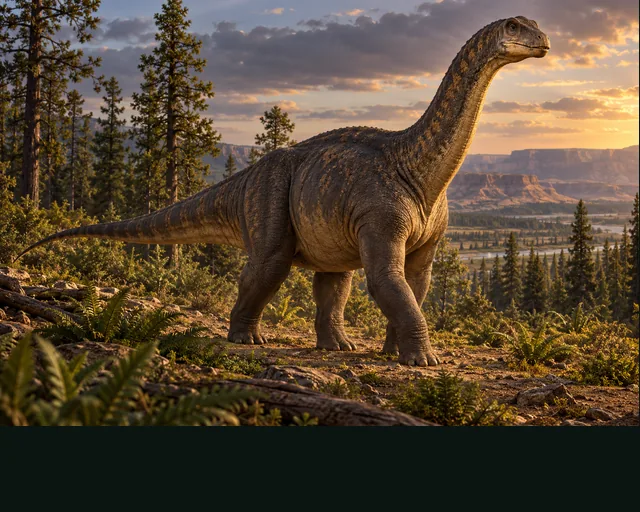
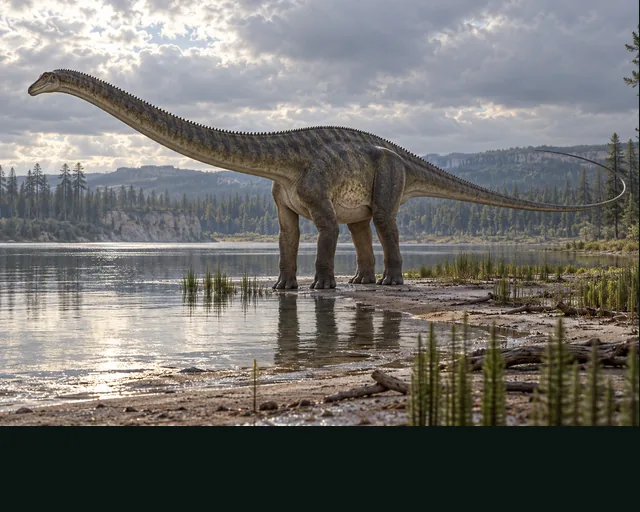
The museum’s complete named illustration supplies our visual reference: a small head at the end of a rising neck, a broad torso supported by four legs and a long tail. Skin, colours, posture and missing-body details remain artistic interpretations. Our new independent scene follows that whole restoration rather than constructing an animal from scattered fossil bones.
Compare Diplodocus and Camarasaurus for later sauropod accounts, then browse the A–Z directory. Their more familiar silhouettes should not obscure the evidence that makes an early Indian sauropod scientifically important.
Quick answers
- Where did Barapasaurus live?
- In what is now India, represented by the Kota Formation.
- Did researchers find 300 complete skeletons?
- No. The 2010 study describes about 300 bones, mostly scattered, representing several individuals.
- When did it live?
- The cited anatomical study places the material in the Early Jurassic; geological age assessments should retain their source context.
- Can one mount be treated as one complete original animal?
- Not without checking which parts are associated and how a mount was assembled.