Jurassic Dinos editorial · Updated · Source-based review
What was Rativates?
Rativates evadens was an ornithomimid theropod from Late Cretaceous Alberta, Canada. Ornithomimids are often called ostrich-mimic dinosaurs because their long legs, slender necks and small heads invite comparison with living ground birds. That resemblance does not make Rativates a modern ostrich or establish every aspect of its behaviour.
Why did an old specimen receive a new identification?
The partial skeleton ROM 1790 came from the lower Dinosaur Park Formation and had previously been referred to Struthiomimus altus. The 2016 describing study found that it lacked diagnostic features needed for that assignment and instead supported a new genus and species.
Diagnostic features help distinguish an animal from relevant comparisons. In this case, the argument involved parts of the skull, tail, pelvis and hindlimb. A change of name can therefore reflect a more detailed assessment of existing evidence rather than a newly excavated complete skeleton.
How did researchers test whether it was young?
Rativates was relatively small compared with large Struthiomimus specimens, but size alone did not establish its growth stage. The researchers examined a microscopic section of the femur, the thigh bone, and concluded that the type individual was not a juvenile.
This matters because a smaller adult or near-adult can be mistaken for the young of a larger species if comparisons rely only on overall size. Bone tissue and anatomical distinctions give researchers independent ways to test that idea. They still do not provide a simple exact final body size for every member of the species.
What can its family placement tell us?
The study recovered Rativates within a derived ornithomimid group including Ornithomimus and Struthiomimus. That result concerns evolutionary relationships, not proof that it ate exactly the same foods or ran at an identical measured speed. An old general account of ostrich dinosaurs cannot automatically answer those questions for this particular taxon.
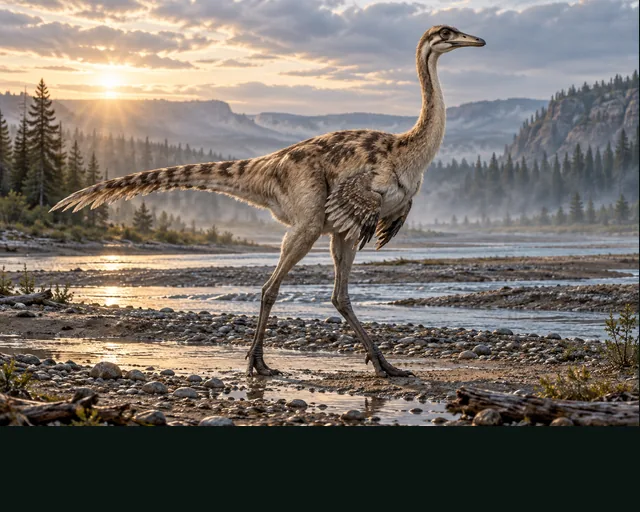
Our illustration follows a complete Rativates restoration by Tom Parker, with a feathered body, long forearms, slender hindlegs and tapering tail. Feather extent, colour and soft tissues remain artistic interpretations rather than a preserved coat from ROM 1790. Compare Ornithomimus and Gallimimus, then browse the R directory for their separate evidence and sources.
Quick answers
- Where was Rativates discovered?
- The Dinosaur Park Formation in Alberta, Canada.
- Was ROM1790 originally given another identification?
- Yes. It had been referred to Struthiomimus altus.
- Was its small size enough to call it a juvenile?
- No. Bone tissue evidence supported a non-juvenile individual.
- Does ostrich-mimic mean it was an ostrich?
- No. Similar overall form is different from being the same animal.