Jurassic Dinos editorial · Updated · Source-based review
What was Rajasaurus?
Rajasaurus was a large meat-eating dinosaur from Late Cretaceous India. It belonged to the abelisaurid group, whose members often had deep skulls and reduced forelimbs. Its distinctive head ornament and Indian fossil record offer a different perspective from the better-known tyrannosaurs of northern continents.
What makes the fossil distinctive?
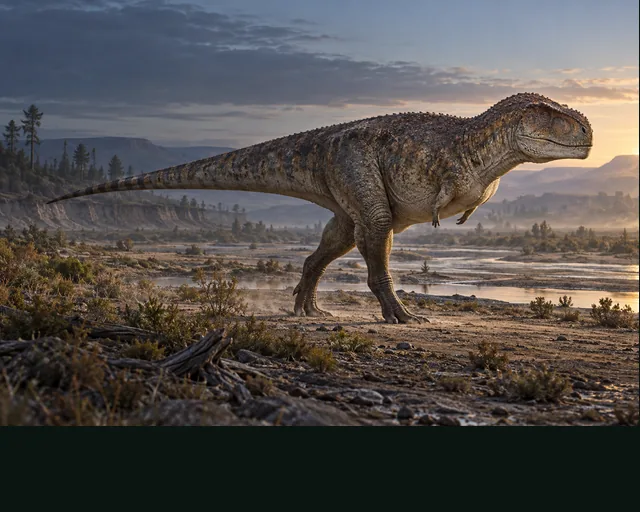
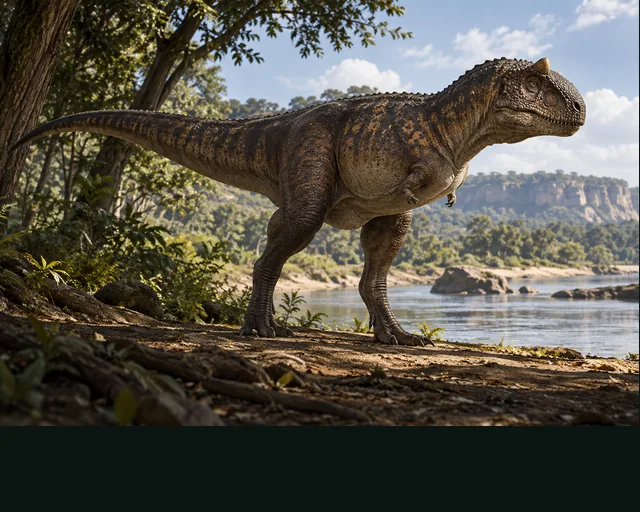
The named skeleton includes parts of the braincase, backbone, hips, legs and tail. A single prominent ornament sits on the forehead in reconstructions. The exact use of this feature is uncertain: display and physical interactions have been proposed, but neither a horn nor a dramatic illustration provides direct evidence of a particular fight.
Where was it found and how was it named?
The bones were recovered from the Lameta Formation and formally described in 2003. Geological Survey of India work and later collaborative study helped turn separated fossil elements into an anatomical account. The species name narmadensis refers to the Narmada region. Fossil discoveries in this area also include eggs and other dinosaurs, although not every nearby egg can be assigned to Rajasaurus.
What can we infer, and what remains uncertain?
India was an isolated landmass moving northward during this part of the Cretaceous. Comparing its abelisaurids with those from Madagascar and other former Gondwanan regions helps investigate their history. It does not establish that all similar animals lived together or travelled the same route. Hunting methods such as ambush are reconstructions, not directly preserved scenes. The strongest comparisons begin with skull and limb anatomy and then consider geography and age.
Was Rajasaurus an Indian Tyrannosaurus?
It filled a broadly comparable role as a large predator, but belonged to a different theropod family. Shared carnivory does not make two dinosaurs close relatives.
How can you check the evidence?
The Paleobiology Database record catalogues Rajasaurus under Majungasaurini. Its linked bibliography identifies this research starting point: J. A. Wilson, P. C. Sereno, and S. Srivastava, D. K. Bhatt, A. Khosla, A. Sahni. 2003. A new abelisaurid (Dinosauria, Theropoda) from the Lameta Formation (Cretaceous, Maastrichtian) of India. Contributions from the Museum of Paleontology, University of Michigan 31(1):1-42. Open the bibliographic record. A catalogue entry establishes the source trail; it does not independently verify every later illustration or behavioural claim.
Use the dated genus overview to follow the references behind the discovery and anatomy discussed above. When sources disagree, compare which specimen and rock layer each author studied. A reconstructed whole animal can combine original bones with comparisons to relatives; those two kinds of evidence should not be confused. The account above explains the particular limits that matter for Rajasaurus, rather than supplying unsupported size, speed or lifespan figures.
Read the image and keep exploring
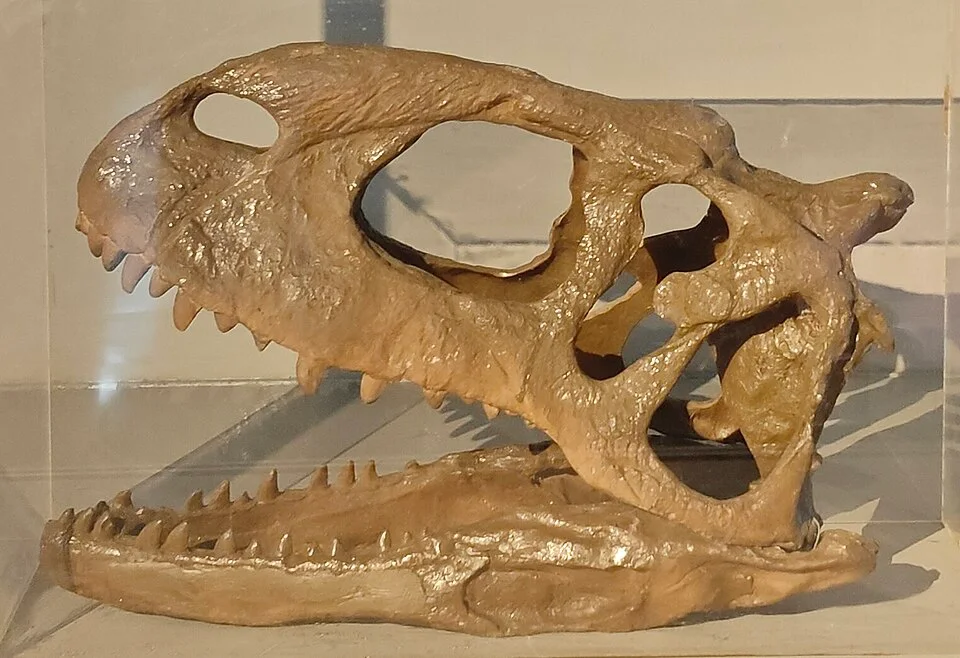
A reconstructed Rajasaurus skull illustrates the broad abelisaurid head; restored surfaces should be distinguished from original fossil material. A displayed specimen or skeletal mount can include restored parts. Its appearance should be read alongside the original specimen description.
Compare Carnotaurus, Majungasaurus, Abelisaurus. Find more names in the R index and explore theropod field notes. The glossary explains unfamiliar fossil terms.
Quick answers
- Where have Rajasaurus fossils been found?
- The discoveries discussed here come from India. Modern place names describe discovery locations, not a complete ancient geographic range.
- When did Rajasaurus live?
- It is placed in the Cretaceous period. See the discovery discussion for qualifications about the particular rock layers and dating.
- Where can I compare Rajasaurus with related dinosaurs?
- Follow the related field notes below. Comparisons explain shared anatomy; they do not imply that all the animals lived together.
.jpg)