Jurassic Dinos editorial · Updated · Source-based review
What was Pulaosaurus?
Pulaosaurus qinglong was an early-diverging neornithischian dinosaur from northern China. Its fossils came from the Tiaojishan Formation in Qinglong, Hebei Province. The describing paper places the material in the Late Jurassic and highlights an unusually rare part of the animal’s anatomy: elements of its larynx.
What is a larynx?
The larynx is the voice-box region, involved in controlling the airway and, in many animals, producing or modifying sounds. Soft tissues are often lost during fossilisation, so preserved bony elements associated with this structure are particularly informative. In this specimen, the study identified ossified elements, meaning structures that had become bone.
The authors described paired arytenoids as slender and leaf-like. Arytenoids are components of the laryngeal framework. Their shape provides a comparison with other animals, not an audio recording or a direct measurement of the dinosaur’s voice. A small fossil structure can be important precisely because such evidence rarely survives.
Can we hear its exact call?
No. The paper interpreted the anatomy as supporting an early origin of bird-like vocal characteristics in non-avian dinosaurs. That is a scientific hypothesis about function and evolution. It does not establish an exact pitch, melody, volume or familiar living bird’s call for Pulaosaurus.
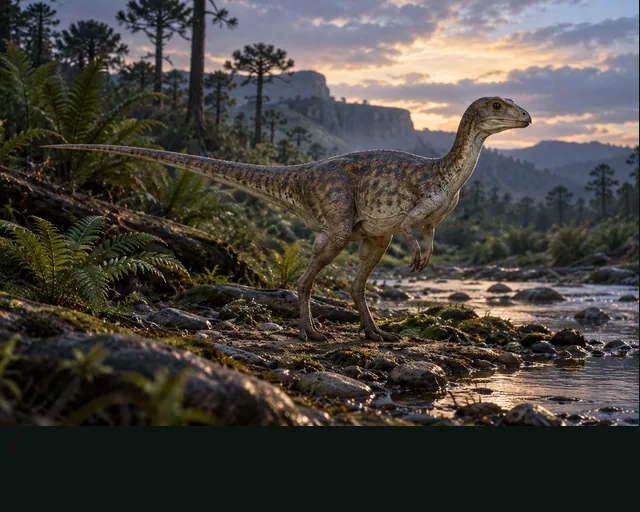
A headline saying it definitely chirped and never made another sound would go beyond that evidence. Likewise, an illustration cannot demonstrate a vocal mechanism by adding an unsupported throat balloon. Our scene keeps the external outline of the approved complete reference without inventing such a structure.
What else did the study describe?
The original account identified five digits in the manus, the hand, together with distinctive features in the jaws, pelvis and hindlimb. It placed the animal near the early branches of Neornithischia in its evolutionary analysis. Early-diverging describes a branching relationship rather than proving a direct ancestor of every later member.
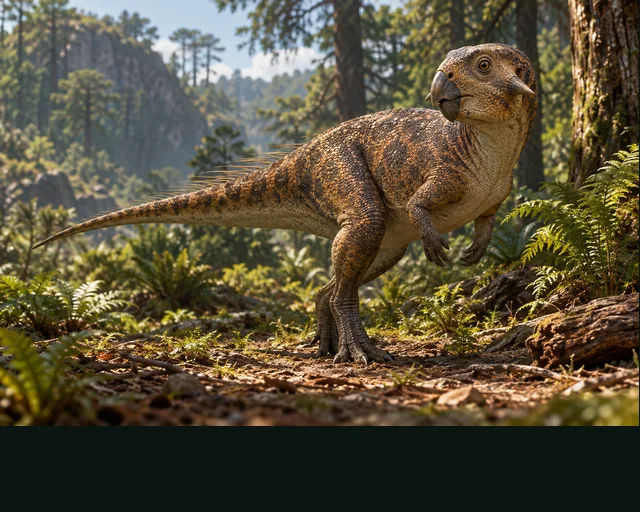
Our living reconstruction shows a small beaked head, slim neck, short forelimbs, long hindlegs and slender tail. Colour, covering and missing soft tissues remain artistic interpretations. Compare Lesothosaurus and Psittacosaurus for other ornithischian accounts, then explore the P directory for their separate evidence and sources.
Quick answers
- Where did Pulaosaurus live?
- The region now known as Hebei Province in northern China.
- What was unusual about the fossil?
- It preserved rare bony elements of the larynx, or voice-box region.
- Do researchers know its exact call?
- No. Anatomical evidence cannot replay a sound.
- How many fingers did the study identify?
- Five digits in the hand.