Jurassic Dinos editorial · Updated · Source-based review
What was Protohadros?
Protohadros byrdi was a plant-eating ornithopod from Late Cretaceous Texas. Its fossils came from Cenomanian rocks of the Woodbine Formation. The name means first hadrosaur, reflecting the original study’s interpretation of its position near the early history of duck-billed dinosaurs.
What material was discovered?
The original description was based on a disarticulated skull and isolated postcranial remains. Disarticulated means the bones were no longer joined in their original anatomical positions. Postcranial refers to material from behind the head, rather than another part of the skull.
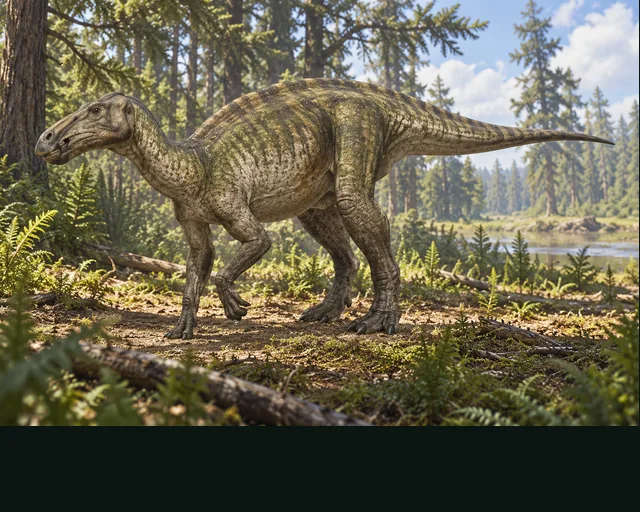
A detailed skull can reveal useful feeding features even when the rest of the animal is incomplete. It does not, however, establish every living body proportion or provide a complete skeleton. The full exterior shown here follows a separately approved named restoration, not a new interpretation generated from skull photographs.
Why was low browsing proposed?
The describing study highlighted a downward-directed muzzle and a deep, robust lower jaw. It interpreted that combination as suited to obtaining food close to the ground in a deltaic environment. Deltaic refers to the sedimentary setting where rivers meet a larger body of water and deposit material.
This is a functional and environmental interpretation, rather than direct observation of the dinosaur feeding. It does not identify an exact plant species eaten at every meal or demonstrate that the animal never used another posture. Our scene therefore leaves the mouth free of a specific unverified food item.
Was it permanently established as the first hadrosaur?
No scientific name guarantees an enduring earliest-known ranking. The 1998 paper proposed a basal position within its treatment of Hadrosauridae and discussed implications for the group’s geographical origin. Such conclusions depend on the fossils available and the definition of the group used in an analysis.
New discoveries and revised family boundaries can change those interpretations without requiring a new name for the animal. A historically important hypothesis should therefore be presented with its context rather than as a universal fact. Our image’s skin, colour and restored body remain artistic. Compare Eolambia and Iguanodon, then explore the P directory for separate accounts and their sources.
Quick answers
- Where was Protohadros found?
- The Woodbine Formation of Texas.
- What was distinctive about its muzzle?
- The original study described it as directed downward.
- Was low browsing directly observed?
- No. It is an interpretation based on anatomy and environment.
- Does first hadrosaur prove it was the first or direct ancestor?
- No. Names and historical classification proposals do not establish those claims permanently.