Jurassic Dinos editorial · Updated · Source-based review
What was Prosaurolophus?
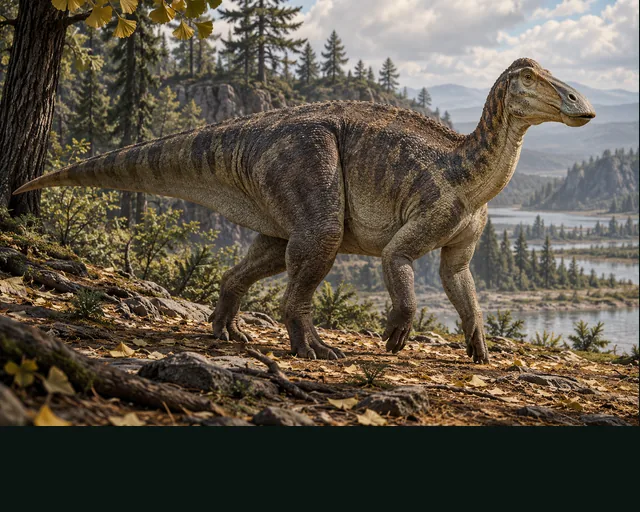
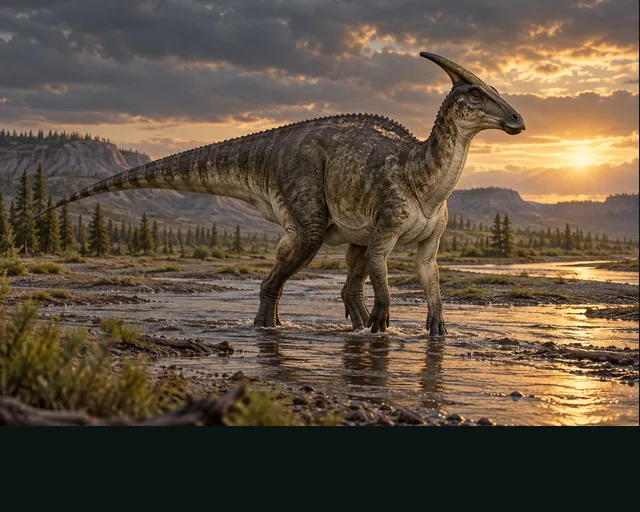
Prosaurolophus maximus was a plant-eating hadrosaurid from Late Cretaceous western North America. The Natural History Museum records it from Canada and the United States. Its broad beak and modest nasal crest distinguish its familiar restored appearance from the much taller or tubular crests of some other duck-billed dinosaurs.
How did its crest change during growth?
A study of three juvenile specimens from Alberta’s Bearpaw Formation examined differences between younger and older individuals. In the smallest animal, the crest and a nearby depression around the nasal region were poorly developed or absent. Larger juveniles approached the adult crest outline, while greater robustness developed later.
Ontogeny means the changes an individual undergoes as it grows. Understanding ontogeny helps researchers avoid naming every youthful-looking shape as a separate species. A feature that identifies an adult may be less obvious in a juvenile, making comparisons between very different growth stages more difficult.
Did the study find a preserved display structure?
No. The authors considered the possibility that soft tissues associated with the nasal region played a role in display. That interpretation is a hypothesis derived from patterns of crest growth. It does not provide a directly preserved colour, inflatable sac or exact outline for an illustrator to copy as fact.
Our picture therefore follows the approved complete museum restoration’s modest crest without adding an elaborate unverified membrane. Even when a functional explanation is plausible, the distinction between evidence and the proposed explanation should remain clear to readers.
What do different rock settings tell us?
Prosaurolophus specimens are reported from both terrestrial and marine deposits. These occurrences help researchers investigate a range of environments in western North America, but a marine burial site does not alone make the animal a habitual sea-dweller. Transport, burial and daily habitat use require separate consideration.
The museum also distinguishes articulated specimens, whose bones remain connected, from disarticulated material. Multiple preservation styles can supply complementary information rather than competing versions of the animal. Our image retains the broad beak, robust body, four supporting limbs and deep tail of the named living reference. Skin and colour remain artistic. Compare Saurolophus and Edmontosaurus, then browse the P directory for their separate discoveries.
Quick answers
- What did Prosaurolophus eat?
- The museum identifies it as herbivorous.
- Did young individuals have identical crests to adults?
- No. The juvenile study describes changes in development and robustness.
- Does the study prove a specific display sac?
- No. It proposes a soft-tissue interpretation rather than preserving its exact form.
- Do marine sediments prove permanent marine life?
- No. Burial setting and habitual lifestyle are different questions.